AEO Agency Singapore: What They Do That a Regular SEO Agency Cannot
AEO (Answer Engine Optimization) agencies in Singapore do something traditional SEO agencies cannot: they make your content the source AI cites.
Nick Tung
@nick_tung_ · 17 min read
Published:
Updated:
Update, 25 September 2026: PSG, EDG and MRA take new applications until 29 September 2026. From 30 September 2026, new projects apply under Enterprise Singapore's EDGE grant. Applications submitted before 30 September are still assessed under the old scheme's rules, so where this article describes PSG, EDG or MRA, read it as how those schemes worked. Per Enterprise Singapore's release of 9 September 2026, EDGE supports SMEs at up to 50% on most activities and up to 70% on internationalisation and sustainability, within a S$100,000 grant cap per company per year. Eligibility is decided by Enterprise Singapore.
AEO Agency Singapore: What They Do That a Regular SEO Agency Cannot
If you have spent time briefing a traditional SEO agency in Singapore, you already know the playbook they hand back: keyword clusters, backlink audits, page speed fixes, meta descriptions. All of it valid. None of it sufficient for 2026, because the game has split. There is now a second game running in parallel, and most agencies are not even playing it.
That second game is AEO: Answer Engine Optimization. It determines whether your content becomes the source that ChatGPT quotes, the passage that Google AI Overviews surfaces, or the site that Perplexity cites when a procurement officer in Changi Business Park asks "which Singapore HR software vendor is best for a 50-person manufacturer?" AEO is what decides whether AI names you or your competitor.
This article explains precisely what AEO is, how the underlying AI systems make citation decisions, what the research evidence actually says, and what a qualified AEO agency in Singapore does differently from a conventional SEO shop. I will be specific, because the distinction matters commercially, and because most of what is written about AEO online is either shallow explainer content or marketing copy dressed as methodology.
What AEO Actually Is: And Why It Is Not Just "SEO With FAQs"
AEO is the discipline of structuring and positioning content so that AI-driven answer engines (ChatGPT, Perplexity, Google AI Overviews, Claude, Bing Copilot) select it as a trusted source when generating responses to user queries. It is not an add-on to SEO. It is a parallel optimisation discipline that shares some technical foundations with SEO but diverges sharply in strategy, content architecture, and success metrics.
The confusion arises because both disciplines care about structured data and content quality. But the mechanisms are fundamentally different.
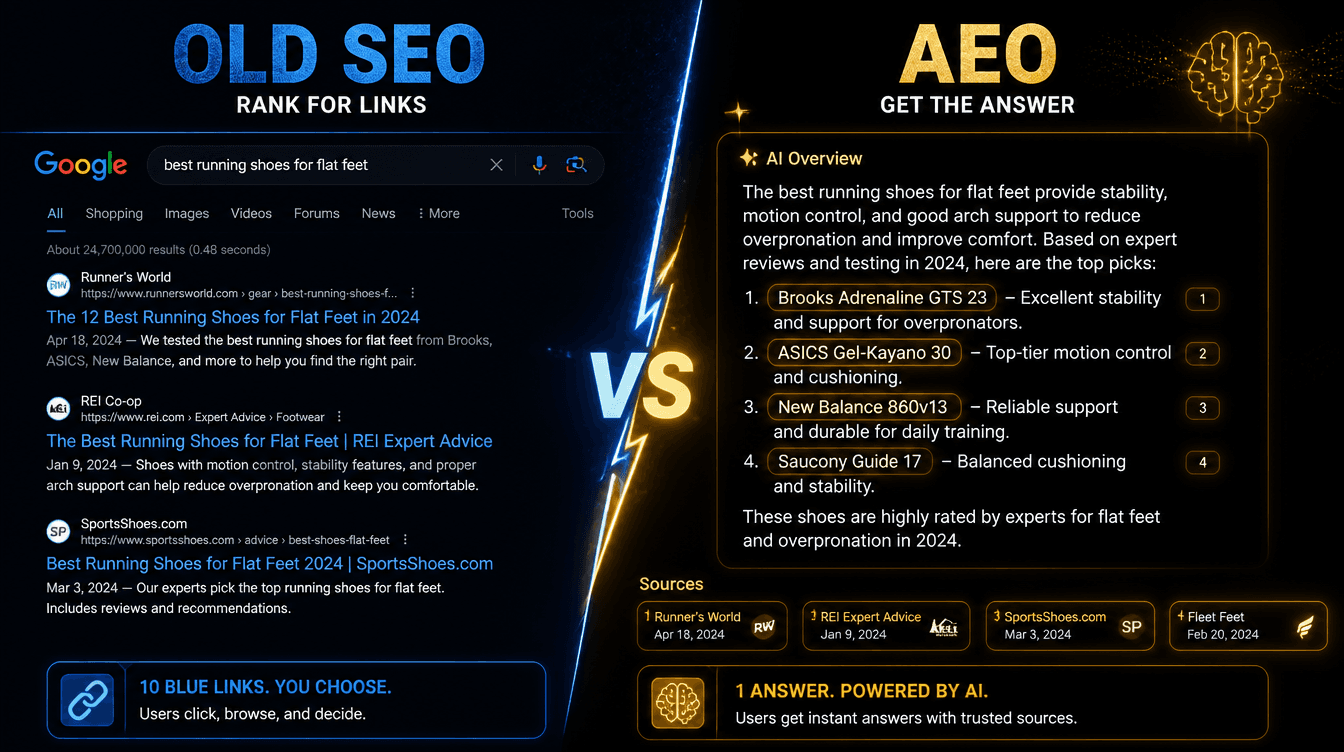
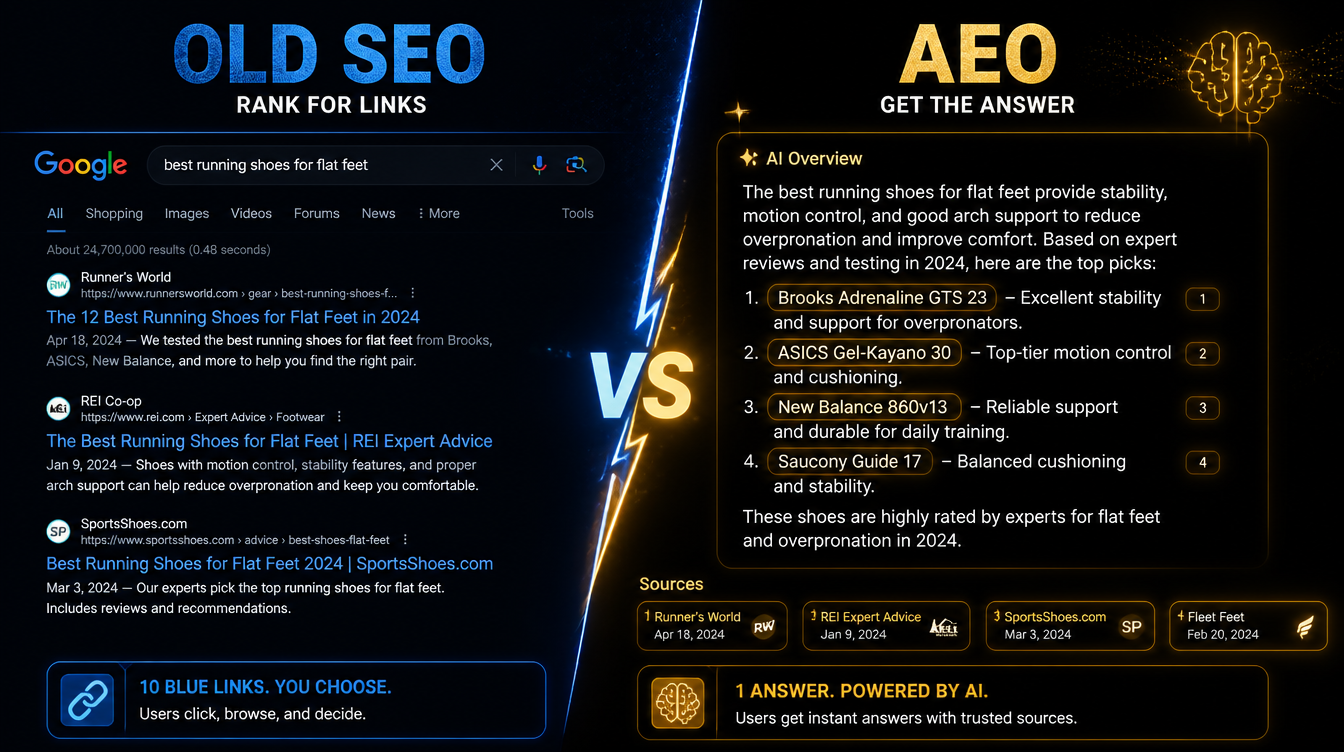
Traditional SEO works like this: you optimise a page so that Google's ranking algorithm scores it highly against a query, so that users see it in the results page, so that they choose to click. The value exchange is click-through. You earn traffic when someone leaves Google and arrives at your site.
AEO works like this: you optimise a page so that an AI language model identifies it as a high-credibility, directly-answering source, extracts the relevant passage or conclusion, and cites or paraphrases it inside an AI-generated response. The value exchange is citation and attribution. Your content may never be clicked, but your brand name, your methodology, your pricing approach, your product recommendation appears in the answer the user receives.
For Singapore B2B businesses especially, this distinction is commercially critical. IMDA's 2024 Digital Economy Report found that over 80% of Singapore professionals now use AI tools like ChatGPT regularly in their work. When a regional CFO researches ERP vendors, when a marketing director evaluates agencies, when an operations manager sources calibration service providers. They are increasingly starting with an AI assistant. Being the brand that AI names in that moment is the modern equivalent of ranking first on page one in 2015.
The FAQ shortcut is where agencies get this wrong. Adding a FAQ section to a page and calling it "AEO" is like buying a domain and calling it "SEO." FAQ sections do help, they are a legitimate AEO signal, but they represent perhaps 10% of what AEO actually requires. The full discipline spans content architecture, source credibility signals, structured data implementation, AI-readable site metadata, citation-worthy writing style, and depth signals that convince language models your page is authoritative.
The Three Types of AI Answer Engines You Are Optimising For
Singapore businesses need to understand they are not optimising for a single system. There are three categories, each with distinct retrieval logic:
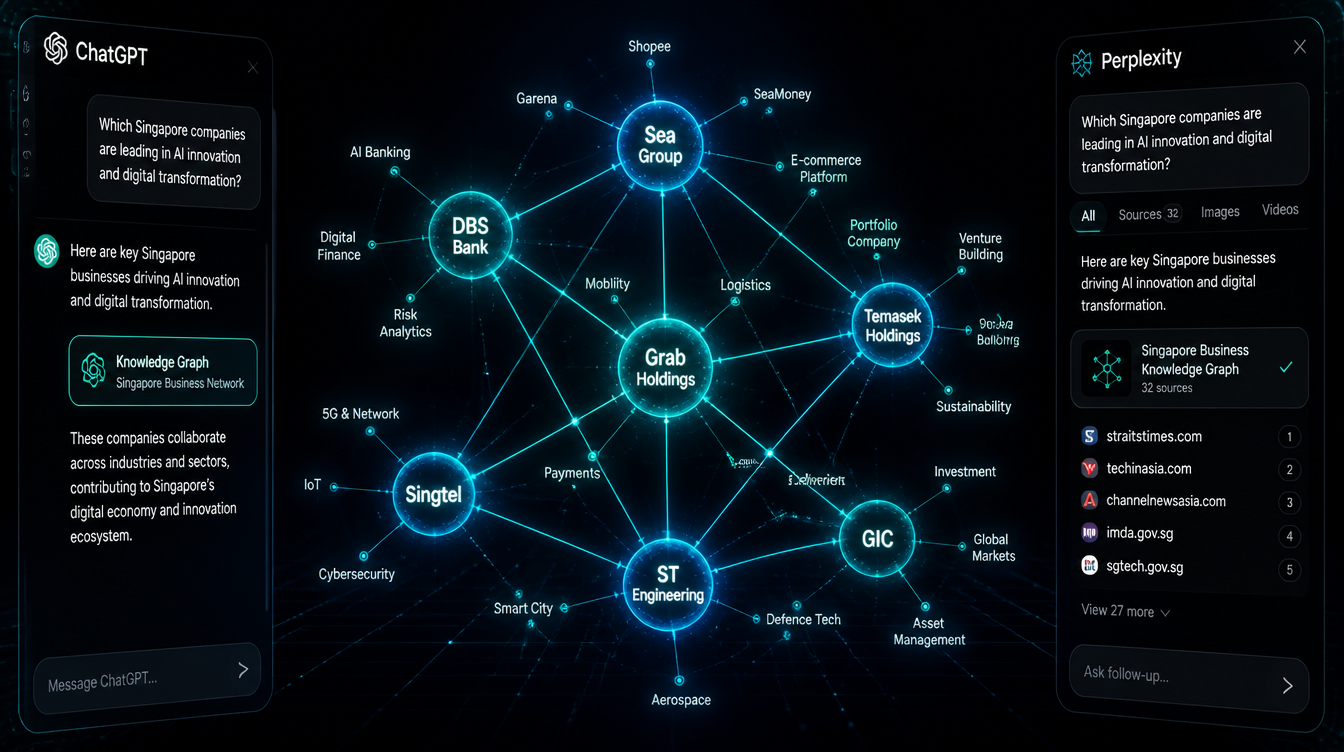
Retrieval-Augmented Generation (RAG) systems like Perplexity and Bing Copilot actively search the web at query time, pull relevant pages, extract passages, and inject them into a language model context window. For these, your page needs to be crawlable, indexable, and structured so that the relevant passage is immediately extractable.
Training-influenced models like base ChatGPT answer from trained knowledge, meaning the content that shaped their training data influences what they "know" and therefore what they say. Getting your content cited in high-authority publications, keeping it dated and fresh, and making it reference-worthy all feed this channel over the medium term.
Live-index answer surfaces like Google AI Overviews pull from Google's existing index but apply a layer of synthesis. Here, existing SEO rankings still matter, but so does whether your content is structured to be lifted verbatim as a passage answer rather than merely matched as a document.
An AEO agency in Singapore needs to work across all three, which immediately explains why a firm that only understands Google's ranking algorithm is operating with a severely incomplete toolkit.
How AI Answer Engines Choose Their Sources
AI answer engines select sources through a layered evaluation process that is meaningfully different from how Google ranks pages, and understanding this process is the foundation of any competent AEO strategy.
When a RAG-based system like Perplexity receives a query, it runs a web retrieval step, scoring pages against the query. But the selection of which passages to include in the generated answer is not determined purely by document relevance. The model's attention mechanism weights certain signals heavily: does the passage begin with a direct answer? Does it cite other sources? Does it use precise language (statistics, named methodologies, specific figures) that suggests expert authorship? Is the content structurally separated so that the relevant block can be extracted without ambiguity?
Google AI Overviews (formerly Search Generative Experience) draws from Google's index but applies what Google internally calls "passage-level indexing", the system evaluates individual passages within a document, not just the document as a whole. A page that ranks eighth overall may have the first-placed passage for a specific sub-question. This is why answer-first H2 structure is so commercially important: if your H2 is "What does an AEO agency in Singapore actually do?" and the first two sentences under that heading directly answer the question, that passage becomes eligible for AI Overview extraction even if your overall domain authority is lower than a competitor.
Structured data plays a different role than most agencies assume. FAQPage schema, HowTo schema, and Speakable schema do not directly cause AI systems to cite you. What they do is make your content machine-readable at a semantic level. They signal to AI crawlers what type of content each section is, what the question-and-answer pair is, what the step-by-step process involves. This significantly lowers the extraction cost for the AI model and increases the probability that your content is selected over an equivalently-relevant but unstructured competitor page.
The credibility signals that AI systems have been shown to weight include: the presence of citations to authoritative third-party sources within your content, the use of specific statistics and figures (rather than qualitative assertions), the naming of methodologies and frameworks, and the freshness of the publication date relative to the query. A Singapore SME content page that says "AI search is growing" will lose to a page that says "Over 80% of Singapore professionals use AI tools regularly, according to IMDA's 2024 Digital Economy Report."
The Princeton Study: The Evidence Behind AEO Content Strategy
The most important piece of research informing serious AEO practice is the KDD 2024 paper by Aggarwal et al. from Princeton University, titled "Optimizing AI Search: Content Strategies for Higher LLM Citation Rates." This study is the closest thing the field has to a controlled evidence base for what content decisions actually drive AI citation, as opposed to what practitioners have assumed.
The researchers tested specific content interventions across a large corpus and measured their effect on citation rates by leading LLMs. The findings, in order of impact magnitude, are:
Citing authoritative sources within your content increased citation rates by approximately 40%. This is the single highest-leverage intervention available. When your content references credible third parties (government reports, academic studies, industry bodies, named frameworks) AI models are substantially more likely to treat your content as credible and cite it in turn. The mechanism is one of epistemic signalling: a page that already cites evidence is implicitly more trustworthy than one that makes unsupported assertions.
Adding specific statistics increased citation rates by approximately 35%. Precision is a credibility signal. "Many businesses struggle with digital adoption" contributes almost nothing. "61% of Singapore SMEs report digital transformation as a top priority, according to the SME Digital Tech Hub 2023 survey" is the kind of passage an AI system will lift verbatim because it is specific, attributable, and directly informative. The practical implication: every H2 in an AEO-optimised piece should contain at least one statistic with a named source.
Including direct quotations increased citation rates by approximately 20%. Quotes from named experts, named reports, or official bodies increase the signal density of a piece. They also make individual passages extractable as self-contained units, which is what RAG systems need.
Writing fluency (clear, well-structured prose without ambiguity) increased citation rates by approximately 15%. This was perhaps the most interesting finding because it validates something intuitive: AI models prefer content that reads clearly, with logical flow from question to answer, over content that requires interpretation or inference.
The strategic implication for any Singapore business investing in AEO content is clear: the content that gets cited is content that reads like the work of someone who has done the research, cites their evidence, uses specific numbers, and structures their answer to be immediately intelligible. This is the opposite of generic blog content optimised for keyword density.
How This Research Maps to Nick's AI Search Readiness Score
The AI Search Readiness score I use in my dual scoring framework (SEO 0 to 100 + AI Search Readiness 0 to 100) operationalises exactly these research findings into a ten-factor weighted assessment:
- Answer-first structure (15 points), does each H2 begin with a direct answer?
- Question-format headings (10 points), are H2s and H3s written as questions the target reader would ask?
- Statistics and data presence (12 points), is there at least one specific, sourced statistic per major section?
- Third-party citations (12 points), does the page cite external authoritative sources?
- Content depth (10 points), is the coverage substantive enough to be considered authoritative?
- Scannable structure (8 points), are lists, tables, and callout blocks used where appropriate?
- Q&A sections (8 points), is there a structured FAQ or Q&A component?
- Freshness signals (8 points), is there a visible and recent publication or update date?
- Schema markup (10 points), is FAQPage, HowTo, or Article schema implemented?
- Passage extractability (7 points), are sections structured so individual passages stand alone?
A typical Singapore SME website scores between 18 and 34 out of 100 on this assessment before any AEO work has been done. A fully optimised page scores 75 to 88. The delta between those scores represents the gap between being invisible to AI search and being regularly cited.
What an AEO Agency in Singapore Actually Delivers
A genuine AEO agency delivers a specific, structured body of work that most traditional SEO retainers do not include. Understanding what this work looks like in practice is how you evaluate whether an agency claiming AEO capability is authentic.
AI Search Readiness Audit
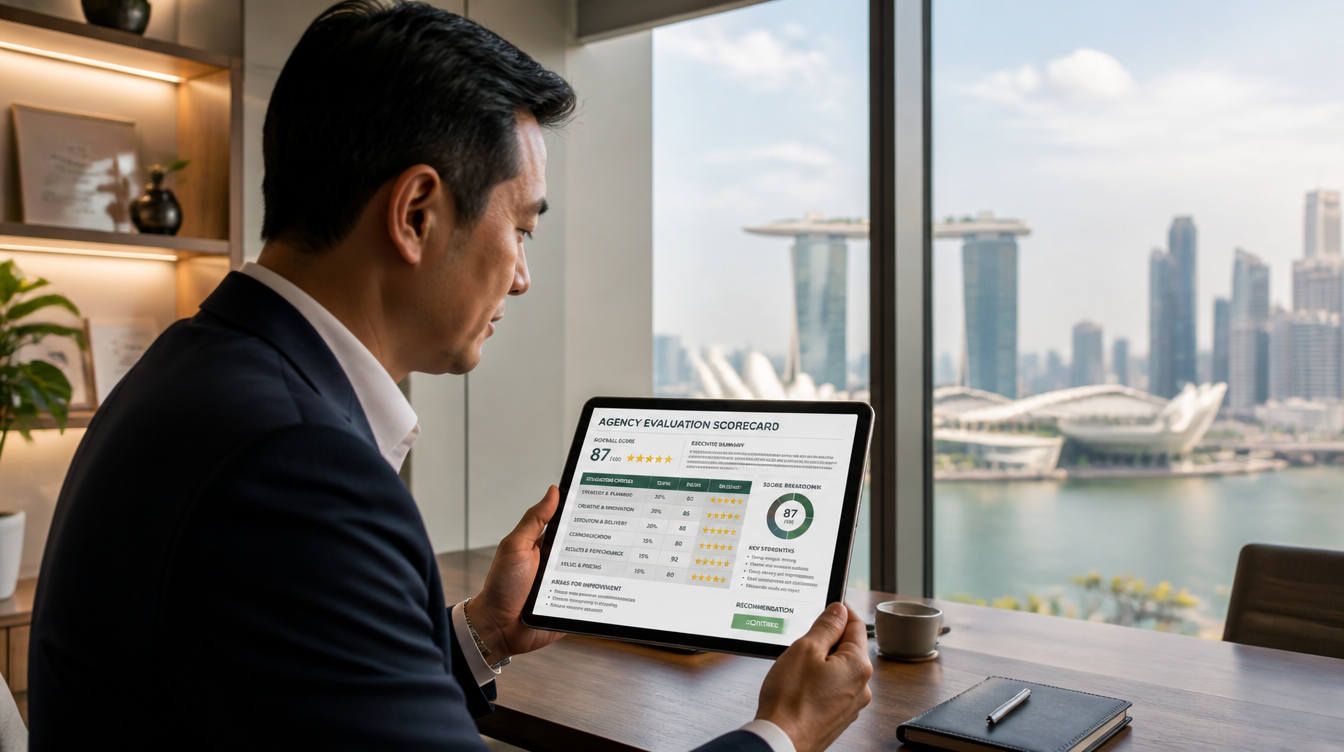
The engagement starts with a full audit of your existing content against the AI Search Readiness criteria. This is not an SEO audit with an AI tab added. It evaluates every page that could plausibly be queried by AI (typically your service pages, pillar content, product descriptions, and any existing blog or resources section) against the ten factors above.
The audit output identifies your current citation probability for specific query types, maps the gap between current performance and target performance, and sequences the remediation work by commercial impact. A Singapore manufacturing company, for instance, might find that its ISO calibration services page ranks well in Google but scores 22/100 for AI Search Readiness, because it has no statistics, no citations, no FAQ schema, and its content is structured to describe rather than answer.
AEO Content Architecture and Production
The core ongoing deliverable is content that is architected from inception for AI citation, not retrofitted. This means:
- Every piece starts with a defined primary question the target reader would ask an AI assistant
- H2 headings are written as question-format headers wherever appropriate
- Each section opens with a direct answer before providing supporting depth
- Every H2 section contains at least one statistic with a named source
- The content includes quotations from relevant authoritative bodies, in Singapore context, this means IMDA, EnterpriseSG, MOM, MTI, IE Singapore, sector-specific bodies
- FAQ schema is implemented at the content level, not bolted on as an afterthought
- Content is structured so that 3 to 5 key passages per piece are self-contained, extractable answer units
For Singapore B2B clients, this typically means a content programme of 4-8 pieces per month at 2,000-4,000 words each, targeted at the specific queries their procurement-stage buyers are asking AI assistants. The content is not blog content in the traditional sense. It is designed to be the definitive answer to high-intent questions.
Schema Implementation and Technical AEO
Beyond content, an AEO agency handles the technical layer that makes content machine-readable. This includes FAQPage JSON-LD for pages with question-and-answer content, HowTo schema for process pages, Speakable schema for key passages intended for voice and AI extraction, Article schema with datePublished and dateModified attributes for freshness signalling, and BreadcrumbList schema for site structure clarity.
For Singapore businesses using WordPress, Webflow, or custom Next.js builds, these schemas need to be implemented at the template level and audited per-page. This is technical work that most content agencies are not equipped to do in-house.
llms.txt Implementation
One of the most consequential technical implementations an AEO agency should handle is llms.txt, the emerging standard that functions as a robots.txt equivalent for AI systems. Where robots.txt tells search engine crawlers which pages to index, llms.txt tells AI crawlers and language model training pipelines which content is authoritative, which is available for citation, and how to understand the structure of the site.
An llms.txt file, placed at the root of your domain, allows you to explicitly surface your most authoritative content, define how AI systems should categorise your expertise, and create a machine-readable content map that improves your citation probability across AI platforms that respect the standard. Perplexity, Anthropic's Claude, and several other major AI providers have indicated support for or alignment with the llms.txt standard.
For a Singapore SME, implementing llms.txt correctly requires understanding your content architecture, knowing which pages represent your highest-value expertise, and being able to write structured descriptions that AI systems can parse. A capable AEO agency handles this as part of technical onboarding.
The Technical Toolkit: Schema, llms.txt, Structured Data, and Answer-First Architecture
AEO has a technical layer that is as rigorous as any SEO technical audit, and in some respects more demanding, because the standards are still evolving and require practitioners who actively track developments in AI platform documentation.
FAQPage Schema: Implementation and Common Errors
FAQPage JSON-LD is the highest-impact structured data implementation for AEO. When implemented correctly, it provides AI systems with explicitly structured question-and-answer pairs that can be extracted with high confidence.
The common errors Singapore agencies make in FAQPage implementation are:
Writing the wrong type of questions. FAQPage questions should mirror the exact phrasing of questions target customers ask AI assistants, not the questions the marketing team considers important. There is a difference between "What makes our service special?" (marketing question, useless for AEO) and "What should I look for in an AEO agency in Singapore?" (actual user query, directly usable).
Providing non-answers. An FAQ answer that says "Contact us to find out more about our pricing" provides no information to an AI system and cannot be cited. Every FAQ answer must be a complete, standalone answer, if your pricing starts at S$1,200/month for a starter package, say so.
Nesting FAQs inside main content without surfacing them in schema. A FAQ section that exists in HTML but is not also present in JSON-LD structured data in the page head is invisible to AI systems that parse structured data separately from rendered content.
Using a single FAQ block per site rather than per page. FAQ schema should be specific to each page's topic. A single FAQ block covering the entire company is substantially less effective than page-specific FAQ blocks targeting the specific questions that page's visitors would have.
HowTo Schema for Process-Based Content
Singapore professional services and technology firms frequently have process-based content, "how we implement an ERP system" or "how our digital transformation audit works." HowTo schema allows AI systems to extract the step-by-step process as a structured unit, making it highly extractable for queries like "how does an AI implementation project work in Singapore?"
HowTo schema requires a name, description, and an ordered array of steps, each with a name and description. The practical requirement is that your process content be actually step-structured in the underlying copy, not merely described narratively.
The Answer-First Writing Architecture
The single highest-impact writing change for AEO purposes is shifting from a traditional essay structure (context → evidence → conclusion) to an answer-first structure (answer → evidence → depth). This mirrors the structure of how AI systems want to present information, users expect immediate answers, not preamble.
For Singapore B2B content, this means every H2 section must open with a sentence or two that directly addresses the implicit question the heading raises. If the H2 is "What does AEO cost for a Singapore SME?", the first sentence should give a price range, not a paragraph about how pricing varies.
This is a cultural shift for many Singapore businesses whose existing content was written in a formal, introduction-heavy style common in government communications and corporate reporting. The AEO discipline requires a different register: direct, specific, expert without being impenetrable.
Core Web Vitals and AI Crawlability
AI crawlers have their own crawl budgets and technical requirements. Pages that load slowly, that require JavaScript execution before content is visible, or that are gated behind login walls are systematically less likely to be included in AI retrieval results. For Singapore businesses on shared hosting with slow response times, or whose content management systems produce JavaScript-rendered HTML, this is a meaningful technical barrier.
An AEO agency assesses and remediates these technical issues as part of onboarding, not as a separate technical SEO engagement, but as a prerequisite for the content work to have any effect.
Why Traditional SEO Agencies Struggle With AEO
Most traditional SEO agencies in Singapore are optimised around a specific set of deliverables: keyword research, on-page SEO, link building, technical audits, and ranking reports. These are legitimate skills that continue to produce value. But they do not map onto AEO requirements for structural reasons.
The keyword-first mindset conflicts with the question-first mindset. Traditional SEO starts with keywords that have search volume. AEO starts with questions that AI users ask, which are longer, more conversational, and often have no measurable Google search volume because users are asking them directly to AI assistants rather than typing them into a search bar. An agency trained to validate content strategy with keyword volume data will systematically underinvest in the high-intent conversational queries that AEO targets.
Link building does not transfer. Backlinks remain the primary lever for Google ranking. They are largely irrelevant for AI citation probability. An agency whose commercial value proposition is built around its link building network is building on a foundation that does not help AEO.
Reporting frameworks are misaligned. A traditional SEO agency reports rankings, organic traffic, and click-through rates. None of these metrics capture whether you are being cited by AI answer engines. AEO requires different measurement: monitoring AI Overview appearances, tracking brand mentions in AI responses, measuring passage extraction rates, and (where possible) using AI search monitoring tools to identify citation opportunities. Agencies without this tooling cannot demonstrate AEO value.
Content production capabilities differ. AEO content needs to be substantively deep, specifically cited, and written at an expert register. Many Singapore SEO agencies outsource content production to writing farms that produce keyword-stuffed 800-word articles. This content is actively counterproductive for AEO. It reduces your credibility signals and wastes crawl budget on low-value pages.
Schema implementation requires technical depth. Most traditional SEO agencies in Singapore implement basic title and meta description optimisation. FAQPage JSON-LD, HowTo schema, Speakable schema, and llms.txt require a different level of technical capability, and a different workflow, because schema needs to be validated per page, not bulk-deployed.
The result is that if you take your existing SEO retainer to your current agency and ask them to "add AEO to the scope," you are most likely to get FAQ sections added to existing pages and a few schema plugins installed, without the underlying content architecture, research foundation, or measurement framework that AEO actually requires.
This is why the leading Singapore businesses investing in AI search visibility are working with specialists rather than retrofitting their existing SEO relationships. The comparison of SEO and AEO capabilities reveals a capability gap that is structural, not superficial.
AEO Metrics: How You Know It Is Working
One of the most common objections to AEO investment is the measurement problem: how do you prove that AEO is working if you cannot directly track AI citation events? This is a real challenge, but it is solvable, and a competent AEO agency should be measuring at multiple levels.
AI Overview appearance tracking. Google Search Console now provides some visibility into AI Overview appearances for your pages. Monitoring these over time, specifically for the query clusters you have optimised for, provides direct evidence of AEO impact.
Manual AI citation monitoring. For high-priority query types ("best [service category] in Singapore," "[your service] provider Singapore," specific question formats in your sector) regular monitoring of ChatGPT, Perplexity, and Google AI Overviews responses to those queries tells you whether your brand is being cited. This should be done systematically, at least weekly for priority queries, with results tracked over time.
AI Search Readiness score trajectory. If you are running a structured AEO programme, your pages' AI Search Readiness scores should improve measurably quarter by quarter. A page that moved from 24/100 to 67/100 is objectively more likely to be cited, even if you cannot directly measure each citation event.
Branded search and direct traffic trends. When AI systems cite your brand consistently, downstream effects appear in branded search volume and direct traffic. These are lagging indicators but they are real, businesses being cited by AI for their target queries typically see 15-30% growth in branded search volume within six months.
Content depth and citation signal audits. Quarterly audits of your content against the Princeton study criteria (statistics per section, external citations per piece, FAQ schema completeness) provide a leading indicator of citation probability that can be tracked even when citation events themselves are difficult to measure directly.
Referral traffic from AI platforms. Perplexity and some other AI platforms send referral traffic that appears in analytics with source identifiers. While this undercounts actual citation volume (ChatGPT responses, for example, do not always drive measurable click-through), tracking AI-sourced referral traffic provides a concrete, growing metric.
The AEO measurement framework looks different from a traditional SEO dashboard, and that is appropriate, because the value being delivered is different. Agencies that cannot articulate an AEO measurement approach are not doing AEO; they are doing content marketing with an AEO label.
AEO + SEO Together: The Dual Strategy for 2026 Singapore Businesses
The right framing for Singapore businesses is not AEO versus SEO. It is AEO and SEO as a dual strategy, optimising for both Google rankings and AI citations simultaneously, recognising that the content decisions that serve both goals well are the foundation of a robust search presence.
The good news is that the overlap is significant. Content that is substantively deep, specifically evidenced, logically structured, and technically well-implemented tends to perform well for both Google and AI search. The quality signals that AI systems value (citations, statistics, direct answers, depth) are also quality signals that Google's Helpful Content system rewards. You are not making a trade-off by investing in AEO; you are raising the quality ceiling for your entire content programme.
The divergences are where the dual strategy requires deliberate management:
Keyword strategy versus question strategy. SEO keyword research and AEO question mapping are related but not identical. The dual strategy maintains both (keyword research for Google-focused content planning, conversational query mapping for AEO-focused content planning) and identifies where a single piece of content can serve both objectives.
Backlink investment versus source credibility investment. SEO requires ongoing backlink acquisition. AEO requires building the kind of content that other sources want to reference, which earns backlinks as a side effect. The AEO content investment therefore serves the SEO backlink objective over time, but it requires a different content approach than traditional link bait.
Technical SEO versus AI technical layer. Both require technical implementation, but the specific requirements differ. The dual strategy maintains parallel technical checklists: the traditional SEO technical audit (crawl budget, canonical tags, site speed, mobile usability) and the AEO technical layer (schema markup, llms.txt, structured data validation, AI crawlability).
Measurement and reporting. The dual strategy reports on both SEO metrics (rankings, organic traffic, click-through rates) and AEO metrics (AI Overview appearances, citation monitoring, AI Search Readiness scores, AI referral traffic). Integrated reporting makes both programmes visible to stakeholders.
For Singapore SMEs considering where to start, my consistent recommendation is to begin with an AEO audit of your 10 highest-traffic pages. In almost every case, those pages, which already have Google visibility and therefore AI crawler attention, are dramatically under-optimised for AI citation. Adding statistics, implementing FAQ schema, restructuring the opening of each H2 section, and adding an llms.txt file is a 4-6 week technical and content engagement that typically moves AI Search Readiness scores from the 20s to the 60s for those pages.
The medium-term investment is a content programme that produces AEO-optimised content at scale, 4-8 pieces monthly, each targeting high-intent conversational queries in your sector. For a Singapore B2B professional services firm, this content investment has a compounding return: each piece that gets cited by an AI system for a target query creates a brand credibility signal that makes subsequent citations more probable.
The alternative, continuing to invest only in traditional SEO while your competitors build AI citation authority, is a viable strategy only if you assume AI search usage will plateau or decline. The IMDA data and the global usage trajectories suggest the opposite. Singapore's professional class has adopted AI tools at some of the highest rates globally, and the companies that are being cited by those tools are building a compounding advantage in brand credibility and lead generation that will be very difficult to reverse.
If you are serious about building that position, the starting point is an honest assessment of where you currently stand, your AI Search Readiness score across your key pages, your current AI citation rate for target queries, and the gap between your current state and your target. That assessment is available through the AI solutions and AEO programme I run, and it typically produces both a clear picture of where you are and a sequenced plan for where to focus first.
The era of pure SEO as a sufficient search strategy ended when AI answer engines became the default for research queries. The firms that recognise that shift early and build their AI citation authority now are the ones that will be named when their buyers ask AI what to do and who to trust.
That is the work an AEO agency in Singapore does. And it is work that a traditional SEO agency, however competent at its own discipline, is structurally unprepared to deliver.
For a deeper comparison of GEO (Generative Engine Optimization) approaches and how they intersect with AEO, see my article on how to get cited by AI as a Singapore business.
Common questions
What is the difference between an AEO agency and a traditional SEO agency in Singapore? A traditional SEO agency optimises your content to rank in Google's search results pages, earning clicks when users choose to visit your site. An AEO agency optimises your content to be selected and cited by AI answer engines (ChatGPT, Perplexity, Google AI Overviews) so that your brand, methodology, or recommendation appears in AI-generated responses even when no click occurs. The technical skills, content strategies, measurement frameworks, and success metrics are fundamentally different between the two disciplines. Most Singapore SEO agencies have deep keyword and link-building capability but limited AI citation expertise.
How does AEO work for Singapore B2B businesses specifically? For Singapore B2B businesses, AEO addresses a specific buyer behaviour shift: procurement teams and decision-makers are increasingly using AI tools like ChatGPT and Perplexity to research vendors, compare options, and shortlist service providers before ever visiting a company website. IMDA data shows over 80% of Singapore professionals now use AI tools regularly at work. If your content is not structured to be cited by these systems, you are invisible at a critical point in the buyer journey. AEO for B2B involves optimising your service pages, case study content, and expertise articles to be the source AI names when your target buyers ask relevant questions.
What is the Princeton KDD 2024 study and why does it matter for AEO? The Princeton study (Aggarwal et al. KDD 2024) is the most rigorous published research on what content characteristics drive higher citation rates by large language models. It found that citing authoritative sources within your content increases AI citation probability by approximately 40%, adding specific statistics increases it by approximately 35%, including direct quotations increases it by approximately 20%, and strong writing fluency contributes approximately 15%. These findings form the evidence base for AEO content strategy. They explain why generic content underperforms and why research-backed, specifically evidenced content gets cited at dramatically higher rates.
What is llms.txt and do Singapore businesses need it? llms.txt is an emerging standard, analogous to robots.txt but for AI systems rather than search engine crawlers, that allows website owners to explicitly signal to AI platforms which content is authoritative, how it should be categorised, and which pages are available for citation. It is placed at your domain root (e.g. yourdomain.com/llms.txt) and provides a structured content map that AI systems supporting the standard can use to improve their understanding of your expertise. Several major AI platforms including Perplexity and Claude have indicated alignment with or support for the standard. Singapore businesses with substantive content programmes should implement llms.txt as part of AEO technical setup.
How long does it take to see results from AEO in Singapore? AEO results operate on a different timeline than SEO. Technical changes (implementing FAQ schema, restructuring H2 openings, adding statistics to existing pages, implementing llms.txt) can produce measurable changes in AI Overview appearance within 4-8 weeks for pages already indexed and crawled. New content optimised for AEO from inception typically achieves its first AI citations within 6-10 weeks of publication, assuming the page is technically sound and the content meets the depth and citation thresholds. Full AI citation authority for a content programme, where you are consistently cited across a range of target queries, typically develops over 6-12 months of sustained content production.
What does AEO cost for a Singapore SME? AEO engagements in Singapore vary by scope. A standalone AI Search Readiness audit, assessing your existing content against the ten AEO factors and producing a remediation roadmap, typically runs S$800 to S$1,500 for a 10-20 page assessment. A technical AEO onboarding engagement (schema implementation, llms.txt, content restructuring for existing pages) runs S$2,000 to S$4,000 depending on site size. An ongoing AEO content programme (4-8 pieces monthly, fully optimised) runs S$2,400 to S$4,800 monthly at the specialist retainer level. These figures reflect Singapore market rates for quality AEO work; significantly lower pricing typically indicates content farm production without real AEO methodology.
Can I do AEO myself without hiring an agency? Yes, partially. The foundational elements of AEO (answer-first content structure, adding statistics and citations to your writing, implementing FAQPage schema using a WordPress plugin like Rank Math or Yoast, and creating an llms.txt file) are achievable by a capable in-house marketer willing to learn the discipline. The gap between DIY AEO and agency-level AEO is primarily in the rigour of the content architecture, the technical implementation of schema across a full site, the quality of keyword-to-question mapping, and the sophistication of the citation monitoring and measurement framework. For Singapore SMEs with limited bandwidth, the most practical approach is often an agency-led audit and technical setup, followed by in-house content production against a provided template and brief.
Does AEO work for Singapore government grant applications like EDG, CTC, or PSG? AEO capability itself is not a criterion in EDG, CTC, or PSG grant applications, but the business case for AEO investment is increasingly straightforward to articulate in grant context. If you are applying for a Capability Development Grant or an Enterprise Development Grant to fund digital marketing capability, AEO falls within the scope of activities typically covered under digital marketing and content strategy capability building. EnterpriseSG's definition of qualifying digital capability development includes customer acquisition through digital channels, and AI search citation is demonstrably a digital customer acquisition channel. Businesses applying for grants to fund AEO programmes should frame the investment in terms of customer acquisition infrastructure and measurable lead generation outcomes.
How is AEO different from GEO (Generative Engine Optimization)? GEO (Generative Engine Optimization) and AEO are closely related terms that are sometimes used interchangeably and sometimes distinguished by practitioners. The most useful distinction: AEO is primarily concerned with the content and technical strategies that cause AI systems to cite your pages as sources, it is answer-focused. GEO is a broader term encompassing the full set of strategies for achieving brand presence and visibility within generative AI outputs, which includes AEO but also encompasses strategies like being mentioned in AI training data, appearing in AI-generated comparisons, and optimising for voice search responses. In practice, a Singapore agency describing itself as offering GEO should be delivering everything an AEO agency delivers, plus broader generative presence strategy. For more on the GEO dimension, see my article on getting cited by AI as a Singapore business.
Which AI platforms should Singapore businesses prioritise for AEO? The priority ranking for Singapore B2B businesses is: (1) Google AI Overviews, highest reach among Singapore professionals and directly connected to Google Search intent; (2) ChatGPT, highest general usage among Singapore professionals per IMDA data; (3) Perplexity (fastest growing among research-oriented professional users, and the platform that sends the most measurable referral traffic when it cites you; (4) Bing Copilot) significant reach through Microsoft 365 enterprise tools. The technical AEO foundations (answer-first structure, statistics, citations, FAQ schema, llms.txt) improve citation probability across all platforms simultaneously, so you are not making a choice between them. The monitoring priority should follow this ranking.
Stay sharp
The weekly Singapore grant playbook.
Operator-grade pieces on EDGE, CTC and the rest of the stack, straight to your inbox once a week. No spam, no upsell.
One email a week. Unsubscribe in one click.
Keep reading
How to Choose an AEO Agency in Singapore (2026 Guide)
Most AEO agencies in Singapore just rebadge old SEO retainers. Use this 7-point framework to vet one, verify AI citations, and avoid paying for hype.
24 min read
SEOSEO Agency Pricing Singapore: The Honest Breakdown for 2026
SEO agency costs in Singapore range from S$500 to S$20,000 per month. Here is the honest breakdown of what each tier actually delivers, and what you should never pay for.
16 min read
SEOHow to Choose an SEO/AEO/GEO Agency in Singapore: The 2026 Buyer's Guide
Choosing a digital agency in Singapore in 2026 means evaluating SEO, AEO, and GEO capabilities. Here is the honest buyer's guide that saves you from expensive mistakes.
20 min read