How to Choose an SEO/AEO/GEO Agency in Singapore: The 2026 Buyer's Guide
Choosing a digital agency in Singapore in 2026 means evaluating SEO, AEO, and GEO capabilities. Here is the honest buyer's guide that saves you from expensive mistakes.
Nick Tung
@nick_tung_ · 20 min read
Published:
Updated:
Update, 25 September 2026: PSG, EDG and MRA take new applications until 29 September 2026. From 30 September 2026, new projects apply under Enterprise Singapore's EDGE grant. Applications submitted before 30 September are still assessed under the old scheme's rules, so where this article describes PSG, EDG or MRA, read it as how those schemes worked. Per Enterprise Singapore's release of 9 September 2026, EDGE supports SMEs at up to 50% on most activities and up to 70% on internationalisation and sustainability, within a S$100,000 grant cap per company per year. Eligibility is decided by Enterprise Singapore.
How to Choose an SEO/AEO/GEO Agency in Singapore: The 2026 Buyer's Guide
The wrong agency costs you more than money. It costs you 12 to 18 months of stalled traffic, misallocated budget, and the embarrassing task of explaining to your board why organic search still shows no ROI. This guide is written for Singapore business owners who want to make this decision correctly the first time, based on how search actually works in 2026, not how agencies wish it still worked in 2018.
I have been doing SEO and AI search optimisation work for Singapore SMEs for years, and I hold an SPMC certification (SPMC-10960) specifically in digital marketing and AI strategy. What I see repeatedly is the gap between what agencies promise in a pitch and what they actually deliver. This guide gives you the exact questions, red flags, and frameworks to close that gap before you sign anything.
Before You Start: What Kind of Digital Help Do You Actually Need?
The first mistake most Singapore business owners make is walking into agency conversations without knowing what they actually need. This leads to being sold a package rather than buying a solution.
There are three genuinely distinct services in play right now, and an agency can be strong in one and mediocre in the others:
SEO (Search Engine Optimisation) is the foundational work of ranking on Google. It covers technical health (site speed, crawlability, mobile, Core Web Vitals), content strategy, and backlink development. This is what agencies have been selling since 2004. The quality gap between agencies here is enormous, some are genuinely excellent, most are average, and a non-trivial number are still running tactics that Google began penalising years ago.
AEO (Answer Engine Optimisation) is the practice of structuring your content so that Google's featured snippets, AI Overviews, voice search results, and Bing's AI-powered answers pull from your site. This requires a different writing methodology (answer-first structure, schema markup, concise definitional paragraphs) not just keyword stuffing. A 2024 Princeton study on AI citation patterns (Wired, 2024) found that AI systems disproportionately cite sources that present information in direct, structured, low-ambiguity formats. This is not the same as ranking on page one.
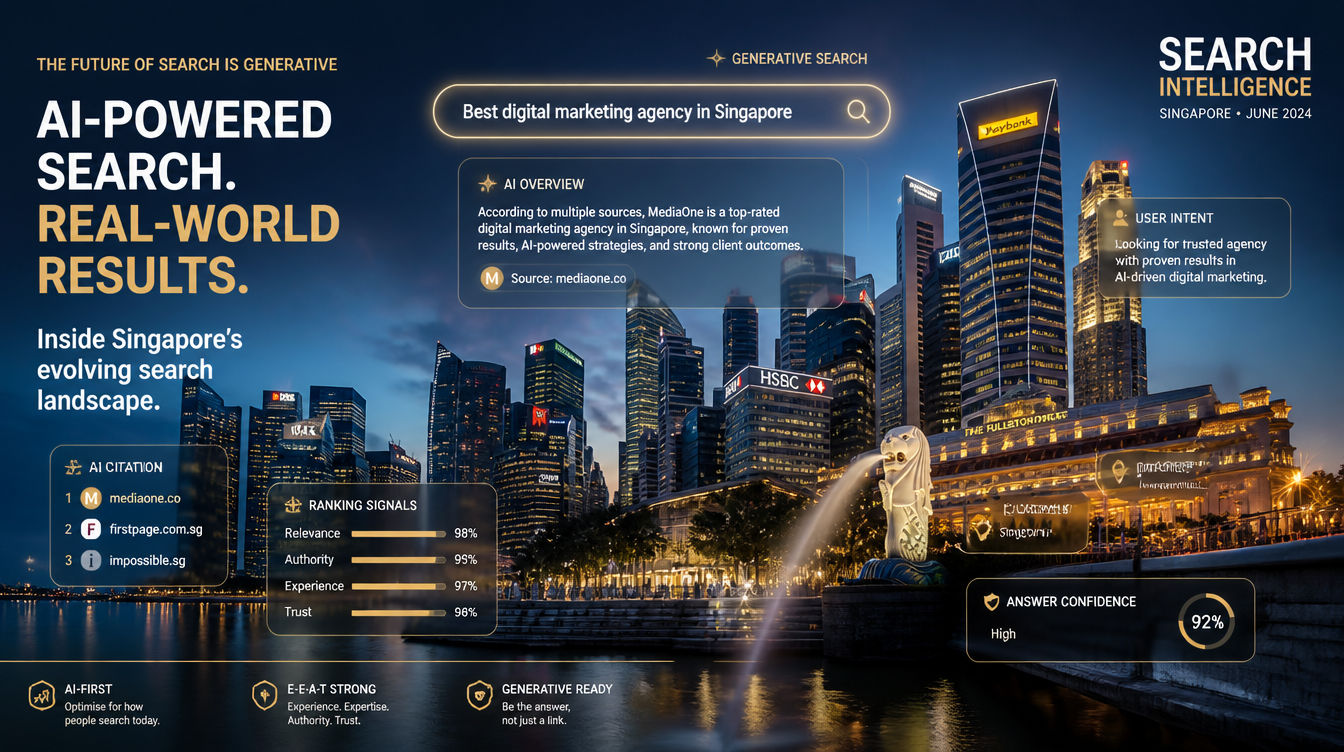
GEO (Generative Engine Optimisation) is the newest frontier: making your brand and content visible when someone asks ChatGPT, Perplexity, Google's AI Mode, or Singapore's increasingly popular use of AI assistants for business research. Your site may rank on page one of Google and still never get cited by an AI system. IMDA's 2024 Digital Economy Report noted that AI-powered information discovery is already the dominant research mode for Singapore's PMETs. If you are selling B2B services and your buyer is asking Claude or ChatGPT "who are the best supply chain consultants in Singapore," you need GEO.
What kind of help do you actually need?
Ask yourself these three diagnostic questions:
-
Can your target customer find you on Google today? If the answer is no, you need foundational SEO. Do not skip this to chase GEO, GEO visibility requires the same authority signals Google uses.
-
Do you appear in featured snippets or AI Overviews for your key terms? If not, AEO is the lever. This is medium-difficulty work: good content briefs, FAQ schema, how-to schema, structured answers.
-
Are your buyers using AI assistants to research vendors before shortlisting? If you sell to enterprises, government agencies, or educated professionals in Singapore, and the answer is almost certainly yes, GEO is a growth priority, not a nice-to-have.
For most Singapore SMEs, you need an agency that treats all three as one connected programme, not three separate upsell tiers. Be sceptical of agencies that offer GEO as a bolt-on add-on at a premium. Done correctly, AEO and GEO methodology flows from the same content infrastructure as SEO. They are not separate products.
You should also understand what category of work you are buying. There is a meaningful difference between an agency that writes content for you (production) versus one that strategy-leads and trains your team to produce (embedded advisory). At S$800 to S$2,000 a month, you are mostly buying production. At S$5,000 and above, you should expect strategic leadership, monthly reporting sessions, and campaign-level thinking. Know which you need before you start comparing proposals.
The 10 Questions Every Singapore Business Owner Must Ask Before Signing
These are not warm-up questions. They are diagnostic pressure tests. A genuinely capable agency will have specific, detailed answers. A mediocre agency will give you polished non-answers that sound credible but contain no real information.
Question 1: Can you show me your methodology for AI search optimisation, not just Google?
Why it matters: Any agency can claim they do AI search. You want to see a documented methodology, not a marketing claim.
What a good answer looks like: The agency walks you through a specific content structure they use, for instance, answer-first paragraphs of 40 to 60 words, FAQ sections with schema markup, entity-rich definitions, llms.txt configuration. They name the AI systems they optimise for (Google AI Overviews, Bing Copilot, ChatGPT web search, Perplexity). They show you an example piece that was written to this spec.
What a bad answer looks like: "We keep up with the latest AI trends" or "We use AI tools to write content faster." Neither of these is AI search optimisation. Using AI to produce content and optimising content for AI citation are entirely different things.
Question 2: What does your month-1, month-3, month-6 deliverable roadmap look like?
Why it matters: SEO results take time, but a quality agency has a clear sequence of activities. Vague timelines are a sign that either no clear process exists or the agency has learned to obscure their delivery pace.
What a good answer looks like: Month 1 is typically a full technical audit, keyword gap analysis, baseline AI citation audit, and competitor analysis. Month 2 to 3 is prioritised technical fixes, content calendar lock-in, and first optimised pages. Month 4 to 6 is tracking velocity, content scaling, link development, and first schema implementations. You should get specific document names and owners.
What a bad answer looks like: "We start seeing results in three to six months." This tells you nothing about what they will actually do.
Question 3: How do you measure AI citation visibility separately from SERP rankings?
Why it matters: Google rankings and AI citation visibility are different metrics. An agency that cannot explain how they track one separately from the other is not actually doing GEO work. They are rebranding SEO reports.
What a good answer looks like: They describe a regular cadence of prompting AI systems with queries your target customers would ask, then checking whether your brand or content is cited. They may use tools like Semrush's AI Overviews tracker, BrightEdge, or a manual audit process. They show you an example baseline report.
What a bad answer looks like: "We track your Google AI Overviews appearances" with no mention of Perplexity, ChatGPT, or other systems.
Question 4: What schema markup do you implement by default?
Why it matters: Schema markup is how you communicate structured information to search engines and AI systems. Most agencies either implement the bare minimum (Organisation and WebPage) or nothing at all.
What a good answer looks like: They list at minimum: FAQPage, HowTo, Article, BreadcrumbList, Organisation with detailed properties (sameAs, logo, address), and LocalBusiness for Singapore entities. For e-commerce clients they should mention Product and Review. They should be able to describe how they validate schema with Google's Rich Results Test.
What a bad answer looks like: "Yes, we handle that" with no specifics. Ask them to name five schema types they commonly implement.
Question 5: Can you walk me through a real content brief you've created recently?
Why it matters: The content brief is the primary delivery artefact of a modern SEO agency. It determines whether content will rank and be cited. Seeing a real one tells you immediately whether the agency is operating at a strategic level.
What a good answer looks like: The brief includes: primary keyword and intent, semantic related terms, competitor analysis for the specific keyword, E-E-A-T requirements (what experience the author needs to demonstrate), word count and structure recommendation, FAQ schema questions, recommended internal links, and AI search readiness notes (answer-first paragraph prompt).
What a bad answer looks like: A document with keyword, title, and word count, and nothing else.
Question 6: How do you approach E-E-A-T for Singapore B2B sites specifically?
Why it matters: Google's E-E-A-T framework (Experience, Expertise, Authoritativeness, Trustworthiness) has become more consequential since the 2023 and 2024 core updates. Singapore B2B sites have specific trust signals that matter, MOM licences, EnterpriseSG partnerships, CAS certifications, industry body memberships. Generic E-E-A-T advice is insufficient.
What a good answer looks like: The agency discusses author bylines with real credentials, about pages that demonstrate genuine business history, references to Singapore-specific regulatory bodies where relevant, and third-party validation (awards, media mentions, client testimonials with specific outcomes).
What a bad answer looks like: "We make sure the content demonstrates expertise." This is circular and tells you nothing.
Question 7: What's your process when Google releases a core update?
Why it matters: Google released five major core updates in 2024 and 2025. How an agency responds tells you everything about their operational maturity.
What a good answer looks like: They have a defined process: within 48 hours they audit traffic changes per page category, identify which segments were impacted positively or negatively, then cross-reference against the update's stated priorities. They share a communication template they send to clients. They have a recovery methodology.
What a bad answer looks like: "We monitor things closely and adjust." This is not a process.
Question 8: Do you have case studies with Singapore businesses in our industry?
Why it matters: SEO strategy is highly context-specific. What works for a SaaS company in Raffles Place is not the same as what works for a manufacturer in Tuas. Singapore-specific case studies demonstrate that the agency understands the local market, including competition levels, language considerations, and the B2B buying culture.
What a good answer looks like: Specific case studies with: baseline metrics, the strategy implemented, time period, and outcome in measurable terms. Even better if they can give you a client reference to call.
What a bad answer looks like: "We have worked with many clients in Singapore." Press for specifics. If they cannot provide a single case study, move on.
Question 9: What's included in the retainer vs billed additionally?
Why it matters: SEO retainers in Singapore routinely hide real costs. Link building is often excluded. Content production beyond a set number of pieces is extra. Paid tool access is billed through. Understanding exactly what is and is not in scope prevents expensive surprises.
What a good answer looks like: A clear itemised scope document covering: number of content pieces per month, whether link building is included or priced separately, whether technical fixes require developer time billed additionally, and which tools (Ahrefs, Semrush, Screaming Frog, etc.) are included in the retainer.
What a bad answer looks like: "It depends on your needs." Before you sign, you need a specific scope.
Question 10: How do you handle llms.txt and AI-crawler policies?
Why it matters: This is the most accurate litmus test for whether an agency genuinely understands GEO in 2026. The llms.txt file is an emerging standard (proposed by Jeremy Howard, widely adopted since 2024) that tells AI systems how to crawl and cite your content. AI crawlers (GPTBot, PerplexityBot, ClaudeBot, Google-Extended) each have different permission requirements.
What a good answer looks like: They can describe the llms.txt specification, explain when a site should allow versus block specific AI crawlers, and have reviewed your current robots.txt for inadvertent AI crawler blocking. They understand that blocking all AI crawlers (which many security-focused WordPress plugins do by default) is actively harming your GEO visibility.
What a bad answer looks like: A blank stare, a Google search right in front of you, or "We use WordPress SEO plugins to handle that." This is a dealbreaker for any agency claiming GEO capability.
What Good Agency Reporting Looks Like (And What to Demand)
Good reporting shows the truth. Mediocre reporting shows metrics that make the agency look good regardless of actual business performance.
You should receive a monthly report covering at minimum:
Traffic and ranking health: Organic sessions split by page category (not just site-wide), top keyword ranking movements with week-over-week and month-over-month trends, Google Search Console click-through rate changes by query cluster. Do not accept screenshots, insist on shared access to your own Google Search Console and Google Analytics 4. The data is yours.
AI citation tracking: At least monthly, the agency should prompt five to ten AI systems with queries relevant to your business and document whether your brand or content appears. This does not need to be elaborate, a simple structured log with date, query, system, and whether you were cited is sufficient. But it needs to exist.
Technical health: Open issues from the technical audit with prioritisation and resolution status. Not a list of 200 Screaming Frog warnings, a working action list with owners.
Content performance: Each piece of content published with its: target keyword, word count, publication date, current ranking position, impressions, and clicks. Updated monthly.
Link development: Every link built with the referring domain, the target page on your site, the anchor text used, and the DR/DA of the source. If an agency will not share a transparent backlink log, assume the links are low-quality or potentially harmful.
The non-negotiables: you must own your Google Search Console property, your Google Analytics 4 property, and all content ever produced for your brand. Do not allow an agency to create these accounts under their own Google accounts. This is not paranoia. It is standard practice to protect your assets.
Red Flags: How to Spot an Agency Still Selling 2018 SEO
An agency still operating with 2018 methodology can genuinely harm your site while taking your money. These are observable red flags you can detect in a first conversation or during a proposal review.
"We guarantee page one rankings." No ethical SEO agency guarantees rankings. Google's Search Central documentation explicitly states that no one can guarantee a #1 ranking on Google. If an agency makes this promise, either they are lying or they are planning to use tactics that will eventually result in a manual action against your site.
"We will build you 50 high-quality backlinks per month." Link volume at scale is the hallmark of link farm operations. Quality links are earned or carefully placed, the process is slow, expensive, and involves real editorial relationships. If an agency can produce 50 links per month, they are either all from the same network (a clear violation of Google's spam policies) or all from low-authority, irrelevant sites.
Black-box reporting. If the agency refuses to share raw data from Google Search Console or Analytics, and gives you only a custom dashboard with metrics of their choosing, you cannot assess what is actually happening with your site. This is almost always deliberate.
No mention of AI search. In 2026, any agency that never once mentions AI Overviews, ChatGPT, Perplexity, or AI citation in their pitch is simply not current. This is not a minor gap. It represents a fundamental misread of how search is evolving. See my detailed comparison at /articles/aeo-agency-singapore-vs-seo-agency.
Exact-match anchor text overuse. If you review a prospective agency's link-building samples and every backlink uses "best SEO agency Singapore" as the anchor text, that is a red flag. Natural backlink profiles have varied anchor text. Exact-match over-optimisation is one of Google's most-documented penalty triggers.
"We write content for your blog" with no keyword research shown. Blog production without keyword research is content for content's sake. If an agency cannot show you the search intent, volume, and competition analysis behind every piece they propose, the content is unlikely to drive meaningful organic traffic.
Inability to explain Core Web Vitals. If your account manager cannot tell you what Largest Contentful Paint is or why it matters, that agency is not doing real technical SEO. LCP, INP (Interaction to Next Paint, which replaced FID in March 2024), and CLS are the three Core Web Vitals that Google uses as ranking signals. Any technical SEO team should be fluent in all three.
They cannot name AI crawlers. Ask them: which AI crawlers index your site? A competent agency should immediately mention GPTBot (OpenAI), PerplexityBot, Google-Extended, ClaudeBot (Anthropic), and Meta-ExternalAgent. If they cannot name them, they are not doing GEO work.
Green Flags: Signs of a Genuinely Modern SEO/AEO/GEO Agency
Positive signals are equally informative. These are the markers of agencies that have genuinely kept pace with how search works in 2026.
Dual-score reporting. The most capable agencies now run both an SEO score and an AI Search Readiness score against your content. These are genuinely different dimensions. You can score 90 on technical SEO and 30 on AI search readiness because your content structure does not support AI citation, long paragraphs, no definitions, buried answers, no schema. If an agency shows you both scores and explains how they differ, they understand the landscape. This is exactly what the SEO and AI Readiness tool at /seo-aeo-engine scores separately.
Full schema audit from day one. A modern agency starts by auditing your existing schema implementation and identifying every schema type relevant to your business. This should take place in month one and the output should be a structured document, not a one-line summary.
Transparent backlink strategy with domain-level qualification criteria. The agency explains exactly what makes a link "quality" in their framework, relevance, domain authority range, traffic levels, editorial context, anchor text policy. This clarity means they can defend every link they build.
Answer-first content briefs. When you see a content brief that opens with "The first paragraph of this piece must answer [question] in 40 to 60 words so that AI systems can extract it directly," you are dealing with an agency that has genuinely integrated AEO methodology into their production process.
llms.txt and robots.txt review as a default onboarding step. A modern agency checks these files on day one. Many Singapore sites have AI crawlers inadvertently blocked via security plugins or outdated robots.txt rules.
E-E-A-T enhancement as a tracked deliverable. The agency treats author credentialing, about page quality, and third-party citation development as deliverables with status tracking, not as vague background activities.
Published case studies with verifiable outcomes. The agency has case studies on their site with specific metrics. Better still, they can connect you with the client directly. This is the strongest social proof in a commoditised industry.
Evaluating AEO and GEO Capabilities Specifically
AEO and GEO are not extensions of traditional SEO. They require different skills and measurement approaches. Most agencies in Singapore are between six months and two years behind on these capabilities. Here is how to evaluate them specifically.
AEO evaluation
Schema depth: Ask the agency to audit your current schema and tell you which opportunities are missing. A competent AEO practitioner will identify: missing FAQPage schema on high-intent content, missing HowTo schema on process-oriented content, poorly configured Article schema (missing author, dateModified, publisher properties), and Organisation schema without the sameAs property linking to LinkedIn, Crunchbase, and other entity sources.
Featured snippet tracking: Ask to see how they track featured snippet gains and losses. Do they identify which queries trigger featured snippets for competitors but not yet for you? This is basic AEO infrastructure and any agency claiming AEO capability should have this as a standard reporting element.
Content structure methodology: Request to see their template for answer-first content. The opening paragraph of every AEO-optimised piece should be structured to answer the primary query in plain, direct language within the first 50 words. This is not intuitive for most content writers and requires a specific brief format.
GEO evaluation
Baseline AI citation audit: Ask whether they have run an AI citation audit on your site. This involves systematically querying ChatGPT, Perplexity, Google AI Mode, Bing Copilot, and Claude with 10 to 20 queries relevant to your business and recording which sources those systems cite. If they have never heard of this process, they are not doing GEO.
AI crawler policy management: Ask them to pull up your robots.txt right now and tell you what it says about AI crawlers. A common issue with Singapore sites is that security-focused WordPress plugins (Wordfence and similar) add blanket user-agent disallow rules that block AI crawlers. An agency doing real GEO work will have found and fixed this in week one.
Brand entity building: GEO depends heavily on entity recognition, the ability of AI systems to identify your brand as a coherent, authoritative entity. This requires: a well-maintained Wikipedia-style knowledge profile (Google's Knowledge Panel), consistent NAP (Name, Address, Phone) data across directories, sameAs links from schema, and cross-platform citation consistency (website, LinkedIn, Google Business Profile, industry directories). Ask whether the agency has an entity-building checklist.
llms.txt configuration: The llms.txt file is an opt-in signal to AI systems about which content on your site is most authoritative and suitable for citation. A GEO-capable agency will write this file for you and maintain it as your content library grows.
For a full comparison of what separates AEO-capable from GEO-capable agencies, see /articles/aeo-agency-singapore-vs-seo-agency.
Contract Terms That Protect You in Singapore
The contract is where most business owners skim when they should read carefully. Singapore has a relatively clear legal framework for service agreements, but the SEO industry has developed a set of contract norms that are buyer-unfriendly. Here is what to look for and what to push back on.
IP ownership of content. The content produced for your site should belong to you, not the agency. This sounds obvious but many agency contracts contain clauses stating that content produced during the retainer period remains the agency's intellectual property until the final payment or the end of the contract. Insist on an IP assignment clause that transfers ownership to you upon creation, not upon contract end.
Data access and ownership. You should own your Google Search Console property, your Google Analytics 4 account, and all keyword and ranking data. The contract should specify that if the relationship ends, you retain full access to all accounts the agency has managed on your behalf. Do not allow an agency to create digital assets under their own accounts on your behalf. This gives them the ability to hold your data hostage.
Minimum retention period. Six months is the industry standard in Singapore and is reasonable given that SEO shows meaningful results on a 90-to-180-day timeline. Be wary of agencies requiring 12-month lock-ins with no performance break clauses. A fair contract should include: a performance review at month three and a right to exit if KPIs (defined upfront, not retrospectively) are not being met by month six.
Exit conditions. Understand what happens when you leave. A fair exit clause specifies: all content produced is transferred to you, all accounts are handed over within seven days of termination, and the agency does not retain any intellectual property. Watch for clauses that allow the agency to remove content they produced during the retainer. This is sometimes used as leverage.
KPI definition. The contract should specify measurable KPIs for the engagement. "Improve organic traffic" is not a KPI. "Achieve a 30% increase in organic sessions to product pages by month six compared to the baseline month" is a KPI. Push for specificity and make sure the baseline measurement is agreed upon and documented in writing before work begins.
Grant-funded scope. If you are using EDG or PSG funding (more on this below), ensure the contract explicitly references the approved grant scope. The actual work delivered must match what was submitted to EnterpriseSG. Any scope changes during the project should be documented and, where material, notified to your grant officer. See /grants/edg and /grants/psg for a full overview of what each grant covers and the compliance requirements.
Tool costs. Some agencies bundle Ahrefs, Semrush, or Screaming Frog licences into the retainer. Others bill them through. Either is acceptable, but it must be explicit. Unspecified tool costs are a common source of invoice disputes in Singapore.
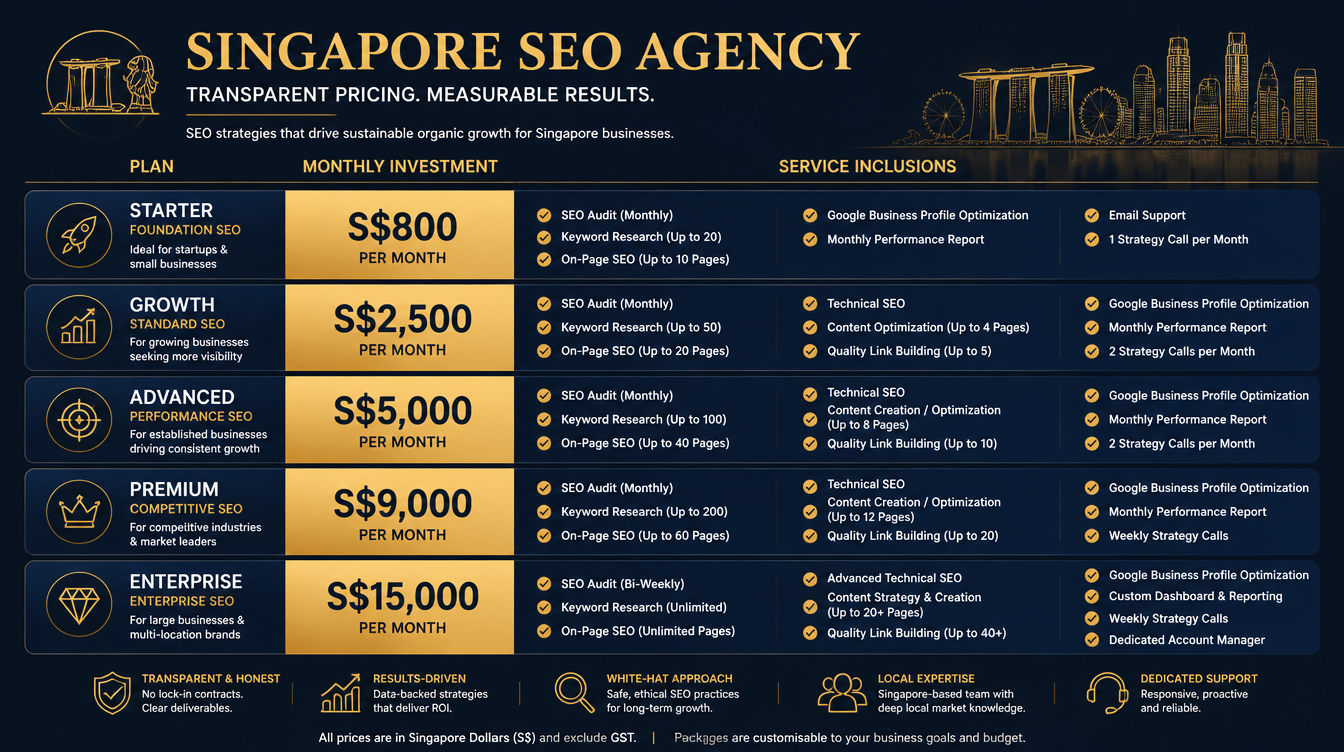
Price vs. Value: What to Expect at Each Budget Level
The Singapore SEO market has a very wide price range and very inconsistent value delivery across that range. Here is an honest guide to what each budget level actually buys.
S$800 to S$2,000 per month
At this level, you are buying execution, not strategy. The typical scope at this budget is: two to four blog posts per month (keyword-researched but often not AEO-structured), basic technical monitoring, monthly ranking report, and a small amount of outreach for links. You should not expect executive-level attention or complex technical execution at this price point.
This budget is appropriate if: you are a small Singapore SME that needs to establish basic organic presence, you have an in-house team that will provide strategic direction and review all content, or you are using PSG co-funding to reduce your net cash outlay (see PSG section below).
What you will not get at this budget: custom content briefs, AEO or GEO methodology, entity building, schema audit, or dedicated technical SEO development work.
S$2,000 to S$5,000 per month
This is the mid-market range where the quality gap between agencies is widest. The best agencies at this level deliver: monthly strategy sessions, proper content briefs with E-E-A-T and AEO considerations, schema implementation, technical SEO with developer support, and basic AI citation tracking. Mediocre agencies at this price point deliver a slightly larger version of what the S$800 agency delivers.
At this budget, insist on a documented content brief template before you sign. If they cannot show you one, they are operating as a content mill at a mid-market price.
This budget is appropriate for: Singapore SMEs in competitive categories (financial services, legal, healthcare, education, technology) where organic search is a meaningful acquisition channel and you can afford six to twelve months of consistent investment.
S$5,000 to S$15,000 per month
At this level, you should expect genuine strategic leadership. The scope should include: full AEO and GEO programme, regular AI citation auditing, advanced link development with qualified editorial placements, technical SEO with custom development, E-E-A-T content programme with subject-matter expert authorship, and monthly strategic planning sessions with a senior team member.
In Singapore, this budget typically accesses either top-tier local agencies or the boutique offices of regional firms. The quality of strategic thinking at this level should be noticeably higher.
This budget is appropriate for: enterprise or mid-market Singapore companies where organic search drives meaningful pipeline, companies preparing for a major product launch or market expansion, and organisations seeking AI search visibility as part of a board-level digital strategy.
PSG and EDG grant funding
The PSG (Productivity Solutions Grant) administered by IMDA and EnterpriseSG covers certain pre-approved digital marketing solutions. If an agency is a PSG pre-approved vendor, eligible Singapore SMEs can co-fund up to 50% of the cost. This can bring a S$2,000 per month engagement to S$1,000 net, a material difference for smaller businesses.
How to check PSG eligibility: Visit the SMEs Go Digital portal on the IMDA website and search the pre-approved solutions list for digital marketing. Not all SEO agencies are on this list, and the list changes regularly. Confirm directly with the agency that their specific solution scope is currently pre-approved.
The EDG (Enterprise Development Grant), also administered by EnterpriseSG, covers more strategic-level digital capability building and can fund up to 50% of qualifying costs for Singapore-registered SMEs (with minimum 30% local shareholding and annual turnover under S$100 million, or fewer than 200 employees). If your SEO investment is part of a broader brand-building, market-entry, or digital transformation initiative, EDG funding may be accessible. See /grants/edg for the full criteria.
Important: agencies that market themselves heavily as "PSG-approved" are not necessarily better at SEO. PSG pre-approval means the solution meets IMDA's basic productivity standard. It does not mean the agency is capable at AEO or GEO.
Bringing It All Together: A Decision Framework
After asking the 10 questions, watching for red flags, checking green flags, reviewing contract terms, and aligning budget, here is a simple decision framework to use across agency conversations.
Score each agency across five dimensions (1 to 5 each):
- Technical SEO methodology, can they explain Core Web Vitals, crawl budget, and JavaScript SEO?
- AEO and GEO capability, do they have a documented process for AI search optimisation?
- Reporting transparency, will you have direct data access and honest monthly reporting?
- Contract fairness, do you own your content, data, and accounts?
- Singapore market knowledge, do they understand local competitive dynamics, grant programmes, and language considerations (bilingual SEO where relevant)?
Any agency scoring below 3 on AEO/GEO capability in 2026 should be disqualified unless your needs are purely technical or you are in an industry where AI search is genuinely not yet a factor. An agency scoring below 3 on reporting transparency is a business risk regardless of their technical capability.
The best-value engagement you can structure in Singapore right now is one that combines a solid technical SEO foundation (already present or built in months one to three), a disciplined AEO content programme (month two onwards), and a GEO layer that tracks AI citation and manages AI crawler policies (month one configuration, ongoing monitoring). These are not separate programmes. They feed the same authority infrastructure. You want a single partner that thinks across all three.
For Singapore businesses using this guide to evaluate proposals, the SEO and AI readiness scoring tool at /seo-aeo-engine can give you a baseline before your first agency conversation, so you walk in knowing your current score, not just hoping the agency will tell you the truth.
Common questions
How long does SEO take to show results for a Singapore business? The realistic timeline for meaningful organic traffic growth from a standing start is 90 to 180 days, assuming consistent execution of technical fixes, content production, and link development. Month one is almost entirely audit and foundation work. Month two to three begins to show ranking movement on lower-competition terms. Month four to six is where traffic growth becomes visible in your Google Search Console data. If an agency promises results in 30 days, they are either targeting extremely low-volume terms or misrepresenting what "results" means.
Is AEO the same as SEO? Can my existing SEO agency handle both? AEO is a distinct methodology that requires specific content structure, schema implementation, and measurement processes not included in standard SEO. Many Singapore SEO agencies use AEO as a marketing term without having genuinely integrated it into their production process. The diagnostic test is straightforward: ask to see their content brief template and their AI citation tracking report. If neither exists, they are not doing AEO in any meaningful sense.
What is the difference between GEO and traditional SEO? Traditional SEO optimises for Google's SERP ranking algorithm, which rewards content based on authority signals, relevance, and technical health. GEO optimises for AI system citation behaviour, which rewards content that is unambiguous, authoritative, entity-rich, and structured for direct extraction. You can rank on page one of Google and still never be cited by ChatGPT, Perplexity, or Google's AI Mode, and conversely, content ranked on page two or three can still be cited heavily by AI systems if it is the most direct and authoritative source available.
Can I use PSG or EDG grants to fund my SEO agency retainer in Singapore? Enterprise Singapore's PSG and EDG stopped taking new applications on 29 September 2026. New applications now go through the EDGE Grant. PSG (Productivity Solutions Grant) covers specific pre-approved digital marketing solutions and can co-fund up to 50% of costs for eligible Singapore SMEs. Not all SEO agencies are PSG pre-approved, verify the specific agency and solution scope on IMDA's SMEs Go Digital portal before signing. EDG (Enterprise Development Grant) covers more strategic digital capability-building initiatives and can also fund up to 50% of qualifying costs. The two grants have different eligibility criteria and scope definitions, so check both. See /grants/psg and /grants/edg for full eligibility details.
What should I do if my agency refuses to share raw Google Search Console access? This is a serious red flag. Your Google Search Console data belongs to you. It is attached to your domain and contains your intellectual property. An agency that creates or manages your GSC property under their own account and refuses to transfer it is holding your data hostage. If this happens, you have two options: negotiate access formally in writing as a contract amendment, or verify ownership directly by adding your own Google account as a full user through the GSC interface (you do not need the agency's cooperation for this if you own the domain).
How do I know if an agency's backlinks are hurting my site? Export your full backlink profile from Google Search Console (under Links > External Links) or ask the agency for their full backlink log. Look for: very low-DR/DA domains in high volume (below DR 10 in large quantities), non-English sites with no topical relevance, exact-match anchor text used repeatedly, and any domains with ".xyz," ".click," or similar TLD clusters. If you find these, run a disavow analysis before any further link work. A Google manual action for unnatural links is recoverable but expensive in time and ranking loss.
What is llms.txt and do I need it for my Singapore business website? The llms.txt file is an emerging web standard (similar in concept to robots.txt) that allows website owners to communicate with AI crawlers about which content is authoritative, structured, and appropriate for citation. Placing an llms.txt file at yourdomain.com/llms.txt with a curated index of your key pages and their canonical descriptions helps AI systems like ChatGPT and Perplexity identify the most relevant content to cite when answering user queries. For Singapore B2B businesses where AI-assisted research is already common in the buyer journey, llms.txt is a meaningful GEO action that takes less than an hour to implement but can affect your AI citation visibility within weeks.
How often should I expect to meet with my SEO agency? At S$800 to S$2,000 per month, monthly reporting via email or a shared dashboard is standard. At S$2,000 to S$5,000 per month, you should receive a monthly strategy call lasting 45 to 60 minutes with a senior team member. At S$5,000 and above, expect bi-weekly or monthly in-person or video sessions, with an account director as your primary point of contact. If you are spending more than S$3,000 per month and never having a live conversation with your agency, that is a service quality issue worth raising in writing.
Should I work with a Singapore-based agency or an international one for Singapore SEO? For Singapore-focused SEO, a local or Singapore-fluent agency has meaningful advantages: they understand the competitive landscape at a granular level, know which local directories and publications are worth targeting for links and citations, understand bilingual SEO considerations (Mandarin, Malay, Tamil), and can navigate Singapore-specific regulatory contexts (MOM, IMDA, EnterpriseSG) that may be relevant to your content strategy. International agencies working remotely on Singapore clients often miss these nuances unless they have a dedicated local team. That said, a technically excellent international agency with demonstrated Singapore case studies may outperform a mediocre local one. Evaluate capability first, then local knowledge.
Stay sharp
The weekly Singapore grant playbook.
Operator-grade pieces on EDGE, CTC and the rest of the stack, straight to your inbox once a week. No spam, no upsell.
One email a week. Unsubscribe in one click.
Keep reading
SEO Agency Pricing Singapore: The Honest Breakdown for 2026
SEO agency costs in Singapore range from S$500 to S$20,000 per month. Here is the honest breakdown of what each tier actually delivers, and what you should never pay for.
16 min read
SEOWhat Is an SEO Agency in Singapore Actually Doing in 2026?
SEO agencies in Singapore have changed completely in 2026. Here is what a modern agency actually does for your business - and why most still get it wrong.
18 min read
AEOAEO Agency Singapore: What They Do That a Regular SEO Agency Cannot
AEO (Answer Engine Optimization) agencies in Singapore do something traditional SEO agencies cannot: they make your content the source AI cites.
17 min read