SEO Agency Pricing Singapore: The Honest Breakdown for 2026
SEO agency costs in Singapore range from S$500 to S$20,000 per month. Here is the honest breakdown of what each tier actually delivers, and what you should never pay for.
Nick Tung
@nick_tung_ · 16 min read
Published:
Updated:
Update, 25 September 2026: PSG, EDG and MRA take new applications until 29 September 2026. From 30 September 2026, new projects apply under Enterprise Singapore's EDGE grant. Applications submitted before 30 September are still assessed under the old scheme's rules, so where this article describes PSG, EDG or MRA, read it as how those schemes worked. Per Enterprise Singapore's release of 9 September 2026, EDGE supports SMEs at up to 50% on most activities and up to 70% on internationalisation and sustainability, within a S$100,000 grant cap per company per year. Eligibility is decided by Enterprise Singapore.
SEO Agency Pricing Singapore: The Honest Breakdown for 2026
I have been doing SEO in Singapore for long enough to know how this market works. Agencies obscure their pricing because opacity is profitable. SMEs pay for deliverables that sound impressive ("500 keywords tracked," "20 backlinks per month") without ever connecting those deliverables to actual business results.
This article gives you the real numbers, the real breakdowns, and the real traps. I am going to tell you what each price tier actually delivers, what you should never pay for, and how to calculate whether SEO makes financial sense for your specific business before you sign a single contract.
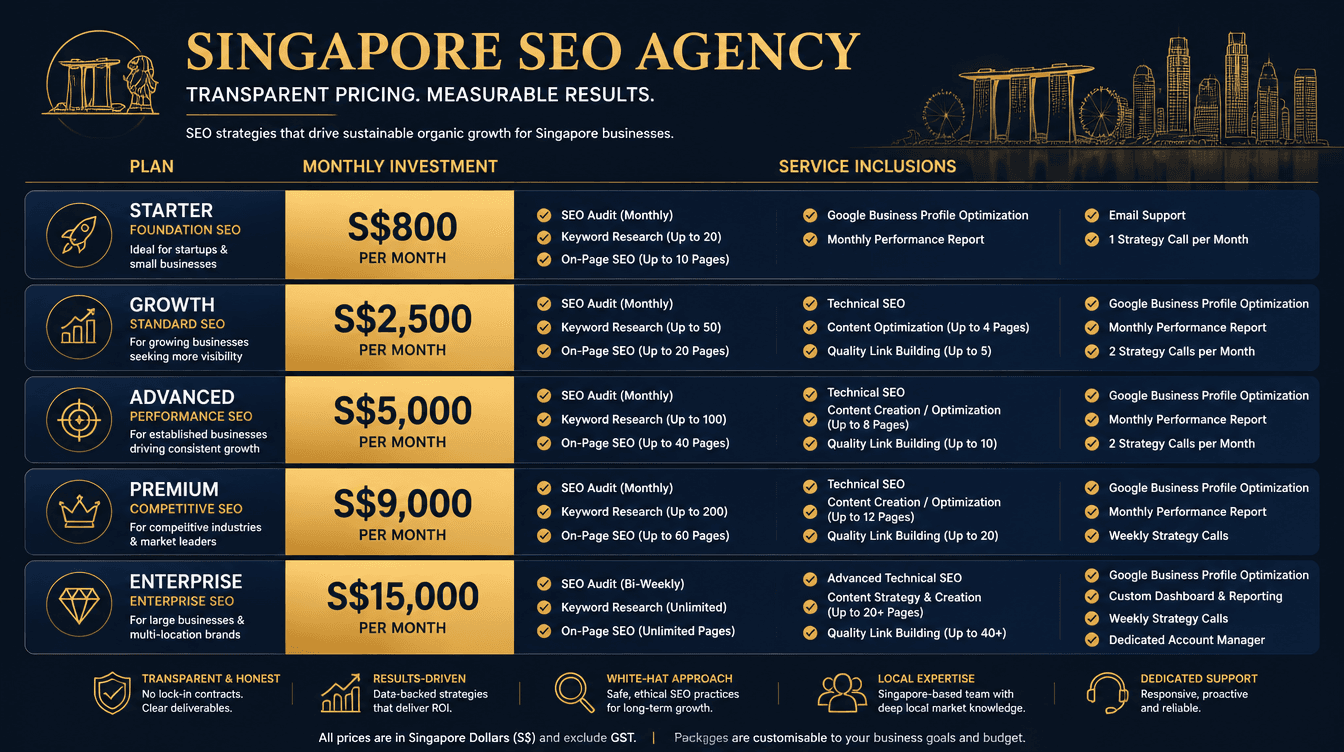
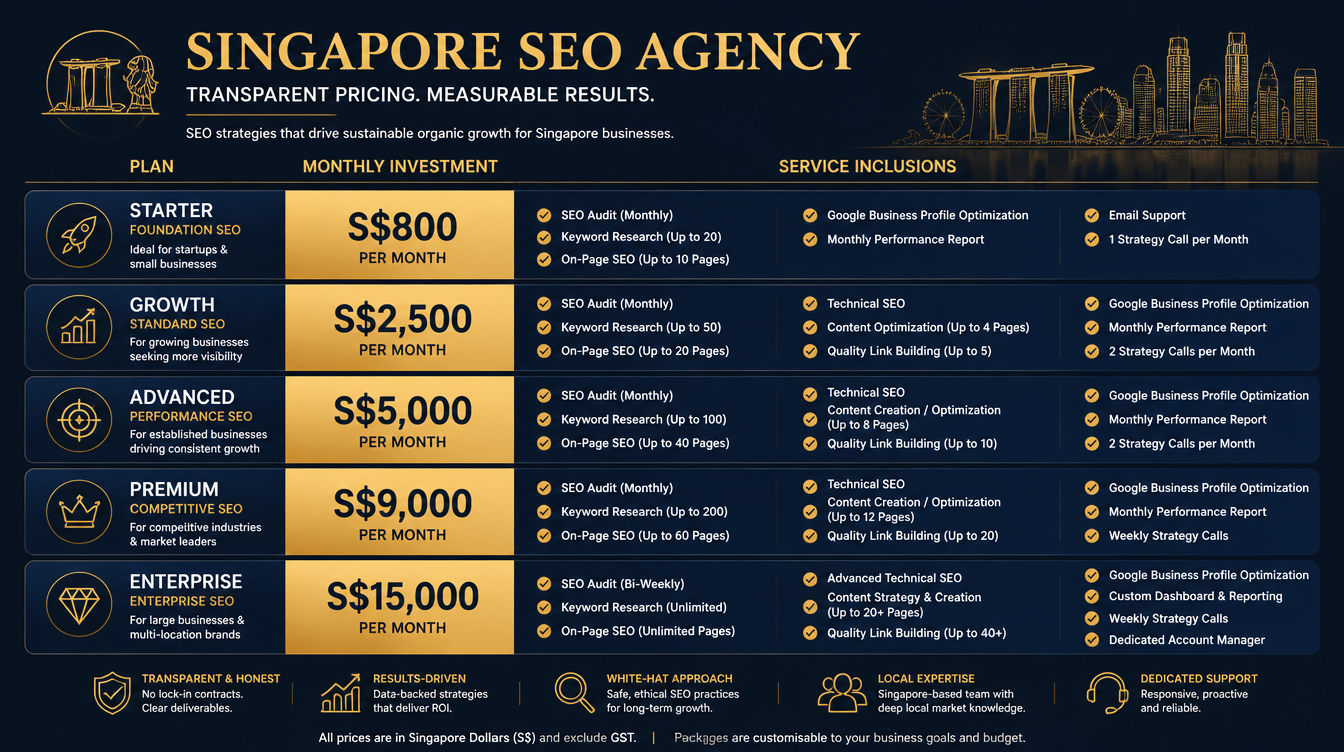
SEO agency pricing in Singapore ranges from S$500 to S$20,000 per month. The question is not which price is right. It is which price is right for your stage, your competition, and your margins.
Why SEO Pricing in Singapore Is So Confusing (And Who Benefits From That Confusion)
The confusion is intentional. When pricing is opaque, buyers default to the cheapest option or the most familiar brand, and agencies know this. There is no standardised pricing framework in Singapore, no IMDA guideline on what a fair SEO retainer looks like, and no mandatory disclosure of what goes into a monthly package.
Here is what actually creates the confusion:
Bundled deliverables hide actual work. A package that says "keyword research, on-page optimisation, monthly reporting, and link building" could mean four hours of work or forty hours of work. The deliverables are real; the labour behind them is invisible.
ROI timelines are weaponised. Agencies that charge S$800 per month will tell you to wait 12 months before judging results. By then, you are S$9,600 poorer, you have experienced one Google algorithm update, and you are told that "rankings are improving", even if they are not improving in any meaningful revenue sense.
Vanity metrics are everywhere. "We rank you for 200 keywords" means nothing if none of those keywords have buying intent or search volume. Singapore has an extraordinary density of agencies selling keyword rankings for long-tail terms that get eight searches per month.
Offshore pricing distorts the market. The presence of India-based, Philippines-based, and Malaysia-based SEO agencies offering S$300-S$600 per month packages pulls the entire market's price perception downward. These are not equivalent services, but the average SME owner cannot tell the difference from a sales deck.
The agency business model rewards contracts, not results. A 12-month retainer is valuable to an agency regardless of whether it produces revenue for you. Most SEO contracts in Singapore lock you in for six to twelve months with minimal performance accountability. This is not a conspiracy. It is just an incentive structure that does not align with your interests.
Who benefits from the confusion? The agency that wins the contract, the business owner who gets to defer the hard decision, and frankly the client who genuinely needs 12 months of patience but would abandon ship at month four without a contractual reason to stay.
Understanding this dynamic is the first step. The second step is understanding what each price tier actually delivers, and what it does not.
The Five Price Tiers Explained: From S$500 to S$20,000+ Per Month
Singapore's SEO market naturally clusters into five price bands. Each band reflects a different type of provider, a different level of service depth, and a different expected outcome.
Tier 1: S$500 to S$1,500 per month (Offshore or Entry-Level Freelancer)
At this price point, you are typically engaging an offshore team, a fresh local freelancer, or an agency using outsourced execution. The margins only work if the work is systematised and low-touch.
What is feasible at this budget: basic keyword tracking (usually 20 to 50 keywords via a platform like Semrush or Ahrefs), minimal on-page optimisation on existing pages, one to two blog posts per month from template-driven processes, and link building from low-authority directories and guest post farms.
This tier can produce results for micro-businesses in low-competition niches. If you are a sole proprietor offering a specialised service with no meaningful local competitors and an existing domain with some history, S$800 per month might move the needle enough to justify the spend.
It will not work if you have any real competition, if your category has local competitors with existing domain authority, or if you need content that demonstrates genuine expertise. In those situations, Tier 1 is not slow money. It is lost money with a side effect of risk.
Tier 2: S$1,500 to S$3,000 per month (Local Boutique or Mid-Level Freelancer)
This is where you start getting something that resembles a real SEO engagement in Singapore. At this budget, a reputable local boutique or senior freelancer can deliver: a technical SEO audit with remediation guidance, four to eight articles per month with locally relevant content, Google Business Profile management with post scheduling and review response, and local citation building across Singapore directories such as Hotfrog, Singapore Business Directory, and Yellow Pages SG.
The critical word is "reputable." There are agencies in Singapore charging S$2,000 per month using the same playbook as the S$800 offshore team. The difference at this tier is whether the work is being done by someone who understands the Singapore search landscape, which means understanding that Google.com.sg has unique SERP features, that Singaporean searchers use a mix of English and Singlish query patterns, and that local citations have different authority signals than global ones.
For most established SMEs (retail, F&B, professional services, education) this is the minimum viable SEO investment if you want meaningful results within 12 months.
Tier 3: S$3,000 to S$6,000 per month (Mid-Tier Full-Service Agency)
At this level, you are paying for a genuine SEO team rather than an individual. A credible mid-tier agency at this price point will provide: full technical SEO covering site speed, Core Web Vitals, crawl budget management, and structured data implementation; a content strategy aligned to search intent and your conversion funnel; link outreach to topically relevant Singapore publications and industry sites; and monthly reporting that connects keywords to traffic, traffic to leads, and leads to revenue.
This is the most competitive segment of the market in Singapore, and quality varies enormously. The best mid-tier agencies produce better results than some full-service agencies at twice the price. The worst mid-tier agencies use Tier 1 execution with Tier 3 pricing.
How to distinguish: ask to see case studies from Singapore businesses with comparable competition levels to yours. Ask what tools they use for link prospecting and content planning. Ask how they have handled a Google core algorithm update for a client. If the answers are vague, the execution will match.
Tier 4: S$6,000 to S$10,000 per month (Full-Service with CRO and AEO)
This tier represents what I consider the minimum viable investment for companies where SEO is a primary growth channel, not a side project but the main driver of inbound leads.
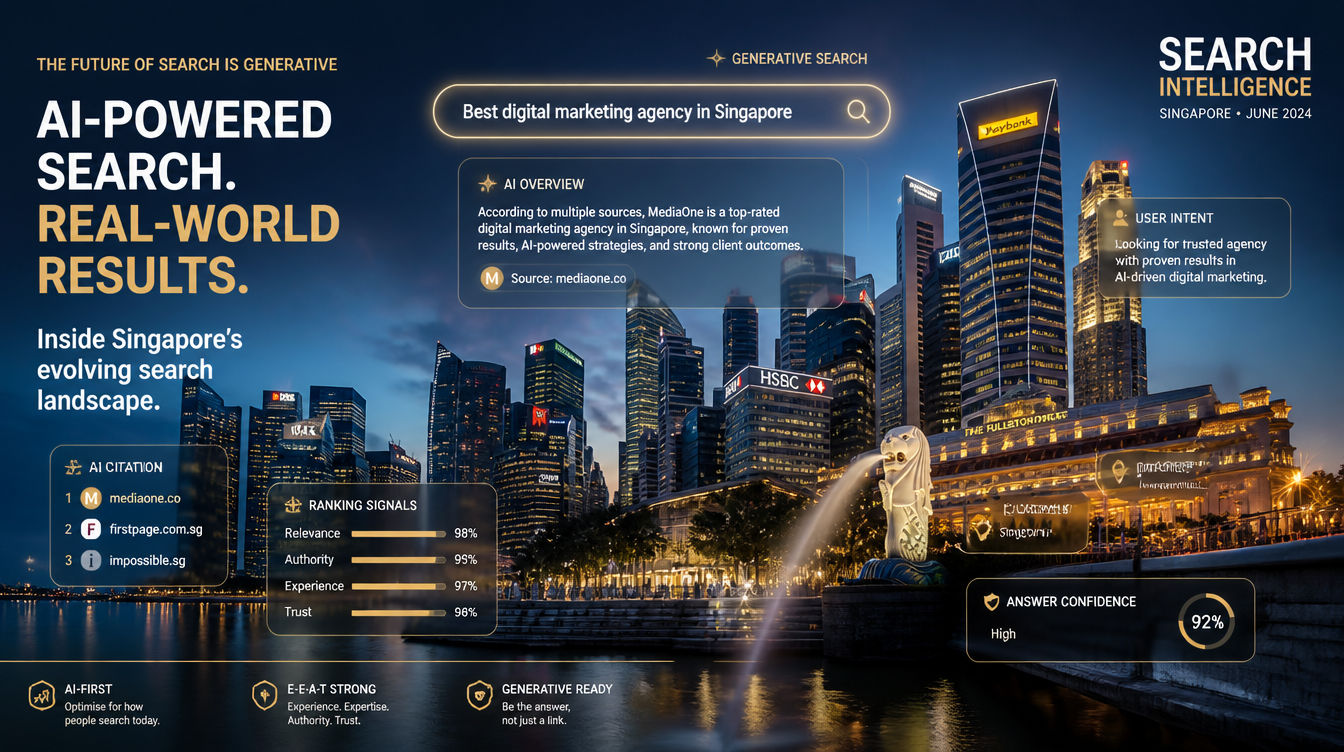
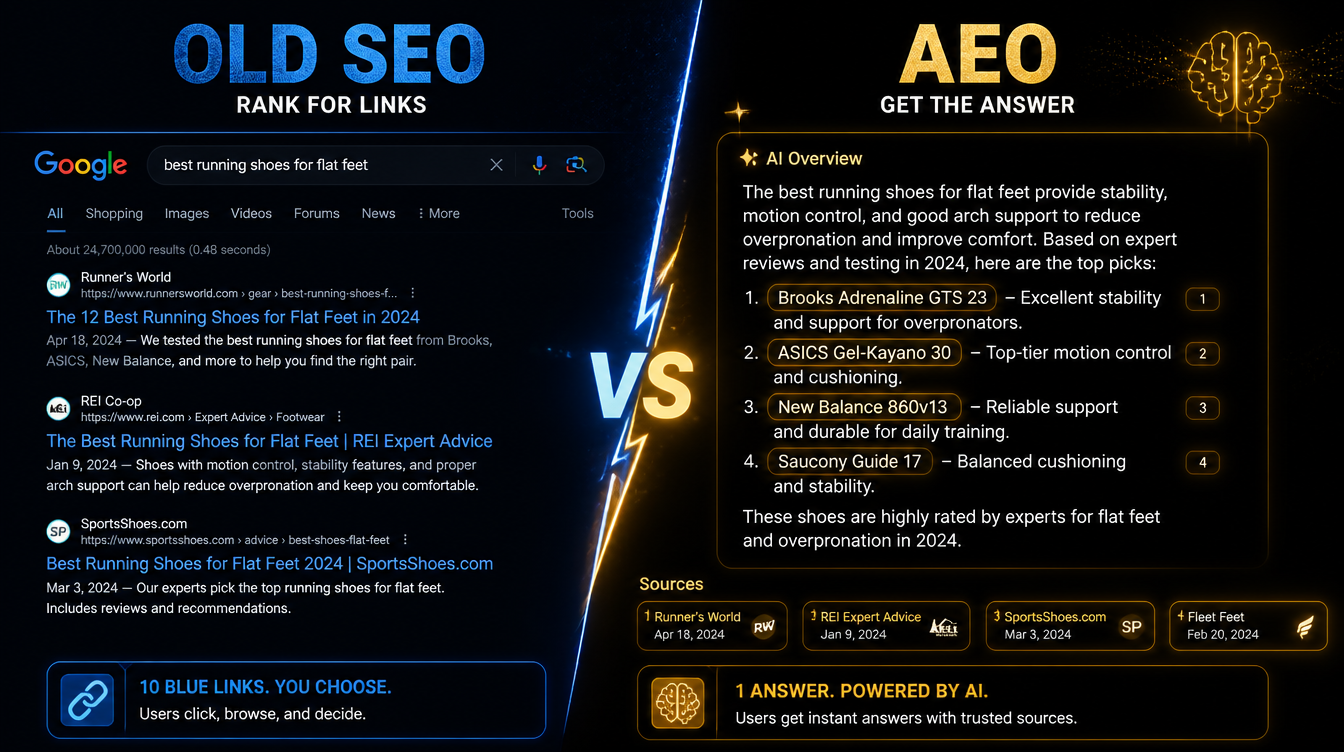
At this budget, you should expect everything in Tier 3, plus: conversion rate optimisation (CRO) work aligned to your SEO traffic, answer engine optimisation (AEO) content strategy that positions your site to be cited by AI systems like ChatGPT, Perplexity, and Google's AI Overviews, PR-driven link acquisition from credible Singapore media, and competitive intelligence reporting on your direct competitors' search activities.
The AEO component is increasingly non-negotiable in 2026. Google's own documentation on E-E-A-T (Experience, Expertise, Authoritativeness, Trustworthiness) has shifted to reward content that demonstrates genuine expertise in ways that AI systems can extract and reference. If your SEO agency is not building for AI citation alongside traditional ranking, you are optimising for a shrinking share of search attention. You can explore our SEO and AEO engine to understand how a dual-score approach works in practice.
Tier 5: S$10,000 to S$20,000+ per month (Enterprise SEO)
Enterprise SEO in Singapore is a different category entirely. It is not "more SEO". It is a fundamentally different scope of work. At this level, agencies manage: multiple domains including international expansion into Malaysia, Indonesia, and Australia; content production at scale producing 20-50 pieces per month across formats; brand entity building ensuring your business is correctly represented across the Knowledge Graph, Wikipedia, LinkedIn, and third-party authority sources; technical SEO for complex site architectures such as e-commerce with thousands of SKUs or multi-language sites; and Generative Engine Optimisation (GEO) for sustained AI citation across all major AI platforms.
The buyers here are typically scale-ups, large local enterprises, Singapore-based regional headquarters, and businesses with significant online revenue where SEO ROI is measurable in millions rather than thousands.
If you are evaluating whether this tier is appropriate, the decision is financial: if your monthly SEO-attributable revenue target is not meaningfully above S$30,000, this scope is probably not justified regardless of ambition.
What Is Actually Included at Each Price Point
Beyond the headline services, there are specific deliverables you should demand at each tier. Use this as a negotiation and vetting checklist before signing any contract.
S$500 to S$1,500: Minimum Deliverables to Require
- Keyword ranking report for 20 to 50 target keywords, delivered monthly
- On-page audit of five to ten existing pages with specific improvement recommendations
- One to two blog posts per month at minimum 800 words each
- Basic Google Search Console setup and error monitoring
- Monthly written summary covering rankings changes and next steps
What you should not expect: original research, link acquisition from credible Singapore publications, technical debugging of site infrastructure, or content that would pass an editorial review at any credible publication.
S$1,500 to S$3,000: What to Demand in Writing
- Technical SEO audit with a written remediation checklist and priority ranking
- Four to eight blog posts per month at 1,000 to 1,500 words minimum, written by a native English speaker
- Google Business Profile management including weekly posts and review response within 48 hours
- Local citation audit and a minimum of 10 new Singapore-relevant citations per month
- Monthly call with a named SEO lead, not just a PDF report
- Schema markup implementation on key pages including LocalBusiness and Article schema
S$3,000 to S$6,000: What to Demand in Writing
- Full crawl-level technical audit using Screaming Frog or equivalent, with development briefs for your web team
- Content calendar aligned to search intent and funnel stage, not just keyword density targets
- Minimum three outreach-based backlinks per month to topically relevant domains with domain rating 30 or higher
- Core Web Vitals monitoring with documented remediation actions
- FAQ schema, HowTo schema, and Article schema on all content pieces
- Quarterly competitor gap analysis covering both keyword and backlink gaps
- Reporting connected to Google Analytics 4 goals, not just keyword rankings in isolation
S$6,000 to S$10,000: What to Demand in Writing
- CRO testing aligned to top SEO traffic landing pages, minimum two A/B tests per quarter
- AEO content strategy with answer-first article structures designed for AI extraction
- PR outreach plan with a minimum of two Singapore media placements per month
- Entity optimisation across LinkedIn, Crunchbase, IMDA directory, and relevant Singapore business registries
- Dedicated communication channel for real-time questions and updates
- Monthly executive briefing framing business impact, not just ranking improvements
S$10,000+: What to Demand in Writing
- Dedicated account director with SEO director sign-off on all strategic decisions
- Multi-domain management with consolidated cross-domain reporting
- In-house or retained content production team: minimum three writers plus an editor
- International SEO setup including hreflang implementation, international keyword research, and country-specific link building
- Brand entity monitoring with weekly SERP snapshot across target markets
- GEO strategy covering structured data implementation, knowledge panel claims, and entity disambiguation
The Hidden Costs Most Agencies Do Not Tell You Upfront
This section has saved multiple clients from expensive surprises. Most SEO retainers in Singapore have costs that exist outside the headline monthly fee. Agencies do not always hide these costs maliciously, but they rarely explain them proactively either.
Content production is almost always billed separately at Tier 1 and Tier 2. When an agency says "content strategy included," that typically means the keyword research and the editorial calendar, not the actual writing. If you need 10,000 words of genuinely useful, Singapore-relevant content per month, budget an additional S$500-S$2,000 depending on topic complexity and the writer's experience level.
Link acquisition has real and often unacknowledged costs. High-quality backlinks from credible Singapore publications require either established PR relationships or link placement fees that some publishers charge openly, and others charge quietly. At Tier 3 and above, some of this cost is absorbed within the agency's retainer. At Tier 1 and 2, you often receive links from directories and private blog networks, which are free to acquire and either worthless or actively harmful to own.
Technical development work is almost never included in the SEO retainer. If your site has technical issues requiring code changes (slow page speed, broken pagination, incorrect canonical tags, JavaScript rendering problems affecting Googlebot) someone needs to fix them. SEO agencies identify these issues; your web developer (or the agency's, at an additional hourly rate) fixes them. Budget S$500-S$2,000 per quarter for ongoing technical remediation if your site is not already technically clean.
CMS changes and platform migrations are major cost items. If your SEO audit recommends restructuring your URL hierarchy, moving to a faster hosting stack, or migrating to a headless CMS, these are substantial development projects. A URL restructure alone can require S$3,000 to S$10,000 in developer time and demands careful 301 redirect implementation to preserve existing ranking equity.
Tool costs are sometimes passed through without transparency. Professional-grade SEO tools (Ahrefs, Semrush, Screaming Frog, ContentKing) cost S$200-S$500 per month for credible plans. Some agencies include these within their retainer; others bill them as pass-through costs. Ask explicitly before signing, and verify whether the tools are being used actively on your account or shared across many clients.
Penalty recovery is never included in a standard retainer. If your site carries existing algorithmic penalties from previous low-quality SEO work, a common situation in Singapore where many SMEs have been sold S$500/month link packages for years, removing those penalties is treated as a separate remediation project. Budget S$3,000-S$8,000 for a thorough link audit and disavow process, plus ongoing clean SEO work during the recovery period.
The honest total cost of a credible SEO engagement in Singapore is typically 1.2 to 1.5 times the headline retainer fee once content production, technical development, and tool costs are factored in.
How to Calculate the Real ROI of SEO for Your Singapore Business
The ROI calculation for SEO is straightforward. Most business owners avoid doing it because they fear the answer, but the clarity it provides is always worth the discomfort.
Here is the framework I use with every client before recommending a budget.
Step 1: Define your average customer lifetime value (LTV)
Total revenue from a single customer over the length of your relationship with them. For a corporate law firm, this might be S$20,000 per matter with two matters per year over three years, an LTV of S$120,000. For a fitness studio, it might be S$200 per month with an average retention of 14 months, an LTV of S$2,800. For a B2B SaaS company, it might be S$1,000 per month with an average contract length of 24 months, an LTV of S$24,000.
Step 2: Calculate your current conversion rate from organic traffic to customer
If your site receives 1,000 organic visitors per month, produces 15 lead enquiries from those visitors, and 4 of those enquiries become paying customers, your organic traffic-to-customer conversion rate is 0.4%.
Step 3: Estimate the traffic uplift a credible SEO engagement will produce
A well-executed mid-tier SEO engagement targeting competitive Singapore local keywords should produce a 50 to 200% uplift in qualified organic traffic over 12 months. A conservative estimate for a site with moderate existing authority is 60 to 80% uplift. Use the conservative number for your ROI calculation.
Step 4: Run the numbers
Worked example using a Singapore accounting firm:
- Current organic traffic: 800 visitors per month
- Current LTV: S$9,600 per client (average retention of 2 years at S$400 per month)
- Current organic conversion rate: 0.25% - 2 new clients per month from organic search
- Proposed SEO budget: S$4,000 per month
- Conservative 12-month traffic target: 1,400 organic visitors per month (75% uplift)
- Projected new clients from organic search at 1,400 visitors: 3.5 per month
Additional revenue at steady state: 1.5 extra clients per month times S$9,600 LTV equals S$14,400 per month in new customer value created. Monthly cost: S$4,000. Monthly net: S$10,400. Payback on the ramp-up investment of S$48,000 (12 months times S$4,000): approximately month 5 of steady-state operation.
Step 5: Account for the ramp-up lag
The calculation above assumes steady-state traffic. In reality, meaningful ranking movements occur at three to six months, and full traffic benefit is typically realised at nine to twelve months. Your true break-even on the total investment is therefore at approximately month 17, but from that point, every month of stable rankings produces compounding positive returns with no incremental cost increase.
Compare that to paid advertising: equivalent traffic acquisition via Google Ads for competitive Singapore keywords costs S$3 to S$8 per click. At 1,400 monthly visitors, that is S$4,200 to S$11,200 per month in perpetuity, with zero residual value if you pause the spend. SEO compounds; paid media does not.
Can You Get PSG or EDG Grant Funding for SEO Services?
Yes, and most Singapore SMEs are leaving money on the table by not exploring this route before committing to a full-price retainer.
The Productivity Solutions Grant (PSG), Enterprise Development Grant (EDG), and Career Conversion Programme (CTC) under SkillsFuture all have pathways that can fund SEO-related spending under the right circumstances.
PSG (Productivity Solutions Grant): PSG supports the adoption of pre-approved digital solutions. IMDA and EnterpriseSG maintain a pre-approved vendor list that includes digital marketing service providers, some of which offer structured SEO packages. The grant covers up to 50% of qualifying costs for eligible businesses registered and operating in Singapore with at least 30% local shareholding. PSG is structured around defined packages, not fully bespoke retainers, so if your SEO agency is a PSG pre-approved vendor offering a standardised package with defined deliverables, that package may be claimable at the subsidised rate.
Check the current GoBusiness vendor list, as approvals change. Our PSG grants guide covers the current application process and eligibility criteria.
EDG (Enterprise Development Grant): EDG funds business development and capability-building projects, including digital marketing strategy as a defined project deliverable. If your SEO engagement involves a substantive strategic output (a digital marketing framework, a competitor landscape analysis, a structured content marketing strategy) it may qualify for EDG support of up to 50% of qualifying costs. The critical distinction: EDG is project-based, not retainer-based. You fund a defined project with specific deliverables, a start date, and an end date, not an ongoing monthly service. Consult our EDG grants guide for current qualifying criteria.
CTC (Career Conversion Programme): If you are hiring a marketing executive and upskilling them in digital marketing including SEO and AEO strategy, the Career Conversion Programme under NTUC and SkillsFuture can subsidise significant portions of training costs. This is worth exploring if you are building in-house SEO capability alongside an initial agency engagement.
A practical note from working with Singapore SMEs on grant applications: allow six to eight weeks for PSG applications and eight to twelve weeks for EDG applications. Do not begin work before the grant application is submitted and approved, retrospective claims are generally not accepted. If grant funding is a material part of your SEO budget calculation, engage an advisor familiar with EnterpriseSG's current guidelines before signing any agency contract.
DIY vs. Freelancer vs. Agency: The Full Cost Comparison
Many SMEs seriously consider doing SEO themselves before committing to external spend. The honest comparison is more nuanced than "DIY is always cheaper."
DIY SEO: The real total cost
If a business owner or marketing executive spends 10 hours per week on SEO, the true cost includes: their opportunity cost (what client work, sales activity, or strategic thinking could they be doing instead?), tool costs of S$200-S$500 per month for professional-grade platforms, significant learning curve time especially for technical SEO and link acquisition, and the cost of mistakes, a badly implemented site migration or incorrectly configured canonical tags can cost months of recovered rankings.
DIY SEO is viable for micro-businesses where the owner has existing technical competence, genuinely enjoys the discipline, and is in a low-competition niche. For most SME owners whose time is worth S$150 to S$300 per hour in opportunity cost, DIY SEO is economically justified only when the alternative investment would be S$1,500 per month or less.
Freelancer: The highest value tier for early-stage businesses
A skilled Singapore-based SEO freelancer with three to seven years of specialist experience typically charges S$1,500 to S$4,000 per month. The advantages are direct: you get that person's undivided attention, no account management overhead, and genuine personal ownership of your results. The disadvantages are equally direct: limited bandwidth if your needs scale quickly, potential gaps in technical or creative depth, and single-point-of-failure risk if they become unavailable.
For businesses in the S$1,500-S$3,000 budget range, a vetted senior freelancer consistently outperforms a similarly-priced agency. At an agency at this price point, your account is typically managed by a junior executive following a systematic process, not by the experienced person who pitched you the work.
Agency: Justified once complexity demands a team
An agency structure makes genuine economic sense when your SEO engagement requires coordinated execution across technical, content, and link acquisition workstreams simultaneously. This typically corresponds to the S$4,000 tier and above. Below that level, agency overhead (sales commissions, account management, internal coordination, profit margin) comes at a direct cost to the quality and volume of execution on your account.
Before signing with any agency, ask specifically: who will be working on my account day-to-day, and can I meet them before signing? This one question eliminates a large proportion of underperforming agency relationships before they begin, because it forces accountability on the staffing decision before the contract is executed.
For a more detailed vetting process, our article on how to choose the right SEO and AEO agency in Singapore in 2026 covers the full set of qualifying questions across technical, content, and strategic dimensions.
When Cheap SEO Costs More Than Premium SEO
This is the section most agencies leave out of their pricing comparisons, and it is arguably the most important one.
The spam link trap. An SEO package that delivers "500 backlinks per month" for S$500 is building your site's link profile on a foundation that Google's spam detection systems will eventually penalise. Google's Spam Policies documentation explicitly covers link schemes, including paid links from networks, excessive link exchanges, and links from low-quality directories built specifically for SEO manipulation. When a manual action is issued or an algorithmic update catches the pattern, and both happen regularly, rankings collapse. Typical impact is a 60-90% drop in organic traffic within days of the penalty taking effect.
Penalty recovery is expensive and slow. A link disavow process (identifying every toxic backlink, requesting removal where possible, and filing a disavow file with Google) takes two to four months of dedicated specialist work and costs S$3,000-S$8,000 in fees. A full algorithmic recovery after a significant penalty takes six to twelve months of sustained clean SEO work before the site returns to pre-penalty ranking levels. During that entire period, your business is operating without its organic search channel.
Run the numbers: S$500 per month for 24 months is S$12,000 spent. Followed by S$5,000 in link cleanup plus S$4,000 per month for 10 months of recovery SEO is S$45,000 in reparative spending. Total cost of the cheap approach: S$57,000 for a net negative outcome. The same S$57,000 spent on credible Tier 3 SEO from the outset would have produced 14 months of compounding positive results at an average of S$4,000 per month.
The content farm trap. AI-generated or thin offshore content, even if technically "unique", is increasingly penalised under Google's helpful content system. Google's 2023 and 2024 helpful content updates specifically targeted sites with large volumes of low-quality, low-experience content, and the pattern of enforcement has continued into 2025 and 2026. Sites with significant proportions of this content type have seen ranking drops of 20-80% in affected categories. If your agency is producing eight blog posts per month at S$15-S$25 each, those articles are not improving your authority, they are creating a growing liability that a future update may penalise without warning.
The reporting illusion. Monthly reports showing "keyword rankings improved for X terms" are not the same as business results. I have reviewed agency reports for Singapore SMEs showing genuine ranking improvements for 30-40 keywords, while the business's actual enquiry volume from organic search was flat or declining over the same period. Rankings are a leading indicator. They are not revenue. Insist on reporting that includes organic traffic trends from Google Search Console, conversion events from Google Analytics 4, and where trackable, attribution of actual enquiries to organic search as a channel.
The lock-in opportunity cost. A 12-month contract at S$1,500 per month with mediocre results traps S$18,000 in a non-performing channel. That same S$18,000 deployed in a focused six-month engagement with a better provider at S$3,000 per month would have produced materially better outcomes and preserved your flexibility to adjust the strategy. The contractual lock-in at low tiers is where the compounding damage happens, not because the agency is dishonest about their deliverables, but because the economics of the engagement simply do not allow them to do work that moves the needle against real competition.
The price-signal inversion. In Singapore's SEO market, price is a weak positive signal of quality, but a very low price is a reliable negative signal. An agency charging S$600 per month cannot economically deliver meaningful SEO work while paying a Singapore-based team, covering professional tool costs, and maintaining any margin. The maths simply do not support it. Understanding this constraint helps you interpret pricing more accurately: the question is not merely "is this agency good?" but "can this agency, at this price, afford to do work that genuinely competes for my target keywords in my market?"
Making the Right Decision for Your Business
The right SEO investment is the one that has a credible mathematical path to positive ROI within 18 months. That calculation is specific to your business: your customer LTV, your competitive landscape, your current domain authority, and the quality of execution available at your budget level.
A few principles to carry forward into any agency conversation:
Run the ROI calculation before the first sales call, not after. If the expected traffic uplift times your conversion rate times your LTV does not substantially exceed the total cost of the engagement including hidden fees, renegotiate the scope or increase the budget until the numbers support the engagement. If they never work, SEO may not be the right channel for your business model at this stage, and knowing that is valuable.
Evaluate deliverables per dollar and verifiable past results in your category, not the agency's website or their client logo list. Ask for Google Search Console data from a comparable client. Ask the person who will actually be working on your account, not the person pitching you.
Build for both Google and AI search from day one. The search landscape in 2026 includes Google AI Overviews, ChatGPT browsing, Perplexity, and Microsoft Copilot as material sources of referral traffic for many Singapore businesses. SEO that does not position your content for AI citation is already operating on a narrowing channel.
And if grant funding is available through PSG, EDG, or CTC, use it. EnterpriseSG has invested significantly in Singapore's digital marketing ecosystem precisely to reduce the barrier for SMEs to access credible services. There is no strategic reason to leave that money on the table.
Common questions
How much does SEO cost in Singapore per month? SEO in Singapore ranges from S$500 to S$20,000 per month depending on provider type, service scope, and competition level. For most established SMEs competing in a local market, a realistic budget for meaningful results is S$2,000 to S$5,000 per month from a credible local provider. Below S$1,500 per month, outcomes are inconsistent and the risk of low-quality link building increases significantly, particularly for businesses in any category with meaningful online competition.
Is there a PSG-approved SEO vendor in Singapore? Enterprise Singapore's PSG stopped taking new applications on 29 September 2026. New applications now go through the EDGE Grant. Yes, there are PSG pre-approved digital marketing vendors listed on the GoBusiness portal that include SEO services. PSG covers up to 50% of qualifying costs for eligible Singapore-registered businesses with at least 30% local shareholding. The approved vendor list is updated periodically, check the current list at GoBusiness before engaging any agency on the basis of PSG eligibility, as approvals change regularly. Our PSG grants page has guidance on the current application process.
How long does SEO take to show results in Singapore? For a new or low-authority site, expect three to six months before ranking movements become meaningful and six to twelve months before those rankings translate to measurable revenue impact. For an established site with existing domain authority, meaningful ranking changes can occur within six to twelve weeks. Timeline is heavily influenced by content quality, link acquisition velocity, and technical site health, all three need to be addressed simultaneously, not sequentially, for the fastest possible improvement.
What is the difference between SEO and AEO in 2026? SEO, Search Engine Optimisation, is the practice of improving your site's visibility in traditional search engine results pages, primarily Google. AEO, Answer Engine Optimisation, is the practice of structuring and writing content so that AI systems including Google's AI Overviews, ChatGPT, and Perplexity cite your site when answering user queries. The two disciplines are complementary but distinct. In 2026, a Singapore business investing only in traditional SEO is optimising for a channel that is already sharing search attention with AI-generated answers across many query categories.
Should I choose a freelancer or an agency for SEO in Singapore? For budgets under S$3,000 per month, a senior Singapore-based freelancer consistently delivers better value than an agency at the same price point. You get direct attention from an experienced practitioner rather than account management from a junior executive. For budgets above S$4,000 per month, an agency structure becomes more justified when your engagement genuinely requires coordinated execution across technical SEO, content strategy, and link outreach simultaneously. The deciding factor is whether the complexity of your needs requires a team or whether a single skilled specialist can cover the required scope.
What are the warning signs of a bad SEO agency in Singapore? Key red flags: guaranteed keyword rankings within a fixed timeframe; reports that show only keyword rankings without organic traffic trends or conversion data; link building that relies on mass directory submissions or private blog networks; no named SEO practitioner assigned to your account; and contracts longer than six months with no performance review or exit clause. Any agency promising meaningful results from a new site within 60 days is either misrepresenting what is achievable or planning tactics that carry significant penalty risk.
Can EDG grant fund SEO services in Singapore? EDG stopped taking new applications on 29 September 2026. New applications now go through the EDGE Grant. EDG can fund digital marketing strategy as a defined project, not an ongoing monthly retainer. If your SEO engagement includes a substantive strategic deliverable such as a digital marketing framework, a competitive landscape analysis, or a content marketing strategy document with defined scope and deliverables, it may qualify for EDG support of up to 50% of qualifying costs. The project needs a clear start and end date, documented deliverables, and a genuine capability-building rationale. Consult our EDG grants guide or an EDG-accredited consultant for your specific situation.
What should I ask an SEO agency before signing in Singapore? Five questions that reveal what you need to know: first, can you show me Google Search Console data from a Singapore business in my category or a directly comparable niche? Second, who specifically will be working on my account day-to-day, and can I meet them before signing? Third, what is covered by the monthly retainer versus what will be billed additionally? Fourth, how have you handled a Google core algorithm update for a client whose rankings dropped significantly? Fifth, what does your monthly reporting include, and how does it connect to business outcomes rather than just keyword positions? The quality of answers to these questions is a more reliable predictor of future performance than any pitch deck or client logo list.
How do I know if my current SEO agency is underperforming? Connect Google Search Console and Google Analytics 4 to your own account, not exclusively managed by the agency. Check the organic traffic trend in Search Console under the Performance tab over the last 12 months. Verify whether actual enquiry volume from organic search is growing alongside any reported keyword improvements. Ask for attribution data showing what percentage of your leads and revenue can be connected to organic search as a channel. If your retainer has been running for more than nine months without a meaningful increase in organic traffic or enquiry volume, the engagement is not delivering value commensurate with the price being paid.
What is GEO and is it relevant for Singapore businesses in 2026? GEO, Generative Engine Optimisation, is the discipline of ensuring your brand is correctly understood and cited by large language model-based AI systems when they answer queries related to your category. This includes ensuring your business entity is correctly represented in knowledge graphs and structured data, that your content is formatted for machine extraction and citation, and that your expertise signals are distributed across authoritative platforms. For Singapore businesses, where IMDA has identified AI integration as a national digital economy priority, GEO is increasingly relevant, particularly for businesses in professional services, education, healthcare, and B2B categories where AI search tools are already influencing purchasing research and vendor shortlisting.
Stay sharp
The weekly Singapore grant playbook.
Operator-grade pieces on EDGE, CTC and the rest of the stack, straight to your inbox once a week. No spam, no upsell.
One email a week. Unsubscribe in one click.
Keep reading
How to Choose an SEO/AEO/GEO Agency in Singapore: The 2026 Buyer's Guide
Choosing a digital agency in Singapore in 2026 means evaluating SEO, AEO, and GEO capabilities. Here is the honest buyer's guide that saves you from expensive mistakes.
20 min read
SEOWhat Is an SEO Agency in Singapore Actually Doing in 2026?
SEO agencies in Singapore have changed completely in 2026. Here is what a modern agency actually does for your business - and why most still get it wrong.
18 min read
AEOAEO Agency Singapore: What They Do That a Regular SEO Agency Cannot
AEO (Answer Engine Optimization) agencies in Singapore do something traditional SEO agencies cannot: they make your content the source AI cites.
17 min read