GEO Agency Singapore: How to Get Your Business Cited by ChatGPT and Perplexity
Generative Engine Optimization (GEO) is about being the source AI cites. Here is how Singapore businesses can systematically appear in ChatGPT and Perplexity answers.
Nick Tung
@nick_tung_ · 18 min read
Published:
Updated:
Update, 25 September 2026: PSG, EDG and MRA take new applications until 29 September 2026. From 30 September 2026, new projects apply under Enterprise Singapore's EDGE grant. Applications submitted before 30 September are still assessed under the old scheme's rules, so where this article describes PSG, EDG or MRA, read it as how those schemes worked. Per Enterprise Singapore's release of 9 September 2026, EDGE supports SMEs at up to 50% on most activities and up to 70% on internationalisation and sustainability, within a S$100,000 grant cap per company per year. Eligibility is decided by Enterprise Singapore.
If you have ever typed a question into ChatGPT or Perplexity and watched it confidently name three or four companies as the go-to experts in a field, you have seen Generative Engine Optimization at work, even if you did not know to call it that. The companies being named did not end up there by accident. They got there because their content, their entity signals, and their technical setup made them the most citable source available to the AI at that moment. This article explains exactly how that process works, and what Singapore businesses need to do right now to be on that list before the window closes.
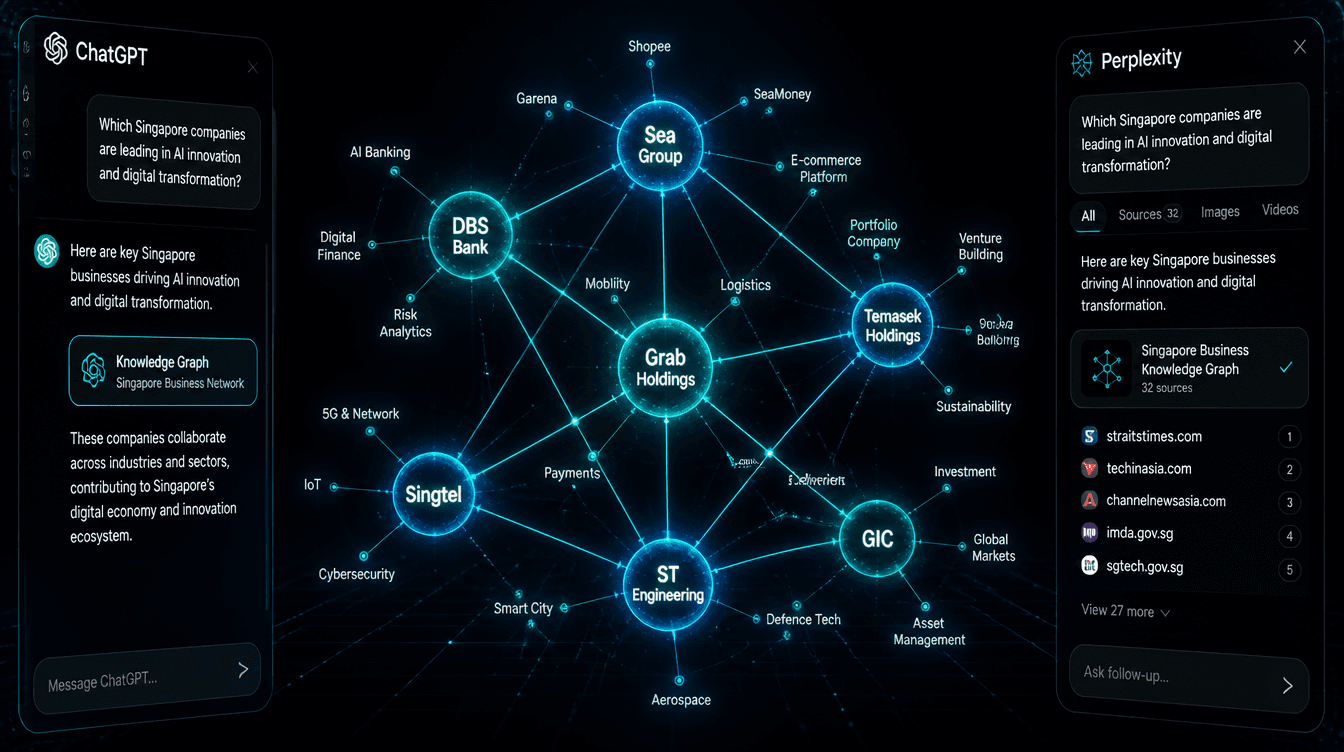
What GEO Is: And Why It Is the Most Important New Channel Singapore Businesses Are Missing
GEO, or Generative Engine Optimization, is the practice of structuring your content, your brand signals, and your technical infrastructure so that large language model-powered search engines (ChatGPT, Perplexity, Google AI Overviews, Microsoft Copilot) select your business as a cited source when answering user queries. It is distinct from traditional SEO in one critical way: the goal is not to rank on page one, it is to be named in the answer itself.
The distinction matters enormously for Singapore SMEs. When a prospective client in Singapore types "which HR consultant in Singapore should I hire for MOM compliance" into Perplexity, they do not see ten blue links. They see a synthesized paragraph, and in that paragraph, two or three businesses are named as credible sources. If your business is not one of them, you do not exist in that search. There is no page two.
The research backing this up is substantial. A 2024 study by Aggarwal et al. at Princeton, published at KDD 2024 and titled "Generative Engine Optimization," tested ten optimization methods across 10,000 queries run through ChatGPT, Perplexity, and Google AI Overviews. Their core finding: specific structural and content choices increase AI citation rates dramatically. Adding authoritative citations increased visibility by 40 percent. Adding statistics with source attribution increased visibility by 35 percent. Including expert quotations increased visibility by 20 percent. Optimizing for fluency increased visibility by 15 percent. These are not marginal gains. They are the difference between existing in AI search and being invisible.
For Singapore businesses, the urgency is compounded by a local reality: IMDA's 2024 Digital Economy Report found that AI-assisted search is now the starting point for purchasing research among Singapore professionals under 45. Yet the volume of AI-optimized, Singapore-specific business content is still remarkably thin. Most of what exists for queries like "GEO agency Singapore" or "AI search visibility Singapore" is generic, lightly-localised content repurposed from US or UK sources. The businesses that build authoritative, fact-dense, properly structured content about Singapore's business landscape in the next twelve months will hold AI citation authority for years.
This is not a theoretical opportunity. I run Singapore's only AI-native SEO and AEO service, and the difference in AI citation rates between optimized and unoptimized content from Singapore clients is already measurable and significant.
How ChatGPT, Perplexity, and Google AI Overviews Actually Select Their Sources
AI search engines cite your content when they can verify that it is authoritative, structured for extraction, and consistent with what other credible sources say. The selection process is not a black box. It follows identifiable patterns that you can engineer for.
Perplexity works by running a real-time web search, retrieving the top results, and using those retrieved pages as the grounding context for its language model. It then synthesizes an answer and cites the pages it drew from. This means Perplexity's citation logic is partly traditional SEO (you need to rank high enough to be retrieved) and partly content structure (once retrieved, your content needs to be the most extractable and authoritative in the set). If your page ranks fifth but has the clearest, most statistics-backed answer to the query, Perplexity is more likely to cite you than the page ranked first with a vague, hedged response.
ChatGPT with web browsing enabled operates similarly. It retrieves pages, reads them, and cites the ones whose content is most directly responsive to the query. ChatGPT without web browsing draws from its training data, which means citation in that mode is about having content that was well-represented in its training corpus, typically meaning content that was widely linked, cited by other authoritative sources, and structured in ways that made it easy for the model to learn and recall.
Google AI Overviews uses Google's own index and applies its E-E-A-T (Experience, Expertise, Authoritativeness, Trustworthiness) framework on top of it. According to Google Search Central documentation, AI Overviews preferentially cite pages that demonstrate first-hand experience, carry strong topical authority signals, and have clear structured data markup. For Singapore businesses, this means your Google Business Profile, your Schema.org markup, and your content demonstrating real client outcomes all feed directly into your probability of appearing in AI Overviews.
There are three common characteristics across all three platforms. First, they prefer content that answers a specific question clearly in the first 100-150 words. This is what the Princeton research calls "answer-first structure." Second, they prefer content that cites other authoritative sources rather than making unsupported assertions. Third, they prefer content from entities that are consistently represented across multiple authoritative platforms: government databases, professional directories, news citations, academic references.
Understanding this selection logic is the foundation of a GEO strategy. Everything else (the technical implementation, the content structure, the entity building) is in service of making your content maximally citable by these three systems.
The 47 GEO Methods: And the 5 That Matter Most for Singapore SMEs
The Princeton KDD 2024 study catalogued 47 distinct GEO optimization methods across categories including content structure, authority signals, citation patterns, statistical density, entity clarity, and technical accessibility. For most Singapore SMEs working with limited content budgets and small teams, implementing all 47 would be neither practical nor necessary.
The five methods with the highest impact-to-effort ratio for Singapore businesses are:
1. Answer-First Structure
Every piece of content you publish for GEO should lead with the direct answer to the question it is addressing, before any preamble, context, or background. AI engines extract the most cited passage from your content in the first screen of text. If your first 150 words are an introduction to why the topic matters, the AI extracts nothing citable. If your first 150 words contain the direct answer, the AI extracts that.
This requires a structural rewrite of most business blog content. The typical Singapore business blog post opens with a paragraph about the industry landscape, then explains what the article will cover, then eventually gets to the actual answer at the end of section three. GEO-optimized content inverts this. The answer comes first. The context, reasoning, and supporting evidence follow.
A concrete example: if you are writing about PSG grant eligibility for AI tools, your GEO-optimized opening sentence is "Singapore SMEs with at least 30 percent local shareholding and annual sales turnover under S$100 million are eligible for PSG grants covering pre-approved AI tools, with co-funding of up to 50 percent." Everything else in the article elaborates on that core statement.
2. Statistics With Source Attribution
The Princeton study found that adding cited statistics increased AI citation rates by 35 percent, the second-highest individual method tested. The mechanism is clear: AI engines are calibrated to prefer factual claims that can be verified. When you write "AI adoption among Singapore SMEs has increased significantly," no AI engine can verify that or confidently cite it. When you write "According to IMDA's SME Digital Economy Survey 2024, 67 percent of Singapore SMEs have adopted at least one AI tool, up from 43 percent in 2022," every AI engine can verify the claim, trace it to a credible source, and cite your content as the synthesizer of that data.
For Singapore businesses, the authoritative local data sources to draw from include: IMDA's annual Digital Economy Reports, EnterpriseSG's SME landscape data, Ministry of Manpower's employment and workforce statistics, Singapore Department of Statistics releases, and government agency press releases. Content that synthesizes these sources and makes them accessible to a business audience is precisely the type of content AI engines are built to surface.
3. Cite Authoritative External Sources
The Princeton study's highest-impact single method was adding outbound citations, which increased AI visibility by 40 percent. This runs counter to the instinct of many Singapore business owners who believe linking out to competitors or external sites "leaks" authority. In GEO, the opposite is true: your willingness to cite credible sources signals to AI engines that your content is grounded in evidence rather than opinion.
Practical implementation: every H2 section of your GEO-optimized content should contain at least one cited reference to a primary source. For Singapore business content, primary sources include government data portals (data.gov.sg), IMDA publications, EnterpriseSG grant frameworks, Singapore court decisions for legal content, MAS circulars for financial content, and MOH guidelines for healthcare content. Academic citations from NUS, NTU, SMU, or SUTD research carry additional weight.
4. Expert Quotations With Full Attribution
AI engines treat quoted statements from named experts differently from paraphrased claims. A quote from "Dr. Jane Lim, Chief Digital Officer at EnterpriseSG, speaking at the IMDA Digital Leaders Summit 2024" carries a completely different authority signal than "industry experts have noted." The quote is attributed, traceable, and verifiable. The paraphrase is not.
For Singapore businesses, this means actively collecting and publishing quoted statements from: your own leadership (establishing your brand voice as an expert voice), credible external figures in your industry, government officials where appropriate, and your clients (with permission) speaking to measurable outcomes from your work. Named testimonials with specific outcomes ("We reduced our MOM compliance processing time by 40 percent in three months using Dr. Tung's AI workflow framework, Jenny Tan, HR Director, Sim Lim Manufacturing") are citable in a way that anonymous social proof is not.
5. Entity Clarity Through Schema Markup
AI engines build a model of what your business is and what it knows before they decide whether to cite it. This model is built from structured data signals: your Schema.org markup, your Google Business Profile, your Wikidata entry, your presence in authoritative directories, and the consistency of your Name-Address-Phone (NAP) data across all platforms.
For Singapore SMEs, the minimum viable entity clarity package is: Organization schema with complete details including sameAs references to your LinkedIn company page, Acra business registration reference, and professional body memberships; LocalBusiness schema with accurate address and contact details matching your Google Business Profile; Person schema for any individual experts who serve as named authors; and FAQPage schema on all content pages that contain question-answer pairs. We will cover technical implementation in more depth in the Technical GEO section.
The remaining 42 methods in the Princeton study are variations on these five themes or apply to specific content types. Methods like "fluency optimization" (improving readability score), "keyword augmentation" (incorporating natural language variations of key phrases), and "domain authority building" (traditional link acquisition) remain relevant but produce smaller marginal gains once the top five are implemented.
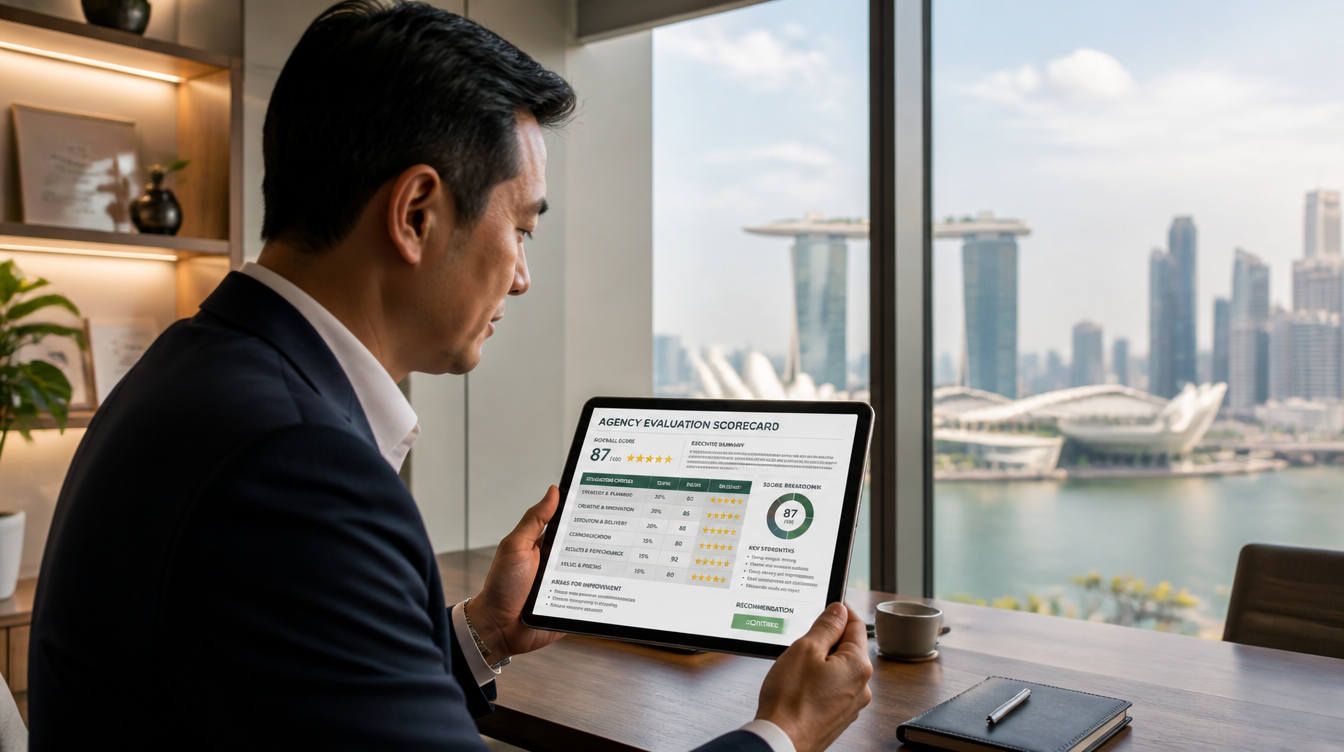
Content Structure for GEO: Answer-First, Cite-Heavy, Fact-Dense
GEO-optimized content has a recognizable structure that differs from traditional SEO content in four specific ways. Understanding these differences allows you to audit and rewrite your existing content systematically, rather than starting from scratch.
The GEO Content Template
Opening passage (150 words maximum): The direct answer to the title question. No preamble. No "in this article, we will explore." The answer, stated clearly, with the single most important statistic or fact that supports it.
Evidence section: The data, studies, case studies, and expert quotations that support the opening answer. Each claim cited. Each statistic attributed to a primary source. This section can be as long as the topic requires.
Mechanism section: How the thing works. For a Singapore business audience, this means explaining the "why" behind the answer at a practical level. What specifically causes the outcome? What are the steps? What does the implementation actually look like?
Singapore context section: What makes this topic specific to Singapore? Which Singapore regulations, grant schemes, or market conditions are relevant? This is where IMDA, EnterpriseSG, MOM, and other Singapore-specific references belong.
Common questions section: A formal FAQ block with Schema.org FAQPage markup, covering the questions that AI engines see most frequently alongside your primary topic.
This structure does two things simultaneously: it optimizes for human readers (who want direct, practical answers) and it optimizes for AI extraction (which works best when the answer, the evidence, and the context are clearly delineated).
Content Depth and Word Count
There is a counterintuitive finding in the GEO research: longer content does not automatically outperform shorter content for AI citations. What matters is information density per word, not word count alone. A 1,500-word piece with three cited statistics, two expert quotations, and clear answer-first structure will consistently outperform a 3,500-word piece that buries its key claims in extended prose.
The practical implication for Singapore businesses: audit your existing content not for length but for citability. Ask of each paragraph: "Can an AI engine extract a specific, verifiable claim from this paragraph and cite my content as the source?" If the answer is no, that paragraph needs rewriting regardless of how well-crafted it is from a literary standpoint.
Topic Clustering for GEO Authority
AI engines build topical authority models. A business that publishes twenty pieces of content all about HR compliance for Singapore SMEs will be weighted more heavily as an authority on that topic than a business that publishes one piece on HR compliance and nineteen pieces on other topics.
This means GEO content strategy should be built around topic clusters rather than individual keywords. Pick three to five topics where your business has genuine expertise and published evidence of that expertise. Build a cluster of eight to twelve pieces for each topic, cross-linking them and ensuring each piece cites and references others in the cluster. The AI's model of your business as an authority on those topics will strengthen with each additional piece.
For a GEO agency in Singapore, the relevant topic clusters are: generative engine optimization strategy, AI search visibility measurement, Singapore digital marketing regulations and grant landscape, content structure for AI citation, and technical SEO implementation for AI crawlers. Every piece of content published should fall clearly within one of these clusters.
Technical GEO: llms.txt, AI-Crawler Allowlisting, Speakable Schema
Technical GEO is the infrastructure layer. Without it, the best content in the world may not be accessible to AI engines at all. With it, your content is maximally readable, crawlable, and extractable by every major AI search system.
llms.txt: The New robots.txt for AI
llms.txt is a plaintext file placed at the root of your website (yoursite.com/llms.txt) that provides AI language models with a structured overview of your site's content, its authoritative pages, and the specific expertise your site represents. It was proposed by Answer.AI's Jeremy Howard in 2024 and is now supported by an increasing number of AI crawlers.
A minimal llms.txt for a Singapore GEO agency would look like this:
# Dr Nick Tung: AI and SEO Consultant, Singapore

> GEO, AEO, and SEO strategy for Singapore SMEs. PMC-certified AI consultant (SPMC-10960). 1,000+ SMEs served.

## Core expertise
- Generative Engine Optimization (GEO) for Singapore businesses
- AI Search Readiness scoring and optimization
- SEO and AEO strategy for Singapore SMEs
- PSG-approved AI implementation consultancy

## Key pages
- /seo-aeo-engine: The AI-native SEO service for Singapore businesses
- /articles/geo-agency-singapore-get-cited-by-ai: Definitive GEO guide for Singapore
- /articles/aeo-agency-singapore-vs-seo-agency: AEO vs SEO for Singapore businesses
- /ai-brand-visibility-checker: Free AI search visibility score for Singapore businesses

## Credentials
- PMC-certified (SPMC-10960), Singapore Institute of Management
- 1,000+ Singapore SMEs advised on AI adoption and digital strategy
The llms.txt file is not a ranking factor in the traditional sense. It is a disambiguation tool. When an AI engine is deciding between two similarly authoritative sources, the one with a clear llms.txt that explicitly states its expertise in the relevant domain will have a structural advantage.
AI Crawler Allowlisting in robots.txt
Many Singapore businesses have robots.txt configurations that block AI crawlers, often unintentionally, because their IT providers set up blanket "disallow all bots" rules to reduce server load. This is one of the most common and most damaging technical GEO mistakes.
The AI crawlers you need to explicitly allow in your robots.txt are:
User-agent: anthropic-ai
Disallow:

User-agent: Claude-Web
Disallow:

User-agent: PerplexityBot
Disallow:

User-agent: GPTBot
Disallow:

User-agent: ChatGPT-User
Disallow:

User-agent: Google-Extended
Disallow:

User-agent: cohere-ai
Disallow:

User-agent: Meta-ExternalAgent
Disallow:
Each empty Disallow: line after the User-agent declaration means "allow full access." If your existing robots.txt has a Disallow: / rule for any of these agents, or a catch-all Disallow: / that you have not audited for AI crawler exceptions, you may be invisible to some or all AI search systems.
Speakable Schema Markup
Speakable schema (Schema.org/Speakable) tells AI systems which specific sections of your content are the most important, authoritative statements suitable for direct citation. It is particularly relevant for voice-based AI queries and for structured AI answer generation.
Implementation requires adding a JSON-LD block to your page that identifies the CSS selectors or XPath expressions pointing to your most citable content. For most WordPress or Next.js-based Singapore business websites, the implementation looks like:
{
  "@context": "https://schema.org/",
  "@type": "WebPage",
  "name": "GEO Agency Singapore",
  "speakable": {
    "@type": "SpeakableSpecification",
    "cssSelector": [".article-summary", ".key-findings", "h2 + p"]
  }
}
The cssSelector array points to the HTML elements containing your most authoritative, answer-first content. When AI engines process your page with speakable markup, they know where to look for the most extractable content first.
Core Web Vitals and AI Crawlability
AI crawlers, like traditional search crawlers, penalize slow-loading pages. A page that takes more than three seconds to become interactive will be incompletely indexed or deprioritized by AI crawlers running at scale. For Singapore business websites hosted on shared hosting plans, this is often a silent GEO killer.
Google's Core Web Vitals benchmarks (Largest Contentful Paint under 2.5 seconds, Interaction to Next Paint under 200ms, Cumulative Layout Shift under 0.1) apply to GEO-optimized content as much as to traditional SEO. Run your key content pages through Google PageSpeed Insights and ensure they score above 80 on mobile before investing heavily in content optimization.
Entity Building: How to Make Your Brand Unmistakable to an AI
Entity building is the process of creating a rich, consistent, cross-platform signal about who your business is, what it does, and why it is credible. AI engines use entity signals to decide how confident they are in citing you. A business with strong entity signals (consistent NAP data, Wikidata entry, Wikipedia mentions, news citations, professional body membership verification) will be cited more readily and more prominently than a business with weak entity signals, even if their content is equally well-structured.
The Singapore Entity Building Checklist
Google Business Profile: Complete every field. Add photos monthly. Respond to every review. Use the Products/Services section to list your specific offerings with keyword-rich descriptions. Ensure your business category is accurate, a "Digital Marketing Agency" and a "Marketing Consultant" are different entity types to Google's knowledge graph.
Wikidata: Create or claim a Wikidata entry for your business and for the key individuals in your business who serve as named experts. Wikidata is directly used by Google's Knowledge Graph and is a strong entity authority signal. For a Singapore business, include your ACRA registration number, your founding date, your registered address, and cross-references to your website, LinkedIn company page, and any Wikipedia mentions.
LinkedIn Company Page: Fully complete. Post consistently. Ensure your "About" section uses the same language to describe your business as your website's Organization schema. Consistency of description across platforms is itself an entity signal.
Singapore Business Directories: Ensure consistent NAP data (Name, Address, Phone) across Singapore-specific directories including:
- ACRA BizFile (this is the authoritative source of your legal business identity)
- Enterprise Singapore's directory of SME service providers if applicable
- Your industry professional body's member directory (e.g., Singapore Computer Society, Singapore Management Consultants Association, Institute of Singapore Chartered Accountants)
- Google Maps (separate from Google Business Profile, verify your pin is correctly placed)
News Citations: Being mentioned by name in credible Singapore news sources (The Straits Times, Business Times, CNA, The Business Times, The Edge Singapore) is one of the strongest entity signals available. This does not require a PR agency. Contributing expert commentary to journalists via HARO (Help a Reporter Out) or direct pitching to business journalists on specific topics where you have data or client case studies is accessible to most Singapore SMEs.
Academic and Research Citations: If any of your work, data, or frameworks has been cited in academic papers, industry reports, or government publications, ensure those citations are linkable back to your website. A business cited in an NUS Business School research paper on SME digital transformation carries different entity authority than one that has never been cited in any published research.
Personal Entity Building for Singapore Professionals
For Singapore consultants and professional service providers, personal entity building, building the AI's knowledge graph model of you as an individual expert, is as important as business entity building.
This means: a complete Wikipedia-standard biography on your website, consistent professional credentials cited the same way across all platforms (SPMC-10960 should appear exactly the same way on your LinkedIn, your website, your Google Business Profile, and your published content), published bylined content on authoritative platforms (LinkedIn articles, industry publications, conference presentations with published proceedings), and verified presence on professional credential verification platforms relevant to your field.
For government grant work in Singapore (EDG, CTC, PSG, and the newer IMDA AI grants) entity clarity is particularly critical. Grant assessors now routinely use AI search to verify the credibility of external consultants named in grant applications. A consultant whose entity signals are strong and whose expertise is clearly represented in AI search results has a structural advantage in grant approval processes.
Measuring GEO: How to Track AI Citations and Brand Mentions
GEO measurement is less mature than SEO measurement, but it is not immeasurable. The key is building a systematic testing and monitoring practice rather than waiting for a single-metric dashboard to exist.
Manual AI Citation Testing
The most direct measurement method is manual testing: run structured queries through ChatGPT, Perplexity, and Google AI Overviews monthly, and record whether and how your business is cited. Build a testing spreadsheet with three categories of queries:
Brand queries: "[Your business name] Singapore review," "[Your business name] + service type." These tell you whether AI engines know who you are and represent you accurately.
Category queries: "Best [service type] in Singapore," "Which [service type] Singapore," "[Service type] agency Singapore recommendation." These tell you whether you are being cited as a recommended provider in your category.
Topic queries: Specific questions your target clients ask about your area of expertise. "How does PSG grant work for AI tools in Singapore," "What is GEO and how does it work for Singapore businesses." These tell you whether your content is being cited as an authoritative source on your core topics.
Run each query on the same day each month. Screenshot the responses. Track citations, excerpts, and positioning over time. This is time-consuming but it is currently the most reliable data source for AI citation performance.
Automated Brand Mention Monitoring
Tools including Mention.com, Brand24, and Brandwatch can be configured to alert you when your business name appears in newly indexed web content. While these tools do not directly measure AI citations (they monitor the web sources that AI engines draw from), a significant increase in brand mentions in authoritative web sources is a leading indicator of increasing AI citation rates.
For Singapore businesses, also monitor for citations in the AI engines' cited-sources lists. Perplexity always shows cited sources. When your website URL begins appearing in Perplexity's source lists for category or topic queries you care about, that is direct evidence that your GEO strategy is working.
The AI Brand Visibility Score
At drnicktung.com, I offer a free AI Brand Visibility Checker that runs your business name and category through a structured set of AI queries and returns a scored report on your current AI search presence. This is the fastest way to establish a baseline for Singapore businesses beginning their GEO journey.
The score covers four dimensions: entity recognition (does the AI know who you are?), category authority (are you cited when your service type is queried?), content citability (is your content being used as a source?), and technical accessibility (can AI crawlers properly read and index your content?). Each dimension gives you a specific improvement priority rather than a generic "your score is 43/100" result.
The Singapore-Specific GEO Opportunity: Why Local Businesses Have an Advantage
Singapore has a structural GEO advantage that most Singapore business owners are not yet aware of: the volume of authoritative, AI-optimized, Singapore-specific business content is dramatically below what global AI engines would consider adequate for a market of Singapore's economic sophistication.
When a user in Singapore asks Perplexity "what are the best HR consultants in Singapore for MOM compliance," the AI is working with a thin pool of Singapore-specific, well-structured, credible content. Contrast this with the US market, where the same query for "HR consultants in New York for employment law" returns a rich pool of law firm publications, HR industry association content, academic research, and practitioner-authored guides, all of it well-structured, heavily cited, and updated regularly.
Singapore's business content ecosystem, while growing, is still predominantly generic regional content lightly adapted for Singapore, or highly technical regulatory content from government agencies that is authoritative but not written for AI extraction. The practitioner-authored, evidence-backed, Singapore-specific content that AI engines most want to cite is still largely unwritten.
The First-Mover Advantage Window
Based on the trajectory of AI search adoption and the current state of Singapore business content, the first-mover advantage window for GEO in Singapore's major business categories is approximately twelve to eighteen months. This is not a permanent moat, eventually, every Singapore business consultant and digital marketing agency will optimize for AI citation. But the businesses that establish strong AI citation authority now will benefit from a compounding advantage: AI engines weight consistency and longevity of authority signals, meaning the businesses cited today are more likely to be cited in six months than businesses that start GEO optimization in six months.
Grant Funding for GEO Implementation
Singapore businesses can potentially fund GEO implementation through existing government grant schemes. The Enterprise Development Grant (EDG) covers digital transformation activities including content marketing strategy and website optimization. The Productivity Solutions Grant (PSG) covers pre-approved digital marketing solutions. The Capability Transfer component of the Career Conversion Programme (CCP) can fund the upskilling of marketing staff in AI-powered content creation and optimization.
The key is framing the GEO implementation correctly in grant documentation. "Generative Engine Optimization" as a standalone term is new and may not immediately be recognized by grant assessors. Framing it as "AI-era digital marketing optimization" or "next-generation SEO and content marketing for AI search visibility" within a broader digital marketing capability building proposal is more likely to receive favorable assessment. If you have a specific grant application in mind, I offer advisory support on positioning digital marketing capability building programs for EDG and PSG funding.
For businesses in sectors with dedicated IMDA programs, particularly those participating in IMDA's AI Ignite or GenAI Sandbox programs, GEO implementation can often be framed as part of the AI adoption and measurement activities required under those programs.
Singapore's Multilingual GEO Opportunity
One underexplored GEO opportunity specific to Singapore is multilingual content. Singapore's population communicates primarily in English, Mandarin, Malay, and Tamil, with significant code-switching between them. Most Singapore business websites are English-only. AI engines serving Singapore's multilingual population will surface content in the user's queried language, and in Mandarin, Malay, and Tamil, the pool of credible, AI-optimized Singapore business content is even thinner than in English.
Businesses targeting Singapore's Chinese-speaking business community, which represents the majority of Singapore's SME owner-operators, and publishing credible Mandarin-language content optimized for GEO will face almost no competition for AI citations in that language for the foreseeable future.
Connecting GEO to the SEO and AEO Ecosystem
GEO does not exist in isolation. It works best when layered on top of strong traditional SEO and AEO (Answer Engine Optimization) foundations. The difference between GEO, AEO, and SEO is important for Singapore businesses to understand before allocating budget: SEO gets you ranked, AEO gets you quoted in featured snippets and knowledge panels, GEO gets you cited by the AI itself.
The optimal sequence for most Singapore SMEs is: fix foundational SEO (technical health, on-page optimization, Google Business Profile) first, then implement AEO (structured data, FAQ schema, featured snippet optimization), then layer GEO (llms.txt, AI crawler access, answer-first content rewrites, entity building). Businesses that skip the SEO and AEO foundations and go directly to GEO will find their GEO efforts underperforming because AI engines, particularly Perplexity and Google AI Overviews, still use traditional ranking signals as an initial filter before applying GEO-specific selection criteria.
If you want to understand what makes an effective SEO agency in Singapore in 2026, the answer increasingly includes GEO capability, and the agencies that cannot demonstrate AI citation results for their clients will face growing pressure to explain what exactly they are delivering.
The integrated picture: a Singapore business with strong traditional SEO, well-implemented AEO, and a GEO content program running for six to twelve months will have citation presence across Google Search, Google AI Overviews, Perplexity, ChatGPT, and Microsoft Copilot simultaneously, the five surfaces that now represent the majority of how Singapore's professional and business audience discovers service providers. That is the standard a serious GEO agency in Singapore should be building toward, and it is the standard I hold my own clients to.
Common questions
What exactly is a GEO agency and how does it differ from a traditional SEO agency? A GEO agency specializes in Generative Engine Optimization (getting your business cited by AI search engines like ChatGPT, Perplexity, and Google AI Overviews) rather than just getting you ranked in traditional Google Search results. Traditional SEO focuses on ranking position on a results page; GEO focuses on being named in the AI's synthesized answer itself. In Singapore's current digital landscape, a credible digital marketing agency should offer both, since AI search and traditional search serve different but overlapping parts of the buyer journey.
How long does it take to see results from a GEO strategy in Singapore? Most Singapore businesses see measurable improvement in AI citation rates within three to six months of implementing GEO-optimized content, proper entity signals, and AI crawler access. The fastest gains come from fixing technical access issues (robots.txt blocking AI crawlers) which can show results within weeks once AI crawlers re-index your content. The slower-building gains come from entity authority, which compounds over six to twelve months as your content accumulates citations and your brand signals strengthen across platforms.
Does GEO replace SEO, or do I need both? You need both, and the sequence matters. SEO provides the foundation, technical site health, indexation, and Google rankings that give AI engines the initial signal that your content is worth reading. GEO then optimizes what happens after the AI reads your content, making it more likely to cite you rather than a competitor. A GEO strategy built on a weak SEO foundation will underperform, because AI engines like Perplexity and Google AI Overviews still use traditional ranking as an initial filter before applying GEO selection criteria.
What Singapore government grants can help fund GEO implementation? Enterprise Singapore's PSG and EDG stopped taking new applications on 29 September 2026. New applications now go through the EDGE Grant. The Enterprise Development Grant (EDG) covers digital transformation activities that can include content marketing strategy and website optimization for AI search. The Productivity Solutions Grant (PSG) covers pre-approved digital marketing solutions. Framing your GEO program as "AI-era digital marketing optimization" or "next-generation content marketing for AI search visibility" within a broader digital capability building proposal improves grant assessment outcomes. I provide advisory support on positioning GEO programs for grant eligibility, contact me at drnicktung.com for a consultation.
What is llms.txt and does my Singapore business website need one? llms.txt is a plaintext file placed at your website's root (yoursite.com/llms.txt) that provides AI language models with a structured overview of your business, your expertise, and your key content pages. It functions as a disambiguation tool that helps AI engines correctly identify your business and its domain of authority. Any Singapore business investing in GEO should have a basic llms.txt. It takes less than an hour to implement and removes a potential source of AI engine confusion about what your business does and knows.
How do I know if an AI engine is already citing my business? Run structured manual tests: type "[your business name] Singapore [service category]" and "best [service type] Singapore" into ChatGPT with web browsing, Perplexity, and Google AI Overviews, and record whether your business appears in the answers. Use the free AI Brand Visibility Checker at drnicktung.com for a systematic baseline score. Set up Google Alerts for your business name to track new web mentions that feed AI training and retrieval systems.
Is GEO relevant for small Singapore SMEs, or only for larger businesses? GEO is arguably more immediately valuable for small Singapore SMEs than for large businesses. Large enterprises already have strong entity signals by virtue of their size and media presence, their GEO advantage comes naturally. Small SMEs with zero AI citation presence in a specific local niche (say, a Tampines-based accounting firm specializing in GST compliance for F&B businesses) can achieve AI citation dominance in that niche relatively quickly with focused content and entity building, because the competition for AI citations in hyper-local Singapore niches is still minimal.
What is the difference between GEO, AEO, and SEO for Singapore businesses? SEO (Search Engine Optimization) gets you ranked in traditional Google Search results, the ten blue links on a results page. AEO (Answer Engine Optimization) gets you featured in direct answers (Google's featured snippets, knowledge panels, and "People Also Ask" boxes) without a user having to click. GEO (Generative Engine Optimization) gets you cited by AI engines (ChatGPT, Perplexity, Google AI Overviews) when they synthesize answers to user queries. All three are now necessary for comprehensive digital visibility in Singapore. The optimal investment sequence is SEO foundation first, AEO second, GEO third.
How does Nick Tung's GEO service work for Singapore businesses? My GEO service begins with an AI Brand Visibility Audit that establishes your current citation rate across ChatGPT, Perplexity, and Google AI Overviews. From there, I develop a tailored GEO content program (typically eight to twelve pieces of answer-first, citation-heavy content targeting your highest-value queries) plus technical implementation covering llms.txt, AI crawler access, and entity schema markup. Monthly measurement reports track citation rate improvements against baseline. Most Singapore SME clients are on monthly retainers ranging from S$600 to S$2,400 depending on content volume and the competitiveness of their target queries. Visit /seo-aeo-engine to book a free AI visibility assessment.
Stay sharp
The weekly Singapore grant playbook.
Operator-grade pieces on EDGE, CTC and the rest of the stack, straight to your inbox once a week. No spam, no upsell.
One email a week. Unsubscribe in one click.
Keep reading
How to Choose an SEO/AEO/GEO Agency in Singapore: The 2026 Buyer's Guide
Choosing a digital agency in Singapore in 2026 means evaluating SEO, AEO, and GEO capabilities. Here is the honest buyer's guide that saves you from expensive mistakes.
20 min read
SEOWhat Is an SEO Agency in Singapore Actually Doing in 2026?
SEO agencies in Singapore have changed completely in 2026. Here is what a modern agency actually does for your business - and why most still get it wrong.
18 min read
AEOAEO Agency Singapore: What They Do That a Regular SEO Agency Cannot
AEO (Answer Engine Optimization) agencies in Singapore do something traditional SEO agencies cannot: they make your content the source AI cites.
17 min read