AI Business Consultant Singapore: What They Do, What to Pay + How to Hire Right (2026)
What an AI business consultant actually does, how they differ from AI agencies, and how EDGE and CTC grants can fund part of the engagement.
Nick Tung
@nick_tung_ · 13 min read
Published:
Updated:
Update, 25 September 2026: PSG, EDG and MRA take new applications until 29 September 2026. From 30 September 2026, new projects apply under Enterprise Singapore's EDGE grant. Applications submitted before 30 September are still assessed under the old scheme's rules, so where this article describes PSG, EDG or MRA, read it as how those schemes worked. Per Enterprise Singapore's release of 9 September 2026, EDGE supports SMEs at up to 50% on most activities and up to 70% on internationalisation and sustainability, within a S$100,000 grant cap per company per year. Eligibility is decided by Enterprise Singapore.
An AI business consultant helps companies identify where artificial intelligence can reduce costs, speed up operations, or open new revenue lines, then builds and deploys those solutions, not just advises on them.
That last part matters. There are a lot of people calling themselves AI consultants in Singapore right now. Most of them will give you a 40-slide deck and a roadmap. A real AI business consultant leaves you with working software.
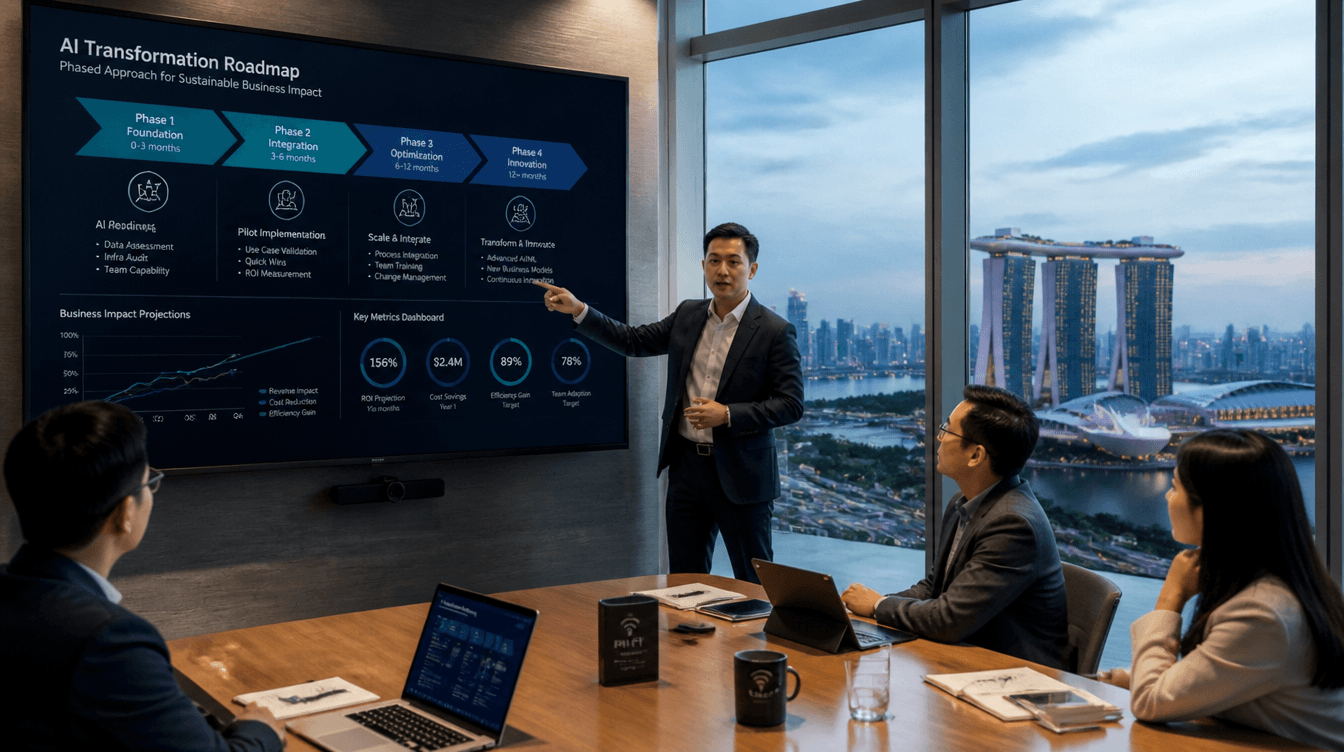
What does an AI business consultant actually do?
The job has five core deliverables:
1. Diagnostic audit. Before writing a line of code, a good consultant maps your current workflows and identifies where AI creates the most value, not where it's most impressive. The audit produces a ranked shortlist: two or three high-ROI use cases, estimated effort, and honest risk.
2. Technology selection. There are dozens of AI tools and platforms competing for your budget. The consultant's job is to match the right tool to your specific constraint, whether that's data privacy, budget, team capability, or existing software stack. In Singapore, this often involves assessing whether a solution qualifies for PSG or EDG co-funding before committing to a vendor.
3. Solution design and build. This is where the line between consultant and advisor becomes clear. A proper AI business consultant writes specifications, oversees development, and in many cases builds directly. The output is production-ready software (integrated with your CRM, ERP, or website) not a proof-of-concept demo.
4. Staff enablement. Adoption kills more AI projects than bad technology does. A consultant designs the change management plan, runs training sessions, and builds internal playbooks so your team can operate the system without external support.
5. Measurement and iteration. The engagement doesn't end at go-live. A consultant sets KPIs before deployment (cost per ticket resolved, lead qualification time, document processing accuracy) and reviews them at 30, 60, and 90 days. If something isn't working, they fix it, not blame the data.
AI business consultant vs AI agency: the critical difference
This distinction matters before you sign anything.
An AI agency executes campaigns and content. They automate your social posts, run AI-generated ad copy, build chatbots for lead capture. Good for marketing execution. Not the right hire if your problem is operations, finance, or core product.
An AI business consultant diagnoses the business problem first, then determines whether AI is even the right solution. Sometimes it isn't. A consultant who tells you AI won't help with a specific workflow is doing their job. An agency that says AI can solve everything is selling you something.
The test: ask them what they'd do if AI wasn't the answer. If they can't give you a clear response, you're talking to a solution looking for a problem.
For most Singapore SMEs, you need a consultant (someone who understands your P&L, your team's skill level, and the grant landscape) before you need an agency.
AI business consultant vs general management consultant
Traditional management consultants are trained in strategy, restructuring, and process design. That's valuable. But AI implementation requires a different muscle: the ability to translate a business problem into a technical specification, assess whether the data exists to train a model, and ship code that actually works in a live production environment.
A general management consultant will often subcontract the technical work. That adds cost, communication overhead, and a layer of abstraction between the business problem and the solution. When something breaks six months after go-live, you're chasing two separate vendors.
The strongest AI business consultants in Singapore sit at the intersection: they can run a board-level strategy conversation in the morning and review a pull request in the afternoon. That's not common, which is why you should ask to see live builds before signing.
Why PMC certification matters for grant access in Singapore
This is specific to Singapore and most business owners don't know it.
Management consultants working on government-supported projects, particularly EDG (Enterprise Development Grant) engagements, are generally required to hold the Practising Management Consultant (PMC) certification, administered by the Singapore Business Advisors and Consultants Council (SBACC) and recognised by EnterpriseSG.
The PMC designation means the consultant has passed a structured competency assessment covering business analysis, project management, and professional ethics. It's not a self-awarded title and it's not just a course certificate. It requires peer review, a client case submission, and ongoing CPD.
What this means for you: if you're funding an AI consulting engagement through EDG, your consultant likely needs to be PMC-certified for the engagement to qualify. An uncertified consultant delivering an EDG-funded engagement creates compliance risk.
I hold SPMC-10960. EDG applications submitted by 29 September 2026 need a certified management consultant for consultancy costs to qualify. From 30 September 2026, new applications go through Enterprise Singapore's EDGE Grant, one activity at a time.
If a consultant can't tell you their PMC number when you ask, check whether your EDG application will hold up.
What a good AI consulting engagement looks like: from scoping to delivery
A well-run engagement has a clear structure. Here's what it should look like:
Week 1 to 2: Discovery. Structured interviews with department heads, review of existing data, systems, and workflows. No solutions at this stage. Just listening and mapping.
Week 3: Diagnostic report. A ranked list of AI opportunities with estimated ROI, implementation complexity, and a clear recommendation on where to start. This is the deliverable that tells you whether the consultant understands your business, not a generic "AI transformation framework."
Week 4-8: Build phase. For a typical first AI deployment (a document processing tool, an internal knowledge base, a customer-facing chatbot) eight weeks from spec to launch is realistic. Longer timelines usually mean scope has grown without budget approval.
Week 9 to 12: Stabilisation. The first 30 days post-launch are critical. Real users find edge cases no one planned for. The consultant should be available and accountable during this period, not on to the next client.
Ongoing: Review and expand. Quarterly reviews tied to the KPIs set in week one. If the first use case worked, the second is faster and cheaper.
How PSG, EDG, and CTC fund AI consulting in Singapore
Singapore has three main grant programmes relevant to AI consulting engagements:
Productivity Solutions Grant (PSG), co-funds pre-approved AI tools and software solutions. Funding is up to 50% of qualifying costs (as of 2026). The fastest route to funding: if your AI solution is on the approved vendor list, the grant process is relatively straightforward. Check the Business Grants Portal for the current list of pre-approved solutions.
Enterprise Development Grant (EDG), co-funds consultancy, capability building, and technology adoption. Up to 50% of qualifying project costs, with higher support rates available for certain categories. EDG is the right grant for a full AI transformation engagement where a PMC-certified consultant is scoping and delivering custom work. Administered by EnterpriseSG.
Career Conversion Programme (CCP) / SkillsFuture for Enterprise, funded by Workforce Singapore and SkillsFuture Singapore, this covers training and reskilling costs when you're deploying AI that changes how roles work. If your AI deployment means some employees need to upskill (from manual data entry to AI system management, for example), this is the relevant programme.
A few points worth knowing:
- Grants are co-funding, not full funding. You still pay the remaining percentage and claim reimbursement.
- You need to apply before the project starts, retrospective grants are not available.
- The IMDA Digital Leaders programme offers enhanced support for specific AI deployments. Worth checking if your project qualifies.
Stacking grants is possible, PSG for software plus EDG for consultancy, for example. A consultant who knows the grant system will help you structure the engagement to maximise eligible costs.
What to pay for an AI business consultant in Singapore
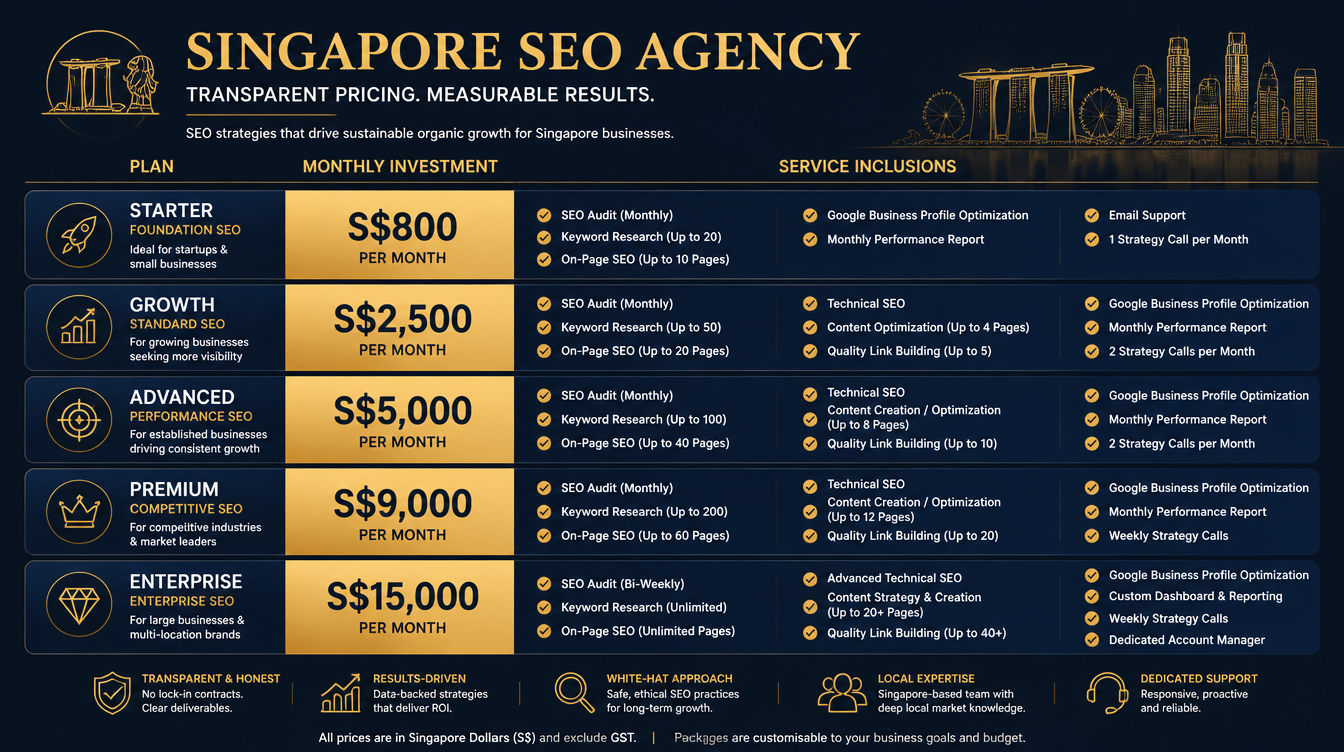
Daily rates for senior AI consultants in Singapore typically run between S$1,200 and S$3,500 per day, depending on depth of technical expertise, track record, and whether the work is strategy-only or includes implementation.
Monthly retainer structures are common but can obscure value. You're paying for time, not outcomes. I recommend structuring engagements around deliverables: a diagnostic report at a fixed fee, a build phase at a capped project price, a stabilisation period at a monthly rate.
For a full breakdown of what to expect at different project sizes and engagement types, see the AI consultant fees guide for Singapore (2026).
One honest note: the cheapest option is rarely the cheapest outcome. A S$5,000 diagnostic that identifies S$200,000 in annual savings is a better investment than a free strategy call that leads to a S$80,000 technology project that doesn't work.
5 red flags when hiring an AI business consultant
1. No PMC certification. If the work touches an EDG-funded engagement, this isn't just a credential question. It's a compliance question. Ask for the PMC number.
2. They quote ROI before scoping. "We typically deliver 300% ROI" before they've seen your data, your team, or your workflow is a sales pitch, not a professional assessment. Genuine consultants don't promise outcomes they haven't diagnosed.
3. Strategy only, no delivery. A consultant who produces reports but can't show you live systems they've built is a deck seller. Ask to see three production AI deployments with real client names you can call.
4. Offshore delivery team with a local face. Nothing wrong with international teams in principle, but if the Singapore-based consultant is just a salesperson and the actual work is done offshore without your knowledge, the accountability chain breaks. Who do you call when something breaks at 10pm?
5. Can't explain it to a non-technical audience. If a consultant can't explain how their AI solution works (without jargon, in plain terms) to your operations manager or finance director, they're not going to be able to drive adoption in your business.
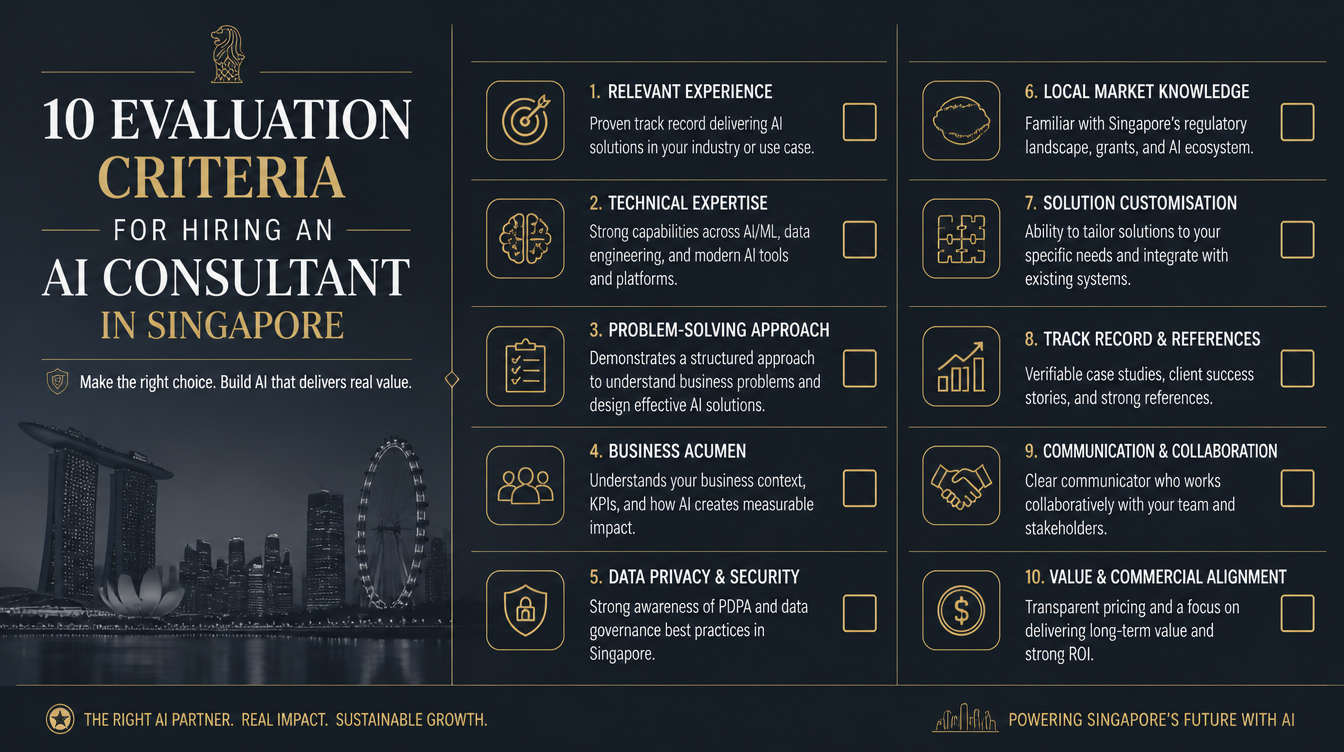
5 questions to ask before signing with an AI business consultant
Before committing to any engagement, get clear answers to these:
1. Can I see three live builds you've shipped for clients similar to my size and industry? The work should be in production, not in a demo environment. Ask if you can contact the client directly.
2. Are you PMC-certified, and can you support EDG grant applications? If they hesitate or can't give you their PMC number, you have your answer.
3. How do you price engagements, by time or by deliverable? Deliverable-based pricing aligns incentives. Time-based pricing means they're incentivised to take longer.
4. What does your post-launch support look like? Get the specifics. Is there a stabilisation period built in? What's the SLA if something breaks? Who holds the IP?
5. What happens if AI turns out not to be the right solution for this problem? A good consultant should be able to tell you when they'd recommend a non-AI solution. If they can't, they're selling AI regardless of whether it fits.
If you want to explore working together, the best starting point is a diagnostic consultation. It's structured, time-bounded, and produces a concrete output, a ranked shortlist of AI opportunities and an honest assessment of whether there's a business case to pursue.
Common questions
What is an AI business consultant? An AI business consultant is a specialist who helps companies identify where artificial intelligence can create business value, then designs and deploys the solution. The key distinction from a general management consultant is hands-on implementation: a genuine AI business consultant leaves you with working software, not just a strategy document.
How is an AI business consultant different from an AI agency? An AI agency typically executes marketing and content operations using AI tools, chatbots for lead capture, AI-generated ad copy, automated social content. An AI business consultant focuses on business process: operations, finance, customer service, and product. The consultant diagnoses the problem first; the agency implements a solution you've already decided on. Most businesses need a consultant before they need an agency.
Do I need a PMC-certified consultant for EDG grants in Singapore? EDG stopped taking new applications on 29 September 2026. New applications now go through the EDGE Grant. For EDG-funded consultancy engagements, EnterpriseSG generally requires that the consultant holds the Practising Management Consultant (PMC) certification, issued by the Singapore Business Advisors and Consultants Council (SBACC). If your consultant cannot provide a PMC number, your EDG application may face compliance issues. Always verify before signing.
How much does an AI business consultant cost in Singapore? Senior AI consultants in Singapore typically charge between S$1,200 and S$3,500 per day, depending on experience, technical depth, and scope. Full transformation engagements (diagnostic + build + stabilisation) commonly range from S$15,000 to S$80,000 depending on complexity. See the full fee guide for a detailed breakdown.
What grants can fund AI consulting in Singapore? Enterprise Singapore's PSG and EDG stopped taking new applications on 29 September 2026. New applications now go through the EDGE Grant. The three main programmes are the Productivity Solutions Grant (PSG, up to 50% co-funding for pre-approved tools), the Enterprise Development Grant (EDG, up to 50% for consultancy and custom builds), and SkillsFuture-funded Career Conversion Programmes for staff reskilling. Grants must be applied for before the project begins. Stacking PSG and EDG on the same project is possible when the scope is structured correctly.
How long does an AI consulting engagement take? A typical first AI deployment, from diagnostic to go-live, takes 10 to 14 weeks for a focused use case (document processing, internal knowledge base, customer chatbot). Larger transformation programmes with multiple use cases run 6 to 12 months. Anything shorter than 6 weeks from scoping to launch is worth scrutinising: either the scope is very small or corners are being cut.
What industries in Singapore benefit most from AI consulting? In Singapore, the highest-density demand for AI consulting is in professional services (law, accounting, HR), logistics and supply chain, construction and engineering, healthcare administration, and financial services. That said, the question isn't industry. It's whether you have a high-volume, repetitive, data-generating process. If you do, there's almost always an AI application worth exploring.
How do I know if my AI consultant is actually building or just reselling tools? Ask to see the code repositories or production deployments they've delivered. A consultant who builds should be able to walk you through the architecture of a past project, how data flows, what the integration points are, what monitoring is in place. If the answer is "we integrate best-in-class platforms" without any underlying custom logic, you're looking at a tools reseller with a consulting label.
Stay sharp
The weekly Singapore grant playbook.
Operator-grade pieces on EDGE, CTC and the rest of the stack, straight to your inbox once a week. No spam, no upsell.
One email a week. Unsubscribe in one click.
Keep reading
AI Consultant Fees in Singapore: The Honest Breakdown for 2026
AI consultant fees in Singapore range from S$3,000 to S$100,000 per engagement. This is the honest breakdown of what each tier delivers and how grants can reduce your cost by up to 50%.
16 min read
AI TransformationWhat Does an AI Consultant Actually Do in Singapore?
An AI consultant in Singapore does far more than recommend ChatGPT. Here is the honest breakdown of deliverables, methodology, and what to expect from an engagement.
19 min read
AI TransformationHow to Hire an AI Consultant in Singapore: The SME Owner's 10-Point Checklist
Hiring an AI consultant in Singapore without a framework is expensive. This 10-point checklist helps Singapore SME owners evaluate, compare, and choose the right AI consultant.
17 min read