How to Hire an AI Consultant in Singapore: The SME Owner's 10-Point Checklist
Hiring an AI consultant in Singapore without a framework is expensive. This 10-point checklist helps Singapore SME owners evaluate, compare, and choose the right AI consultant.
Nick Tung
@nick_tung_ · 17 min read
Published:
Updated:
Update, 25 September 2026: PSG, EDG and MRA take new applications until 29 September 2026. From 30 September 2026, new projects apply under Enterprise Singapore's EDGE grant. Applications submitted before 30 September are still assessed under the old scheme's rules, so where this article describes PSG, EDG or MRA, read it as how those schemes worked. Per Enterprise Singapore's release of 9 September 2026, EDGE supports SMEs at up to 50% on most activities and up to 70% on internationalisation and sustainability, within a S$100,000 grant cap per company per year. Eligibility is decided by Enterprise Singapore.
How to Hire an AI Consultant in Singapore: The SME Owner's 10-Point Checklist
Hiring the wrong AI consultant in Singapore will cost you more than hiring none at all. That is not a cautionary headline. It is the pattern I have watched repeat itself across Singapore SMEs over the past three years: business owners spend S$15,000 to S$50,000 on AI consulting engagements that produce slide decks, vague roadmaps, and one or two tools that nobody uses six months later.
This checklist exists because the market for AI consulting in Singapore has matured faster than the ability to evaluate it. There are now hundreds of individuals and firms offering "AI transformation" services, and very few external signals distinguish a practitioner from a sales professional with a ChatGPT subscription.
I am Dr Nick Tung, SPMC-certified AI consultant (SPMC-10960) and the founder of Freemansland Holdings. I have worked with over 1,000 Singapore SMEs, led AI adoption programmes funded through Enterprise Singapore grants, and built AI workflows that are still running in businesses long after the engagement ended. What follows is the framework I would use if I were a business owner evaluating someone like me.
Use this article before your first discovery call, not after you have already signed a contract.
Why Hiring the Wrong AI Consultant Is Worse Than Hiring None at All
The answer is simple: a failed AI engagement does not just waste money. It poisons the well for AI adoption inside your organisation.
When staff go through an AI implementation that does not stick (where they are trained on tools they do not understand, shown dashboards they were not consulted on, and handed SOPs they had no role in writing) they conclude that AI does not work. Reversing that conclusion is harder than starting from zero. Change management research has consistently shown that failed technology rollouts increase employee resistance to subsequent initiatives, sometimes by years.
The financial dimension is the more visible damage. Singapore SMEs typically run on tighter margins than their regional peers, and a S$20,000 to S$50,000 consulting engagement that produces no measurable business outcome is a serious setback. Worse, if the engagement was funded through an Enterprise Singapore grant such as the Enterprise Development Grant (EDG), a failed project can affect your organisation's eligibility or standing for future grant applications.
The reputational dimension is less visible but equally real. If your competitors implement AI effectively while you recover from a bad engagement, the compounding gap in productivity and cost structure becomes structural. In industries where AI is reducing the labour cost of tasks like quotation generation, customer follow-up, content production, and data analysis by 30 to 60 percent, a six-to-twelve month delay is not neutral. It is a disadvantage that grows over time.
This is why evaluating an AI consultant rigorously before you hire them is one of the highest-ROI decisions you can make as a business owner. The ten-point framework below is designed to help you do exactly that. For more context on what the role actually involves, read what an AI consultant actually does for Singapore businesses.
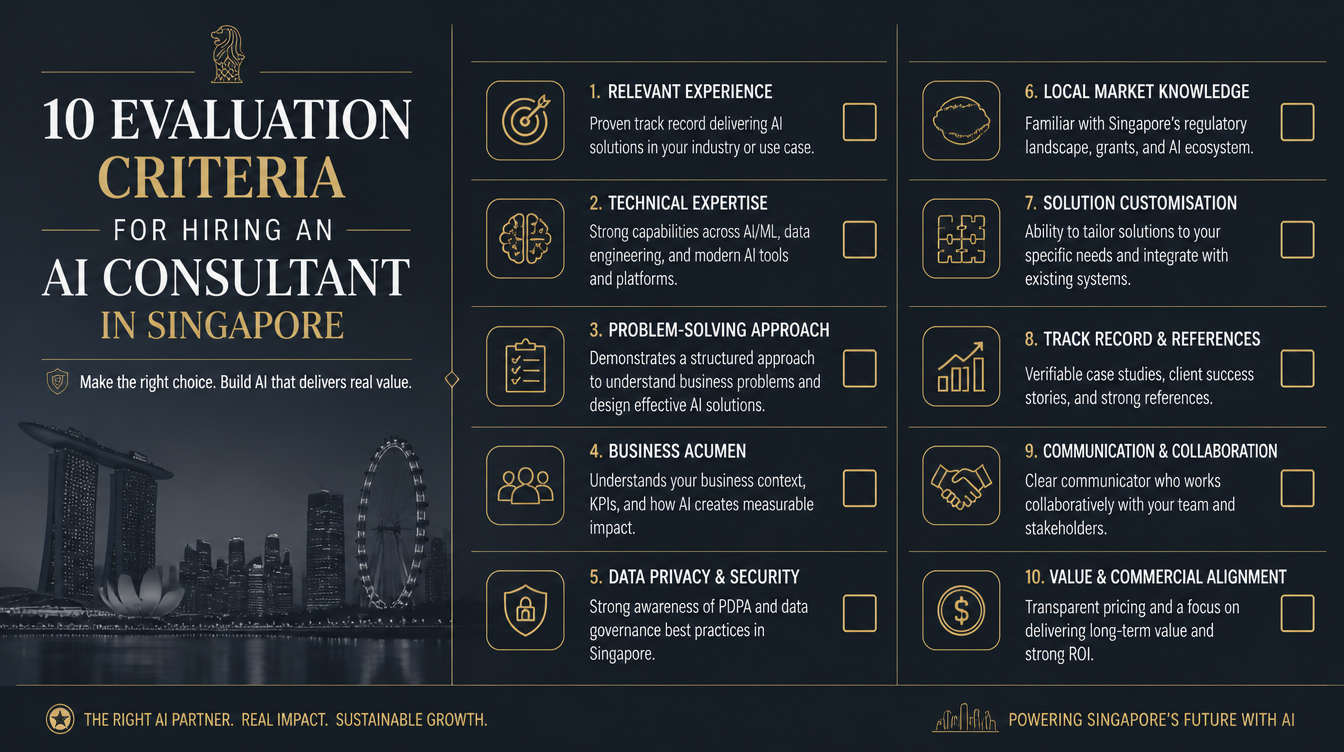
The 10-Point Checklist: Your Framework for Evaluating Any AI Consultant
This is not a scoring rubric. It is a structured set of questions that separates consultants who can deliver from those who can only sell. Work through each point before you commit to an engagement.
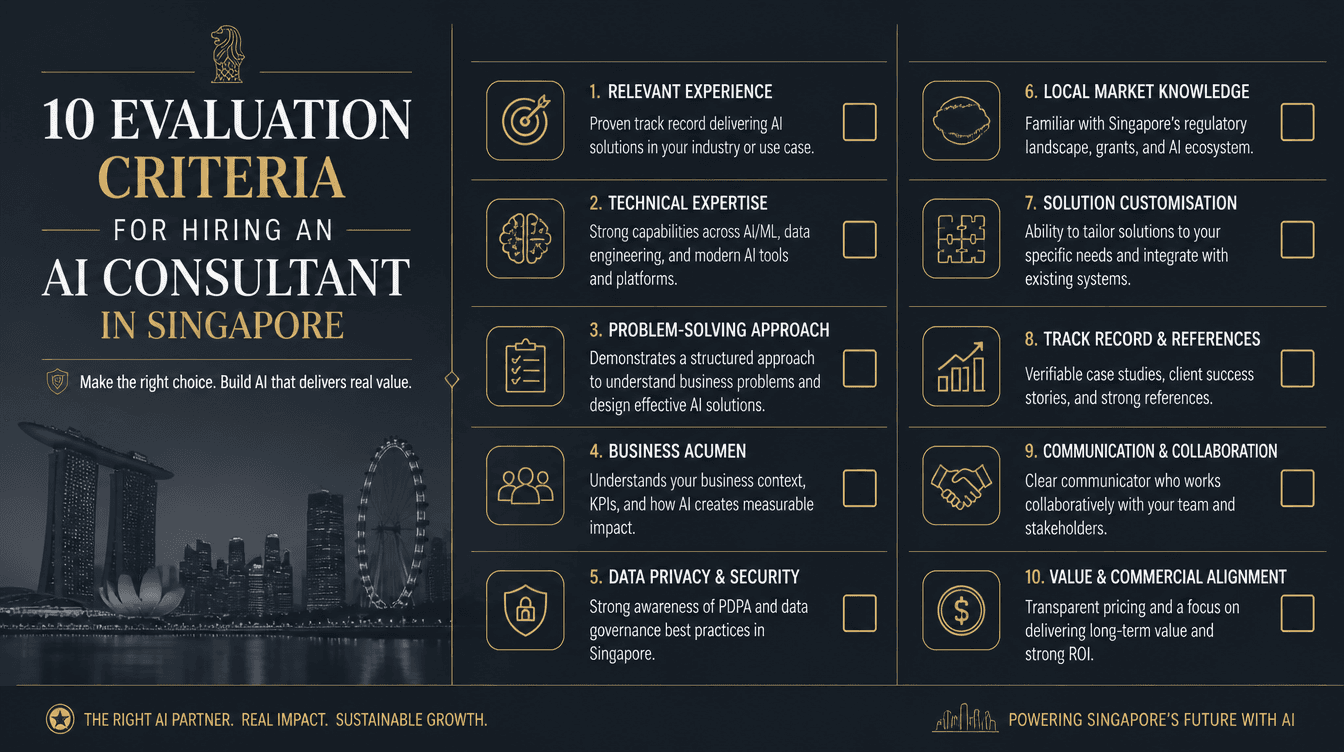
1. Verify PMC Certification
What to check: Is the consultant registered as a Practising Management Consultant (PMC) with the Singapore Business Advisors and Consultants Council (SBACC) or Enterprise Singapore's approved consultant panel?
PMC certification is the single most verifiable credential in Singapore's consulting landscape. It requires demonstrated competency, adherence to a code of ethics, and ongoing professional development. More importantly for you as a business owner, PMC registration is often a prerequisite for accessing Enterprise Singapore grant funding. If you want to use the Enterprise Development Grant (EDG) to subsidise an AI transformation project, which typically covers 50 to 70 percent of qualifying costs for Singapore SMEs, your consultant must be on Enterprise Singapore's qualifying third-party vendor list.
You can verify PMC status directly through the Singapore Business Advisors and Consultants Council (SBACC)'s online directory. Ask any consultant for their PMC number and check it. Do not rely on a logo on their website or a verbal claim. Legitimate PMC-certified consultants will give you their registration number without hesitation, mine is SPMC-10960. The SBACC register lists me under my full legal name, Tung Kai Sheng, and shows PMC-10960, the code I held before my upgrade to Senior PMC, because the register does not display tiers for anyone.
The practical implication is significant: engaging a non-PMC consultant for a project you intend to fund through EDG means those consultancy fees are not claimable. EnterpriseSG's EDG page states no fixed dollar cap, so the stake depends on your project: if the consultant is not certified, their consultancy fee cannot be supported and you pay that part in full. Learn more about how grant-eligible AI consulting works in Singapore in my dedicated guide on PMC-certified AI consulting.
2. Look for a Singapore-Specific Track Record
What to check: Has this consultant delivered AI projects for Singapore businesses, not just international case studies or generic examples?
Singapore's business environment is specific in ways that matter for AI implementation. Labour cost structures are different from Malaysia, Indonesia, or Western markets. The regulatory environment (including PDPA data protection obligations, MOM regulations on workforce change, and the IMDA's AI governance framework) creates compliance considerations that an internationally-focused consultant may not know or flag. The grant landscape is unique and changes regularly.
Beyond regulation, Singapore SMEs have cultural characteristics that affect adoption. Hierarchical decision-making in family businesses, the heavy reliance on foreign workers in sectors like F&B and construction, and the relatively small team sizes in most SMEs all affect how AI workflows need to be designed and how change management must be approached.
Ask the consultant to name the specific sector they have worked in most, and ask what the hardest part of that Singapore-specific work was. A consultant with genuine track record in Singapore will have a specific and detailed answer. A consultant who has done primarily international work or who speaks in generalities about "Southeast Asian markets" has not navigated the specific friction that Singapore SME AI adoption involves.
3. Evaluate Methodology Depth
What to check: Does the consultant follow a defined process, or do they make it up as they go?
The difference between a methodology and an approach is not semantic. A methodology means the consultant has done this enough times to know what works, has built a structured process around it, and can show you what that process looks like before the engagement starts. An approach means they have a general philosophy and will figure it out once they understand your business.
Both have a place, but at an SME scale, with constrained budgets and limited internal bandwidth to manage a consultant, you need someone who can run a proven process without consuming your time in diagnosis. Ask to see their AI readiness framework. Ask how they scope an engagement before they propose a budget. Ask how many similar engagements they have run. A seasoned AI consultant should be able to show you a repeatable discovery-to-implementation arc and tell you which stage most projects get stuck at.
Methodology depth also predicts what happens after the engagement ends. A consultant who uses a defined process will leave documentation, trained workflows, and maintained systems. A consultant who improvises often leaves institutional knowledge that lives only in their head and disappears when the engagement concludes.
4. Check Industry Understanding
What to check: Does the consultant understand the specific AI opportunities and constraints in your industry?
AI implementation in a manufacturing operation looks almost nothing like AI implementation in a professional services firm, which in turn looks nothing like AI in retail or F&B. The data sources are different, the regulatory constraints are different, the bottlenecks are different, and the ROI case is different. A consultant who works primarily in professional services and is being asked to implement AI for a food manufacturer is likely to be learning on your budget.
Ask directly: have they implemented AI in your specific industry or in an adjacent one? Ask what the two or three most common use cases are for AI in your sector, and listen to the answer. A consultant with genuine industry depth will immediately name specific workflow problems, invoice processing for professional services, quality inspection for manufacturing, demand forecasting for retail, not generic answers like "customer service chatbots" and "process automation."
Industry knowledge also matters because the consultant needs to earn the trust of your team. If your production manager or operations director can tell within ten minutes that the consultant does not understand the specific challenges of the factory floor or the clinic reception, the engagement will face internal resistance from day one.
5. Assess Communication Style
What to check: Does this consultant explain AI in business terms, or do they hide behind technical jargon?
This matters more than most business owners realise. If you leave a meeting with an AI consultant feeling slightly confused but vaguely impressed, that is a red flag, not a green one. A consultant who cannot explain AI concepts in plain business language either does not understand the subject well enough to simplify it, or they are using complexity as a sales tool.
Ask a direct test question: "Can you explain how a large language model like ChatGPT works, in terms of what my operations manager needs to understand to use it responsibly?" The answer should be clear, brief, and focused on the business implications rather than the technical architecture. If you get an explanation involving "neural networks," "tokens," and "training data" without a business translation, you are dealing with a technologist who has repositioned as a consultant, not a consulting practitioner.
Communication style also predicts how well the consultant will work with your team. AI adoption requires frontline staff to understand enough about how a tool works to use it accurately and to know when it is wrong. A consultant who cannot explain AI in plain terms to you cannot explain it to your team members either.
6. Confirm Grant Eligibility and Advisory Capability
What to check: Can this consultant help you access EDG, CTC, or PSG grants, not just implement AI?
Enterprise Singapore offers multiple funding schemes that reduce the effective cost of AI transformation for Singapore SMEs. The Enterprise Development Grant (EDG) supports projects that improve business capabilities, including AI-powered workflow transformation. The Company Training Committee (CTC) Grant supports training and upskilling. The Productivity Solutions Grant (PSG) covers specific pre-approved IT solutions.
A consultant who only implements AI without understanding the grant landscape is leaving money on the table, specifically, your money. Depending on the project scope, grant funding can cover 50 to 80 percent of qualifying costs. But grant applications require specific documentation: project scopes written to meet Enterprise Singapore's criteria, cost breakdowns in approved formats, and milestone reporting that aligns with government timelines.
Ask the consultant whether they have helped previous clients prepare grant applications, keeping in mind that under EDGE the application is submitted and managed by your company, not a third party. Ask whether they can help you build the business case in a format that Enterprise Singapore's assessors will find compelling. This is a distinct skill from AI implementation, and a consultant who has done it successfully for other Singapore SMEs can significantly increase both your grant success rate and the amount you recover. For a detailed breakdown of current consulting fee benchmarks, see my guide on AI consultant fees in Singapore for 2026.
7. Understand the Engagement Model
What to check: Is this a project with clear deliverables, a retainer, or an advisory relationship, and which one does your situation actually need?
The engagement model is not a commercial detail. It determines what you get, when you get it, and who is accountable for outcomes. There are three primary models, and they suit different situations.
A project engagement has a defined scope, fixed deliverables, a timeline, and a project fee. It suits situations where you know what you want to build, you want clear accountability, and you want the engagement to have a defined end date. A retainer engagement provides ongoing access to the consultant for a monthly fee, which suits situations where your AI needs are evolving and you need regular strategic input or implementation support without spinning up a new project each time. An advisory engagement provides senior-level input on strategy, decisions, and direction without hands-on implementation. It suits organisations that have internal technical capacity and need experienced guidance rather than execution.
Ask the consultant to explain why they are recommending a specific model for your situation. A consultant who recommends a long retainer for a problem that is clearly a defined project is optimising for their own revenue. A consultant who recommends a one-off project for a problem that clearly requires ongoing iteration is setting you up to fail. The right model should follow from your situation, not from the consultant's preference.
8. Clarify IP Ownership
What to check: Who owns the prompts, frameworks, workflows, and AI configurations built during the engagement?
This is the question most SME owners forget to ask and then regret later. When an AI consultant builds a workflow for your business (a set of prompts, a custom GPT, an automation sequence, a data pipeline) that artefact has value. If the consultant owns it, you are dependent on them to maintain it, update it, and continue accessing it. If you own it, you can hand it to another consultant or an internal team member without losing the work.
Legitimate AI consulting should produce artefacts that belong to the client. Ask explicitly: "Who owns the intellectual property in the AI workflows, prompts, and systems you build during this engagement?" The answer should be unambiguous. If the consultant says something like "we retain the underlying methodology", which is reasonable, follow up by asking what that means in practice if you end the engagement and want to work with someone else.
Also ask about documentation. The value of an AI workflow is halved if it is undocumented, because it becomes dependent on one person knowing how it works. A professional consultant documents their deliverables in a format that a competent non-specialist can follow.
9. Check for Conflicts of Interest
What to check: Is this consultant being paid by any AI platform, software vendor, or technology provider to recommend their products?
Conflicts of interest in AI consulting are more common than they are disclosed. Some consultants have referral arrangements or revenue-sharing agreements with AI tool providers. Some are employees or contractors of technology companies who have positioned themselves as independent advisors. Some receive commissions for recommending specific automation platforms, CRM systems, or AI software licences.
None of this is automatically disqualifying, but it needs to be disclosed. A consultant with a referral arrangement with a particular platform can still give you good advice, but you need to know about the arrangement so you can account for it when evaluating their recommendations.
Ask directly: "Do you have any financial relationships with AI platforms, software vendors, or technology providers whose products you might recommend to me?" A transparent consultant will answer this question directly and explain what their arrangements are. A consultant who deflects or becomes defensive about the question is signalling that the answer is something they prefer not to discuss.
10. Start with a Discovery Audit
What to check: Is the consultant willing to do a structured, paid diagnostic before proposing a full engagement?
This is the most reliable filter of all. A consultant who is confident in their methodology will offer, and charge for, a discovery audit before proposing a full engagement. This is not a free assessment or a sales call disguised as a discovery. It is a structured diagnostic process that produces a written output: an AI readiness assessment, a prioritised list of opportunities, an estimate of ROI, and a clear recommendation on what to do next.
A consultant who moves directly from a sales conversation to a full project proposal without doing proper diagnostic work is guessing at your needs. They may guess correctly, but they are guessing. A structured discovery audit, typically lasting one to two weeks for an SME engagement, means that the subsequent project proposal is grounded in actual analysis of your workflows, your data, your team, and your business goals.
The discovery audit also gives you a low-risk way to evaluate the consultant before a large commitment. If the audit process is structured, the output is clear, and the consultant's thinking is sound, you have strong evidence that the full engagement will be conducted to the same standard. If the audit is vague, late, or unconvincing, you have learned something important at a cost of S$2,000 to S$5,000 rather than S$30,000 to S$80,000.
Explore the range of AI solutions and services that a structured discovery process can unlock for your business.
The Five Questions to Ask in Your First Discovery Call
The discovery call is not a sales meeting. Treat it as a structured interview. These five questions are designed to surface what you need to know before you proceed.
Question 1: What AI projects have you done in Singapore in the last 12 months?
This is the most important question on the list. The answer tells you three things: whether the consultant is active and current (AI moves fast, and a consultant who was last active in the market eighteen months ago may be behind), whether they have worked in Singapore specifically, and whether they have enough client trust to reference specific work.
You are not looking for a detailed case study with client names. Confidentiality is entirely legitimate. You are looking for specificity: industry, problem type, approach used, and result achieved. A confident answer sounds like: "We worked with a mid-size professional services firm in the CBD to build an AI-assisted proposal generation system. We reduced the time from brief to proposal by about 65 percent, and it's still running." A weak answer sounds like: "We've helped many businesses across various industries with their AI journey."
Question 2: How do you handle cases where AI does not deliver the expected result?
This is the question that reveals whether a consultant has done real implementation work. Every AI practitioner with genuine field experience has examples of things that did not work as planned. The expectation gap between what AI tools are marketed to do and what they actually do in a specific business context is one of the defining challenges of real AI consulting.
Listen for whether the consultant talks about specific causes of failure (hallucination in generative tasks, low data quality in prediction models, poor adoption in change-resistant teams) and whether they describe specific mitigation strategies they have used. A consultant who says "we ensure quality at every step" is not answering the question. A consultant who says "we build in a human verification layer for any AI output that affects customers or financials, and we hold a week-two review specifically to catch the things that are not working" is answering the question.
Question 3: What is your approach to staff buy-in and change management?
AI does not fail because the technology does not work. It fails because the people who are supposed to use it do not change how they work. This is the most consistently underestimated factor in AI adoption across Singapore SMEs, and it is the area where most junior consultants have the least experience.
Ask specifically: at what point in the engagement do you start involving the employees who will use the system? How do you handle resistance from team members who feel the AI is replacing their role? What have you seen work in Singapore workplaces specifically? The Singapore workplace (with its mix of permanent staff, foreign workers, specific generational attitudes toward technology adoption, and language diversity) has specific dynamics. A consultant who has navigated it will have specific answers.
Question 4: How do you ensure the AI workflows you build are maintainable after you leave?
The exit is more important than the entry. An AI workflow that requires the original consultant to maintain it is a dependency, not an asset. Ask what documentation standards the consultant uses. Ask whether they train internal staff on how the system works. Ask whether they build on platforms that your team can access and modify independently.
Beware of consultants who build on proprietary systems, custom tools, or platforms that require their own continued involvement to maintain. The right answer to this question involves clear documentation, training sessions for relevant staff, and a handover period with explicit support terms.
Question 5: Are you EDG-registered as a qualifying third-party consultant?
For many Singapore SMEs, this is a binary question that immediately determines whether you can proceed with this consultant on an EDG-funded basis. If the answer is no, and you were planning to use EDG grant funding to subsidise the project, you need to either find a different consultant or fund the engagement entirely from your own budget.
If the answer is yes, follow up by asking about their experience with the grant application process specifically, not just implementation. Grant-funded engagements in Singapore require documentation that is specific to Enterprise Singapore's requirements, and a consultant who has successfully processed grant applications knows the difference between documentation that satisfies the requirement and documentation that delays the disbursement.
Red Flags That Signal an AI Consultant Who Cannot Deliver
No framework is complete without a warning list. These are the specific signals that should end your evaluation process immediately.
Promises 10x productivity with no clear mechanism. Productivity improvements from AI are real, measurable, and often significant. But a consultant who leads with a multiplier claim before they have diagnosed your business is making a sales pitch, not a projection. Any credible ROI estimate must follow a diagnosis of your current workflows, your data quality, your team capacity, and your specific bottlenecks.
Cannot name a specific Singapore business they have helped. Confidentiality is legitimate. But a consultant who cannot describe a single engagement in specific terms (industry, problem, approach, result) has either not done the work or is not confident in the work they have done. "I have helped many businesses across many sectors" is not a track record.
Only talks about tools rather than workflow change. ChatGPT, Claude, Midjourney, Make, Zapier. These are tools, not solutions. A consultant who leads with tool recommendations before they have understood your workflow is not practising consulting. They are reselling technology. Real AI transformation requires understanding what specific tasks are costing you time and money, designing different approaches to those tasks, and then selecting the tool that best fits the redesigned workflow.
Does not mention change management or staff training. If a consultant proposes an AI implementation engagement that does not include a change management component (explicit planning for how staff will be trained, how resistance will be managed, and how adoption will be measured) the engagement will have a low probability of achieving sustained results. Technology without adoption is cost without benefit.
Cannot explain how they measure ROI. Ask them: how will we know if this engagement has succeeded? The answer should reference specific, measurable metrics that are grounded in your business goals. If the answer is vague, "you will see improvements across your operations", the consultant either does not know how to measure ROI or is avoiding the accountability that a specific metric creates.
How to Evaluate AI Consulting Proposals: What Good Looks Like
A well-written AI consulting proposal tells you almost everything you need to know about the quality of the consultant.
A good proposal starts with a clear restatement of your business problem, not your technology gap. It should demonstrate that the consultant understood what you described in the discovery call, and it should show that they have thought about your situation specifically rather than copying a template from a previous engagement.
The methodology section should describe a specific process, with named stages, deliverables at each stage, and clear milestones. Vague language like "we will conduct a thorough assessment and implement appropriate AI solutions" is not a methodology. A specific methodology names what will be assessed, how it will be assessed, what the output looks like, and how it connects to the next stage.
The investment section should itemise costs in a way that allows you to understand what you are paying for. A good proposal separates discovery costs from implementation costs, distinguishes between consultant time and technology costs, and identifies which components are eligible for grant funding. If the proposal is structured for an EDG submission, the cost breakdown should align with Enterprise Singapore's qualifying cost categories.
The success metrics section is where most proposals fail. It should define specific, measurable indicators of success that both parties agree on before the engagement starts. These metrics should be grounded in your business goals (revenue growth, cost reduction, time savings, error rate reduction) not in AI adoption metrics like "number of AI tools implemented" or "percentage of staff trained."
Finally, a good proposal includes a clear statement of what is out of scope. This is the section that prevents scope creep and misaligned expectations. A consultant who is confident in their process will tell you clearly what they will not do, because they know that clarity upfront is better than renegotiation mid-engagement.
Understanding Engagement Models: Project vs. Retainer vs. Advisory
Matching the right engagement model to your situation is a decision that affects outcomes, not just costs.
Project Engagements
A project engagement is the right model when you have a defined problem and want a defined outcome. You are building a specific AI workflow, training a model, implementing a tool, or transforming a specific process. The project has a timeline, clear deliverables, and a fixed or capped fee.
Project engagements work well for Singapore SMEs who are doing their first AI implementation, because they create clear accountability and a defined endpoint. The risk is that once the project ends, ongoing maintenance and evolution require either a new project or a transition to a retainer. For businesses whose AI needs are clear and stable, this is manageable. For businesses whose AI adoption is evolving rapidly, it can create friction.
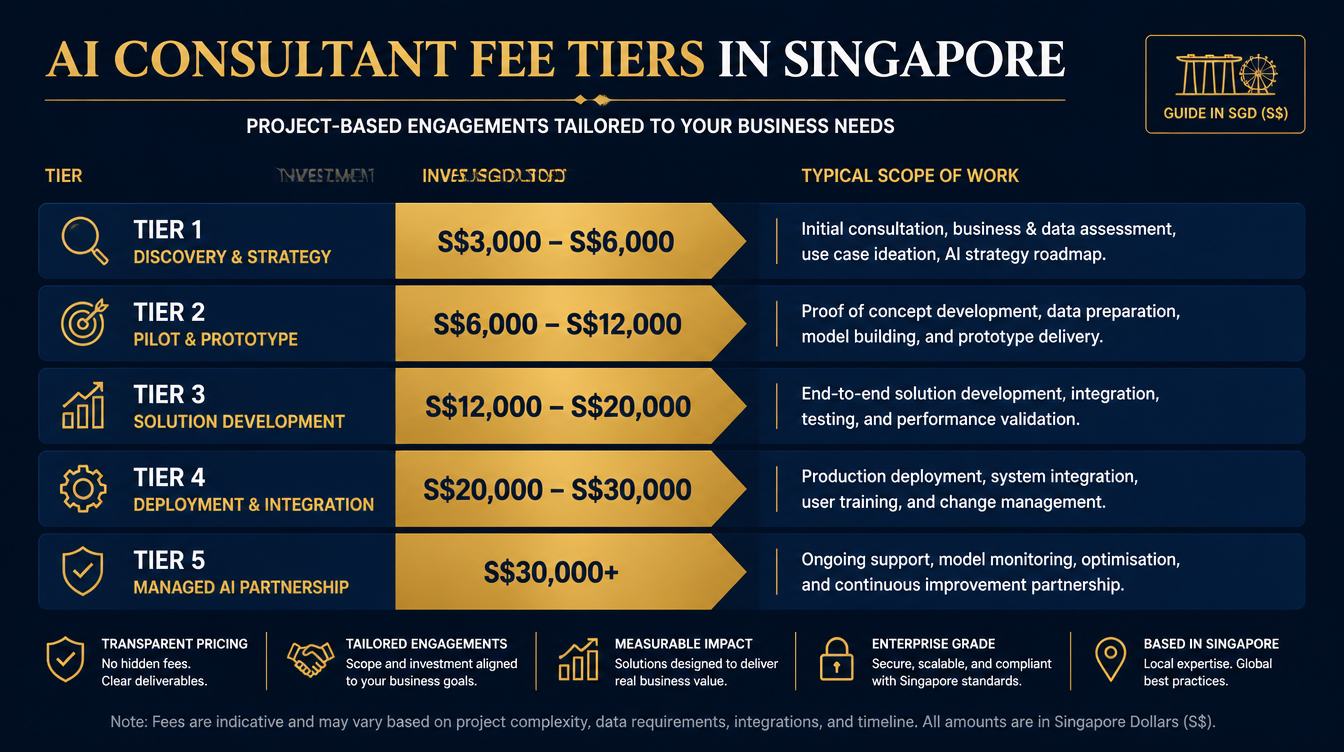
Typical project fees for qualified AI consulting in Singapore range from S$15,000 for a focused single-workflow implementation to S$80,000 or more for a comprehensive transformation programme. Enterprise Singapore EDG funding can reduce the net cost to the SME by 50 to 70 percent for qualifying projects.
Retainer Engagements
A retainer engagement provides ongoing access to the consultant for a fixed monthly fee. It suits situations where your AI needs are evolving, where you want continuous iteration rather than a single transformation, or where you need regular strategic input that is faster and cheaper than spinning up a new project each time a question arises.
Retainer fees for senior AI consulting in Singapore typically range from S$3,000 to S$10,000 per month, depending on the level of access, the scope of deliverables, and the seniority of the consultant. Retainers are generally not eligible for EDG grant funding, which is structured around projects rather than ongoing advisory relationships.
The risk of a retainer is diffuse accountability. When there is no specific deliverable at the end of a defined period, it is easy for a retainer to become a status-quo relationship where the consultant is available but not actively driving outcomes. Mitigate this by building quarterly outcome reviews into the retainer agreement and defining what success looks like over a twelve-month horizon.
Advisory Engagements
An advisory engagement provides senior strategic input without hands-on implementation. It is appropriate for organisations that have internal technical capability (a CTO, a digital team, or an operations manager who can execute) and need experienced guidance on AI strategy, vendor selection, risk management, or board-level education.
Advisory engagements are typically structured as a number of days per month, priced on a daily rate. For senior AI consultants in Singapore, daily advisory rates range from S$3,000 to S$8,000 per day. The value of an advisory engagement is in the quality of judgment, not the volume of time, so the day rate reflects experience and track record more directly than retainer or project fees.
Grant Eligibility: Why Your Consultant's PMC Status Changes Your Costs
For Singapore SMEs, the financial case for AI adoption almost always includes government grant support. Enterprise Singapore and IMDA between them administer multiple schemes that can dramatically reduce the effective cost of AI transformation, but only if your engagement is structured correctly.
The Enterprise Development Grant (EDG) is the most significant funding vehicle for AI transformation in Singapore. It supports projects that help Singapore businesses upgrade, innovate, or venture overseas. AI transformation projects that improve business capabilities are specifically within scope. The grant covers up to 50 percent of qualifying costs for most SMEs, and up to 70 percent for smaller businesses that meet specific criteria. Qualifying costs include consultant fees, software costs, and training costs, up to defined caps.
The critical eligibility factor is consultant qualification. There is no pre-approved vendor list for EDG. Enterprise Singapore's rule is narrower: management consultancy costs are only supported when the consultant holds a TR 43 or SS 680 certification (PMC, RMC or SCMC). An AI consultant without a TR 43 or SS 680 certification cannot have their fees supported as EDG management consultancy costs, regardless of how capable they are.
The practical implication is that for a S$40,000 AI transformation project delivered by a non-PMC consultant, you pay S$40,000. For the same project delivered by a PMC-certified consultant, an EDG application submitted by 29 September 2026 could bring that to S$12,000 to S$20,000. From 30 September 2026 the saving depends on the EDGE activity and its support level. The difference is not marginal. It can mean the difference between a project being financially viable or not.
Beyond EDG, the Company Training Committee (CTC) Grant supports upskilling of Singapore employees, including training on AI tools and workflows. IMDA's AI Trailblazers programme provides resources and support for SMEs adopting generative AI. A consultant with grant advisory experience can help you sequence multiple funding sources across a multi-year AI adoption roadmap, compounding the financial benefit.
The process for accessing EDG funding typically takes two to four months from application to approval, and the project cannot begin before approval is granted. This means grant planning needs to start before you are ready to implement, not after, which is another reason to engage a consultant who can advise on the grant process as part of the overall engagement strategy.
Start Small: Why a Discovery Audit Is the Right First Step
The single most common mistake Singapore SME owners make when hiring an AI consultant is committing to a large engagement before they have validated the opportunity and the consultant.
A discovery audit, typically a one-to-two-week structured diagnostic, produces a written assessment of your AI readiness, a prioritised list of specific opportunities, an estimate of ROI for each opportunity, and a clear recommendation on what to implement first and why. It costs between S$2,000 and S$8,000 depending on scope and seniority, and it gives you three things that no free assessment or sales call can provide.
First, it gives you real information about your own business. Most business owners have a general sense of where AI could help them, but a structured diagnostic identifies the specific workflows, bottlenecks, and data conditions that determine which AI applications will actually work. You learn things about your own operations in a good discovery audit.
Second, it gives you a basis for comparison. If you commission discovery audits from two or three consultants before choosing one for a full engagement, you will quickly be able to compare the quality of their thinking, the specificity of their recommendations, and the credibility of their ROI estimates. This comparison is not possible from proposal documents alone.
Third, it de-risks the full engagement. A full AI transformation project that is preceded by a rigorous discovery audit has a materially higher success rate than one that begins with a proposal-to-contract sequence. The diagnostic ensures that the project scope is grounded in actual business analysis rather than assumptions that looked reasonable before the work began.
If a consultant is not willing to do a paid discovery audit before proposing a full engagement, ask why. The most common answers reveal something important: either they do not have a structured diagnostic process, they are in a competitive sales situation and are afraid a diagnostic will give you too much information to compare them against others, or they are confident enough in the upfront diagnosis that they are willing to skip the validation step. None of these answers are reassuring.
For SMEs ready to take that first step, I offer a structured AI readiness audit that covers your top three workflow priorities, produces a written recommendation, and maps the opportunity to available grant funding. It is the same process I would recommend you require from any consultant you are seriously considering.
Common questions
How much does an AI consultant cost in Singapore? EDG stopped taking new applications on 29 September 2026. New applications now go through the EDGE Grant. AI consultant fees in Singapore vary significantly by scope and seniority. Discovery audits typically range from S$2,000 to S$8,000. Full project engagements range from S$15,000 to S$80,000 or more. Monthly retainers for ongoing advisory and implementation support range from S$3,000 to S$10,000 per month. EDG support for SMEs is up to 50% of qualifying costs on applications submitted by 29 September 2026. From 30 September 2026, new applications go through the EDGE Grant, where the support level depends on the activity. See my detailed breakdown of AI consultant fees in Singapore for 2026 for a full breakdown of what drives these figures.
What is PMC certification and why does it matter for hiring an AI consultant in Singapore? EDG stopped taking new applications on 29 September 2026. New applications now go through the EDGE Grant. PMC stands for Practising Management Consultant, a certification administered by the Singapore Business Advisors and Consultants Council (SBACC). PMC certification verifies that a consultant meets a defined standard of competency and professional ethics. More importantly for Singapore SMEs, Enterprise Singapore's Enterprise Development Grant (EDG) only supports management consultancy costs when the consultant holds a TR 43 or SS 680 certification (PMC, RMC or SCMC). Without PMC certification, your consultant cannot be used for grant-funded AI transformation projects, which means you lose access to 50 to 70 percent government co-funding. Always verify PMC status through the Singapore Business Advisors and Consultants Council (SBACC)'s online directory before engaging any consultant for grant-eligible work.
How long does an AI consulting engagement typically take for a Singapore SME? A focused AI transformation project, implementing AI in one or two specific workflows, typically takes six to twelve weeks from discovery to deployment. A more comprehensive programme covering multiple functions can take three to six months. Discovery audits are typically completed within one to two weeks. Grant-funded projects must be approved before they begin, which means the total timeline from decision to deployment is often four to six months when grant funding is included. Build this lead time into your planning if grant funding is important to your business case.
Can I use EDG grant funding to hire an AI consultant in Singapore? EDG stopped taking new applications on 29 September 2026. New applications now go through the EDGE Grant. Yes, for EDG applications submitted by 29 September 2026, provided the consultant holds a TR 43 or SS 680 certification (PMC, RMC or SCMC), the project scope meets EDG eligibility criteria, and the application is approved before project work begins. From 30 September 2026, new applications go to EDGE, where Enterprise Singapore lists SS 680 certification as required at application for Business Strategic Planning, Financial Framework and Corporate Strategy, Sustainability Strategy Development, International Branding, ISO/IEC 27001 and ISO/IEC 42001. EDG can cover 50 to 70 percent of qualifying costs including consultant fees, software costs, and training costs. The grant application process typically takes two to four months, so planning must begin well before you are ready to implement. My guide on EDG grants for AI projects covers the full eligibility and application process.
What should I expect from an AI consulting proposal? A professional AI consulting proposal should include a clear restatement of your specific business problem, a named and structured methodology with stages and deliverables, a timeline with milestones, an itemised cost breakdown that separates discovery from implementation and identifies grant-eligible costs, specific success metrics agreed upfront, and a clear statement of what is out of scope. Proposals that lack specific metrics, undifferentiated methodology, or vague scope boundaries are proposals from consultants who will be difficult to hold accountable during the engagement.
What is the difference between an AI consultant and an AI vendor in Singapore? An AI vendor sells or implements specific AI products, a chatbot platform, an automation tool, a SaaS AI service. An AI consultant is engaged to diagnose your business problem, design the right approach, and manage implementation, which may or may not involve a specific product. The critical difference is independence: a consultant without vendor affiliations can recommend the best tool for your situation rather than the tool they are commercially incentivised to sell. Always ask your consultant about any vendor relationships or referral arrangements before accepting their tool recommendations.
How do I know if my business is ready for AI transformation? AI readiness depends on three factors: clarity of the problem you want to solve (vague problems produce vague solutions), data availability (AI works best when there is structured historical data to learn from or when the task involves generating or processing language), and internal capacity to manage change (the team needs bandwidth to participate in implementation and adoption). Most Singapore SMEs are ready for at least one or two AI applications, even if they are not ready for comprehensive transformation. A discovery audit is the fastest way to get an honest answer about your specific readiness.
What questions should I ask an AI consultant about data security and PDPA compliance in Singapore? Ask whether the AI tools they recommend store or process your customer or employee data on servers outside Singapore. Ask how they ensure that data shared with AI platforms is not used to train future models. Ask whether their implementation approach produces an audit trail for AI-assisted decisions that affect customers. Singapore's Personal Data Protection Act (PDPA) creates specific obligations around data consent, storage, and use that AI implementations can inadvertently breach. A consultant who does not raise PDPA considerations proactively in their proposal has not thought carefully enough about the compliance dimension of AI deployment.
Is it better to hire an individual AI consultant or an AI consulting firm in Singapore? Individual consultants and consulting firms have different trade-offs. Individual consultants typically offer more direct access to senior expertise, more personalised attention, and lower overheads. Consulting firms offer more staffing depth for larger projects, more formal quality assurance processes, and sometimes better brand recognition for stakeholder management. For most Singapore SMEs at the early stages of AI adoption, an experienced individual consultant with a defined methodology and proven Singapore track record will deliver better value than a large firm where your project may be staffed by junior consultants with the partner only appearing at key review points.
How do I protect myself if an AI consulting engagement does not deliver results? The best protection is structured upfront: define specific, measurable success metrics before the engagement begins and include milestone-based payment terms so that each payment is linked to a defined deliverable. Include a clear scope statement that both parties agree on, and document assumptions about data quality, system access, and staff availability that the project depends on. If something out of scope affects the project, you want a mechanism to discuss it before it derails the timeline. A fixed-fee project with milestone payments and defined success criteria is more protective than an open-ended retainer or a time-and-materials arrangement.
Related reading
Stay sharp
The weekly Singapore grant playbook.
Operator-grade pieces on EDGE, CTC and the rest of the stack, straight to your inbox once a week. No spam, no upsell.
One email a week. Unsubscribe in one click.
Keep reading
AI Transformation Singapore: Complete Guide 2026
AI transformation Singapore in 2026: what it actually means, the Enterprise × Workforce framework, grants up to 70%, real costs, and how SMEs win.
10 min read
AI TransformationDigital Transformation vs AI Transformation Singapore
Digital transformation vs AI transformation in Singapore: DT moves you online, AT automates the judgment calls. Know the difference before you apply for grants.
10 min read
AI TransformationAI Transformation Roadmap Singapore: SME 12-Month Plan
An AI transformation roadmap Singapore SMEs can follow, month 1 to 12, funded through EDGE and CTC grants, proving it cheaply before you build big.
10 min read