What Does an AI Consultant Actually Do in Singapore?
An AI consultant in Singapore does far more than recommend ChatGPT. Here is the honest breakdown of deliverables, methodology, and what to expect from an engagement.
Nick Tung
@nick_tung_ · 19 min read
Published:
Updated:
Update, 25 September 2026: PSG, EDG and MRA take new applications until 29 September 2026. From 30 September 2026, new projects apply under Enterprise Singapore's EDGE grant. Applications submitted before 30 September are still assessed under the old scheme's rules, so where this article describes PSG, EDG or MRA, read it as how those schemes worked. Per Enterprise Singapore's release of 9 September 2026, EDGE supports SMEs at up to 50% on most activities and up to 70% on internationalisation and sustainability, within a S$100,000 grant cap per company per year. Eligibility is decided by Enterprise Singapore.
What Does an AI Consultant Actually Do in Singapore?
An AI consultant in Singapore does far more than recommend ChatGPT. Here is the honest breakdown of deliverables, methodology, and what to expect from an engagement.
I have spent years as an SPMC-certified AI consultant (SPMC-10960) in Singapore, working with SMEs across manufacturing, logistics, professional services, retail, and healthcare. When business owners ask me what I actually do, the honest answer is this: I help companies decide what AI to use, how to use it, and how to make it stick, then I build it with them or oversee the build. That is very different from a technology vendor selling you software, or a trainer teaching your team about AI in a half-day workshop.
This article is the comprehensive, practitioner-level answer to what an AI consulting engagement in Singapore actually looks like, phase by phase, deliverable by deliverable.
What an AI Consultant in Singapore Does (The Real Day-to-Day Work)
An AI consultant's day-to-day work spans four distinct activities: diagnosis, strategy, implementation oversight, and change management. The mix shifts depending on the engagement phase, but all four are always present.
Diagnosis means going into a business and understanding where the friction is. This is not a theoretical exercise. I sit with operations managers, interview salespeople, shadow admin staff, and map out exactly where time is being burned on tasks that AI can handle, document extraction, customer inquiry triage, proposal drafting, inventory forecasting, reporting. The output is a precise map of the opportunity, not a vague "AI can help you."
Strategy means deciding what to build, in what order, with what tools. This is where most business owners get it wrong on their own. They see a demo of a tool that looks impressive and try to implement it. An AI consultant builds the prioritisation framework: what problem is big enough to justify the implementation cost? What are the data dependencies? Which workflow change will generate the fastest ROI and create organisational momentum for the harder changes that follow?
Implementation oversight means managing vendors, reviewing outputs, and ensuring the AI solution actually integrates with the existing tech stack, whether that is a Salesforce CRM, a WhatsApp-based customer service setup, or a legacy ERP system that the business has run for 15 years. I do not necessarily write every line of code. Sometimes I do. But the core value is knowing enough about the technology to hold vendors accountable, catch bad implementations early, and prevent scope creep.
Change management is the work nobody talks about but every engagement requires. AI implementations fail not because the technology does not work, but because the team does not adopt it. This means prompt engineering training for non-technical staff, process documentation that clearly states what AI handles and what humans handle, and building internal champions who keep the new workflow alive after the engagement ends.
A typical week for me might include: reviewing an AI-generated email sequence that a client's sales team is using and refining the prompt logic; a two-hour session mapping new automations for a logistics company's daily operations report; a call with a software vendor to validate their proposed integration architecture; and drafting the deliverable framework for a new AI transformation project with a 30-person SME in the services sector.
The Deliverables You Should Expect from an AI Consulting Engagement
Concrete deliverables separate a real AI consultant from someone who gives you a slide deck and an invoice. In my practice, these are the tangible outputs a client should expect:
-
AI Readiness Audit Report, A scored assessment across six dimensions: data infrastructure, digital process maturity, team capability, leadership alignment, regulatory exposure, and current tool landscape. This is not a questionnaire; it involves actual system reviews.
-
Opportunity Priority Map, A ranked list of AI use cases specific to your business, with estimated effort, estimated value, and dependency mapping. This is the backbone of the engagement roadmap.
-
Vendor Evaluation Matrix, If new software is required, a structured analysis of the options (not just the ones you have already heard of), including total cost of ownership, integration complexity, and exit risk.
-
Prompt Engineering Framework, For businesses using LLMs (large language models like GPT-4, Claude, or Gemini), a documented set of prompts and instructions that govern how the AI behaves in your business context. This is the difference between an AI that sounds professional and one that produces embarrassing output.
-
Workflow Documentation, Updated standard operating procedures that reflect the new AI-assisted workflows, with clear human-AI handoff points.
-
Staff Training Sessions, Practical, role-specific sessions that teach your team to use AI tools in their actual daily tasks, not generic "AI awareness" content.
-
Implementation Oversight Notes, Regular written updates during any build phase, documenting decisions made, risks flagged, and scope changes requested.
The Three Phases Every AI Consulting Engagement Goes Through
Every credible AI consulting engagement in Singapore follows three phases: Readiness Assessment, Implementation Roadmap and POC, and Ongoing Advisory. Here is what each phase actually contains.
Phase 1: AI Readiness Assessment
This phase typically runs two to four weeks. The goal is to establish a clear, honest picture of where the business sits today relative to AI adoption, and to identify the highest-value opportunities with the lowest implementation risk.
The readiness assessment is not a sales pitch for the phases that follow. I have completed assessments that concluded the business is not ready for AI implementation yet, the data quality is too poor, the processes are not standardised, or the leadership team does not have the bandwidth to manage change. Telling a client that is the most valuable thing I can do for them.
What the readiness assessment covers:
Process audit. Mapping current workflows for repetitive, high-volume tasks. In a professional services firm, this might be proposal generation, client onboarding, and monthly reporting. In a logistics company, it might be freight documentation, route planning, and customer ETA communication.
Data audit. AI systems need data. What data does the business currently capture? Where is it stored? How clean is it? A business that runs on WhatsApp messages and Excel files has a very different starting point from one using a CRM with structured records.
Team capability assessment. What is the current digital literacy of the team? Are there any internal champions who can own AI tools after the consultant leaves? This shapes the change management plan.
Risk mapping. In regulated sectors (financial services, healthcare, legal) AI use cases carry compliance risk. The readiness assessment maps these before any build begins.
At the end of Phase 1, the client receives a written AI Readiness Report with a scoring breakdown and a prioritised shortlist of implementation candidates.
Phase 2: Implementation Roadmap and Proof of Concept
This phase typically runs six to twelve weeks, depending on complexity. The roadmap translates the Phase 1 findings into a concrete plan with milestones, budgets, and accountability owners.
The proof of concept (POC) is critical. A POC is a small, fast, low-cost test of the highest-priority AI use case, built to validate whether it actually works in your specific context before committing to a full implementation. This is where I have saved clients from expensive mistakes: the vendor demo looked great, but the POC revealed the AI could not handle Singlish customer messages, or the data format from the legacy system broke the integration.
A well-structured POC has defined success criteria before it starts. Not "let's see if this works" but "if this AI can correctly classify 85% of incoming customer enquiries into the right category within 48 hours of training, we proceed." That specificity is what makes the POC decision-useful.
After a successful POC, the full implementation roadmap is built with realistic timelines, responsible parties, and a clear handoff plan for when the consultant's intensive involvement ends.
Phase 3: Ongoing Advisory and Team Upskilling
Most AI implementations need an ongoing advisory relationship, not just because the technology evolves but because the business evolves too. New use cases emerge. The original implementation needs refinement as real-world usage reveals edge cases. The team needs progressive upskilling as they grow more capable.
In my practice, ongoing advisory typically runs as a monthly retainer: a defined number of hours for strategic reviews, prompt optimisation, new use case scoping, and ad-hoc problem solving. This is not hand-holding. It is a standing relationship with someone who knows your systems deeply and can give you informed direction quickly.
Upskilling in this phase is targeted. Rather than generic AI training, it addresses the specific tools the team is now using, the failure modes they have encountered, and the next level of capability they need to build.
AI Consultant vs. Software Developer vs. Data Scientist: The Actual Differences
An AI consultant decides what to build and why; a software developer builds what they are told to build; a data scientist works with historical data to build predictive models. These are distinct disciplines, and understanding the difference will save you from expensive hiring mistakes.
AI Consultant vs. Software Developer
A software developer is excellent at execution. Give them a clear specification (build an integration between this CRM and this email tool, using this API) and a good developer will build it efficiently and correctly. The problem is that most SME owners cannot write a clear enough specification without strategic guidance. They know they want "AI for customer service" but cannot specify exactly what that means, which data it should draw on, how it should handle exceptions, or how its outputs should be reviewed.
An AI consultant does the upstream work: defining the problem, evaluating whether AI is actually the right solution (it often is not), specifying the system, and then either building it or briefing a developer to build it. After the build, the consultant is responsible for verifying it delivers the intended business outcome, not just that it runs without errors.
Think of it this way: you would not hire a contractor to build your house without an architect to design it first. An AI consultant is closer to the architect.
AI Consultant vs. Data Scientist
Data scientists work with historical datasets to build machine learning models, demand forecasting, churn prediction, fraud detection, recommendation engines. This is highly specialised technical work that requires statistical expertise, model training, and infrastructure to serve predictions at scale.
Most Singapore SMEs do not need a data scientist. They need an AI consultant who understands how to apply pre-built AI tools (LLMs, AI-native SaaS products, API-based AI services) to real business problems without building models from scratch.
The distinction matters because data science projects are expensive, slow, and require large clean datasets that most SMEs do not have. An AI consulting engagement, by contrast, can deliver meaningful results within weeks using existing AI tools, applied intelligently to well-defined problems.
Where the disciplines overlap: when a business has reached AI maturity and wants to build proprietary models on their own data, an AI consultant can scope the data science brief and work alongside the data science team. But this is Phase 3 territory, usually 12 to 18 months into an AI transformation journey.
The Capability Gap an AI Consultant Fills
The real gap an AI consultant fills is the intersection of business strategy, technology evaluation, change management, and AI domain knowledge. No single hire (developer, data scientist, or operations manager) covers all four. For most SMEs, hiring a full-time team with all four capabilities is prohibitively expensive and unnecessary. A consultant provides the full capability set for the duration of the engagement, then exits with documentation that enables the internal team to sustain the results.
What You Get in the First 90 Days of an AI Consulting Engagement
The first 90 days of a well-run AI consulting engagement deliver: a validated readiness baseline, at least one working AI implementation in production, documented workflows, and a trained internal team. Here is the 90-day structure in practice.
Days 1 to 21: Discovery and Readiness Assessment
The engagement opens with stakeholder interviews across the leadership team, operations, sales, and any function that is a candidate for AI augmentation. I follow a structured protocol: understand current state, identify pain points, quantify the time cost of repetitive tasks, and map the data landscape.
By day 21, the AI Readiness Report is delivered. This document becomes the reference for everything that follows. It includes the opportunity priority map with at least five to eight potential AI use cases, ranked by value and implementability, with a recommended starting point.
Days 22 to 45: Roadmap Finalisation and POC Build
The leadership team reviews the readiness report and selects the POC use case. The POC build begins immediately, speed is important here. A 30-day POC that drags into 60 days because of indecision or under-resourced implementation is a red flag.
Success criteria are defined before build starts. Vendor selection, if required, happens in this window. Integration architecture is reviewed. The POC is built, tested with real data, and evaluated against the pre-defined criteria.
Days 46 to 75: Full Implementation and Training
If the POC passes, full implementation follows. This is typically a six-to-eight week build phase. Training sessions for the team happen in parallel, not after the tool is deployed, but during the final two weeks of the build so the team is confident from day one of launch.
The workflow documentation is completed in this phase: who does what, what the AI handles, what the human escalation paths are, and how to flag errors in the AI output.
Days 76 to 90: Stabilisation and Handover
The first two weeks of a live AI implementation always surface edge cases that were not anticipated in the build. This stabilisation period is essential. The consultant reviews early usage data, refines prompts or configurations, and resolves unexpected failure modes.
The handover package is delivered: full documentation, training materials, an escalation protocol for technical issues, and the framework for ongoing monitoring. If an ongoing advisory retainer is in place, the first monthly review is scheduled.
By day 90, a well-run engagement has delivered measurable change. Not a PowerPoint. Not a roadmap sitting in someone's email inbox. An actual AI system running in production, with a team capable of using and maintaining it.
Singapore's AI Landscape: IMDA, National AI Strategy 2.0, and What It Means for Businesses
Singapore's National AI Strategy 2.0 (NAS 2.0), launched in November 2023, is the most ambitious AI policy framework the country has produced. For Singapore businesses engaging an AI consultant, understanding this landscape is not optional. It shapes where funding is available, which industry verticals are being prioritised, and what governance standards consultants and their clients are expected to meet.
NAS 2.0 identifies five key sectors for AI deployment: healthcare (clinical decision support, administrative automation), logistics (smart warehousing, route optimisation), financial services (risk assessment, compliance monitoring), education (personalised learning, administrative efficiency), and sustainability (green building management, energy optimisation). If your business operates in or adjacent to any of these verticals, there are both funding opportunities and a favourable regulatory environment for AI adoption.
The Infocomm Media Development Authority (IMDA) plays a central role in Singapore's AI governance. IMDA's AI governance framework, last updated in 2023, establishes principles that Singapore businesses are expected to apply: human oversight of AI decisions, explainability of AI outputs in high-stakes contexts, fairness in AI-driven decisions affecting individuals, and security by design for AI systems handling personal data.
For an AI consultant working with Singapore SMEs, this framework is not abstract. It translates directly into engagement decisions: should this customer-facing AI be required to log its reasoning? Does this automated HR tool require human review before decisions are communicated to employees? Is this AI system processing NRIC or other sensitive personal data in a way that requires PDPA compliance controls?
IMDA's AI Verify testing framework and the Model AI Governance Framework are the primary reference documents. An AI consultant who cannot navigate these frameworks is not equipped for the Singapore market.
AI Governance in Practice
The gap between AI governance principles and implementation practice is where most SMEs struggle. An AI consultant bridges this gap by translating governance requirements into concrete technical and operational controls.
A common example: a Singapore recruitment firm wants to use AI to screen resumes. The IMDA framework and MOM's fair employment guidelines both require that automated screening tools do not introduce discriminatory bias. An AI consultant's role is to: (1) select or configure a tool that mitigates demographic bias in ranking, (2) build in a human review step before any candidate is rejected solely based on AI output, (3) document the process for audit purposes, and (4) train HR staff on the system's limitations.
This is AI consulting in the Singapore context, not just making technology work, but making it work within the legal, regulatory, and ethical framework that governs Singapore employment.
PMC Certification: Why It Matters More Than You Think for Singapore AI Work
PMC (Practising Management Consultant) certification, administered by the Singapore Business Advisors and Consultants Council (SBACC), is one of the TR 43 or SS 680 certifications EnterpriseSG accepts for EDG management consultancy costs, alongside RMC (IMC(S)) and SCMC (TUV SUD). My credential is SPMC-10960.
Most business owners encounter PMC certification for the first time when they are applying for the Enterprise Development Grant (EDG) and discover that the consultant they want to hire must hold a TR 43 or SS 680 certification (PMC, RMC or SCMC) for the grant to cover consultant fees. But there is more to PMC certification than grant eligibility.
PMC certification requires demonstrated expertise in consulting methodology, business strategy, and the specific domain areas for which the consultant is certified. It also requires continuing professional development, PMC-certified consultants must stay current in their field, which in AI means keeping pace with a landscape that changes every quarter.
The certification process is rigorous. It involves assessment of consulting competencies, review of past project work, and commitment to a professional code of conduct. In a market where anyone can call themselves an "AI consultant" after completing an online course, PMC certification is a meaningful signal of professional credibility.
For clients, the practical implications are:
-
Grant eligibility. If you intend to claim EDG funding for AI consulting fees, your consultant must hold a TR 43 or SS 680 certification (PMC, RMC or SCMC). Without this, the grant application for consulting fees will be rejected.
-
Accountability. PMC-certified consultants are bound by a professional code of conduct and can have their certification reviewed for misconduct. This provides a level of accountability that does not exist with uncertified practitioners.
-
Methodology. PMC training emphasises structured consulting methodology, needs diagnosis before solution recommendation, documented deliverables, defined engagement scopes. This protects clients from engagements that are long on talk and short on output.
If you are evaluating AI consultants in Singapore and have any intention of applying for government grants, verify PMC certification before signing anything. A consultant who cannot provide their PMC number is not grant-eligible, regardless of how impressive their credentials appear.
Which Government Grants Cover AI Consulting Fees in Singapore
Three government grants cover AI consulting fees or AI implementation costs in Singapore: EDG, CTC, and PSG. Each operates differently and serves different purposes.
Enterprise Development Grant (EDG)
The EDG, administered by Enterprise Singapore, is the primary grant for AI consulting engagements. It funds up to 50% of qualifying project costs, which includes consultant fees, software costs (where directly related to the project), and staff costs for internal project team members.
For AI-related projects, EDG typically falls under the Innovation and Productivity category or the Business Strategy category, depending on how the project is scoped. Projects that involve redesigning core business processes using AI tend to qualify under Innovation and Productivity. Projects that involve developing an AI-informed business strategy qualify under Business Strategy.
The key EDG requirement for AI consulting: the consultant must hold a TR 43 or SS 680 certification (PMC, RMC or SCMC), the project must have a defined scope and deliverables, and the SME must be headquartered in Singapore with at least 30% local shareholding. The maximum grant quantum depends on the company's situation, but for SMEs the support level is 50%.
EDG applications take four to eight weeks to process. Work should not begin before the Letter of Offer is received. I have seen clients lose grant eligibility by starting the engagement before the LOI arrived, a costly mistake that is entirely avoidable.
For more details on the EDG, see EDG Grant Guide.
Career Conversion Programme (CTC)
The Career Conversion Programme, administered by Workforce Singapore (WSG), covers AI and digital skills training costs. CTC is specifically designed for reskilling employees into new roles, for example, taking a customer service executive and training them to manage AI-assisted customer service workflows.
The CTC is not the right grant for consulting fees. It is the right grant for the training component of an AI implementation, when you are investing in building internal capability, not just deploying a tool.
CTC support levels vary by programme type, but typically cover 70 to 90% of salary support during the training period and a portion of course fees. For AI-specific roles, there are dedicated CTC pathways aligned with the skills frameworks published by the Skills Framework for ICT.
See CTC Grant Guide for the current list of eligible AI-related CTC programmes.
Productivity Solutions Grant (PSG)
The PSG covers pre-approved AI and digital solutions, essentially, a curated list of software tools that IMDA and Enterprise Singapore have assessed and approved for PSG funding. If you want to implement one of these pre-approved tools, PSG can fund up to 50% of the subscription cost.
The important distinction: PSG does not cover consultant fees for custom work. If your AI solution is one of the pre-approved tools on the IMDA list and requires no customisation, PSG is the fastest grant path. If you need a consultant to design a custom AI workflow, you need EDG.
Many AI consulting engagements involve elements of both: the underlying tool might be PSG-eligible software, while the consulting fees for designing and implementing the workflow are EDG-eligible. Structuring the grant application correctly to capture both funding streams requires understanding both programmes, which is something a PMC-certified consultant can assist with.
Stacking Grants Intelligently
It is possible to use multiple grants on a single AI transformation project. A typical stack for an AI consulting engagement might look like:
- EDG for the Phase 1 AI readiness assessment and Phase 2 implementation roadmap (consultant fees)
- PSG for the AI software subscription (if using a pre-approved solution)
- CTC for the staff training and reskilling component (if roles are significantly changing)
Each grant has separate application processes and different administering agencies. Stacking them requires careful scoping of what each grant covers and ensuring there is no double-claiming of the same cost across multiple grants. A consultant who understands the grant landscape can structure the project scope to maximise total funding while keeping the application straightforward.
How to Know When You Are Ready for an AI Consultant
You are ready for an AI consultant when you have a real problem, enough data to act on, and the organisational bandwidth to implement change. Here are the specific signals that tell me an SME is ready.
Signal 1: You Have a Real Problem, Not an AI Impulse
The worst reason to hire an AI consultant is "I need to do something with AI." This is an impulse, not a problem. Impulse-driven AI engagements almost always produce underwhelming results because the problem definition is wrong from the start.
The right reason to hire an AI consultant is that you have a specific, recurring problem that is costing you money or time, and you suspect AI might solve it, but you are not sure how. Examples:
- "We are spending 40 hours a week on customer inquiry responses that are 80% similar to each other, and our team's response time is hurting conversion."
- "Our sales proposals take four hours to customise each time and our win rate is only 22%. I think we are losing on speed and quality."
- "We are processing 500 invoices a month manually and our error rate is 8%, which is creating downstream problems in accounts payable."
These are real problems. An AI consultant can map a specific solution to each of them with a clear ROI case.
Signal 2: You Have at Least 3 to 5 Hours Per Week of Repetitive Human Tasks Ripe for Automation
AI does not replace human judgment on complex, novel problems. It excels at high-volume, pattern-based tasks where the rules are consistent but the execution is tedious. If you cannot identify at least 3 to 5 hours per week per team member of tasks that fit this description, the ROI on an AI consulting engagement will be hard to justify.
In practice, most businesses that think they are "too small" or "not ready" have far more automation opportunity than they realise. The audit process consistently reveals 15-30 hours per week of automatable work in businesses with as few as five employees. It just requires someone who knows where to look.
Signal 3: You Have the Budget for a Minimum 3-Month Engagement
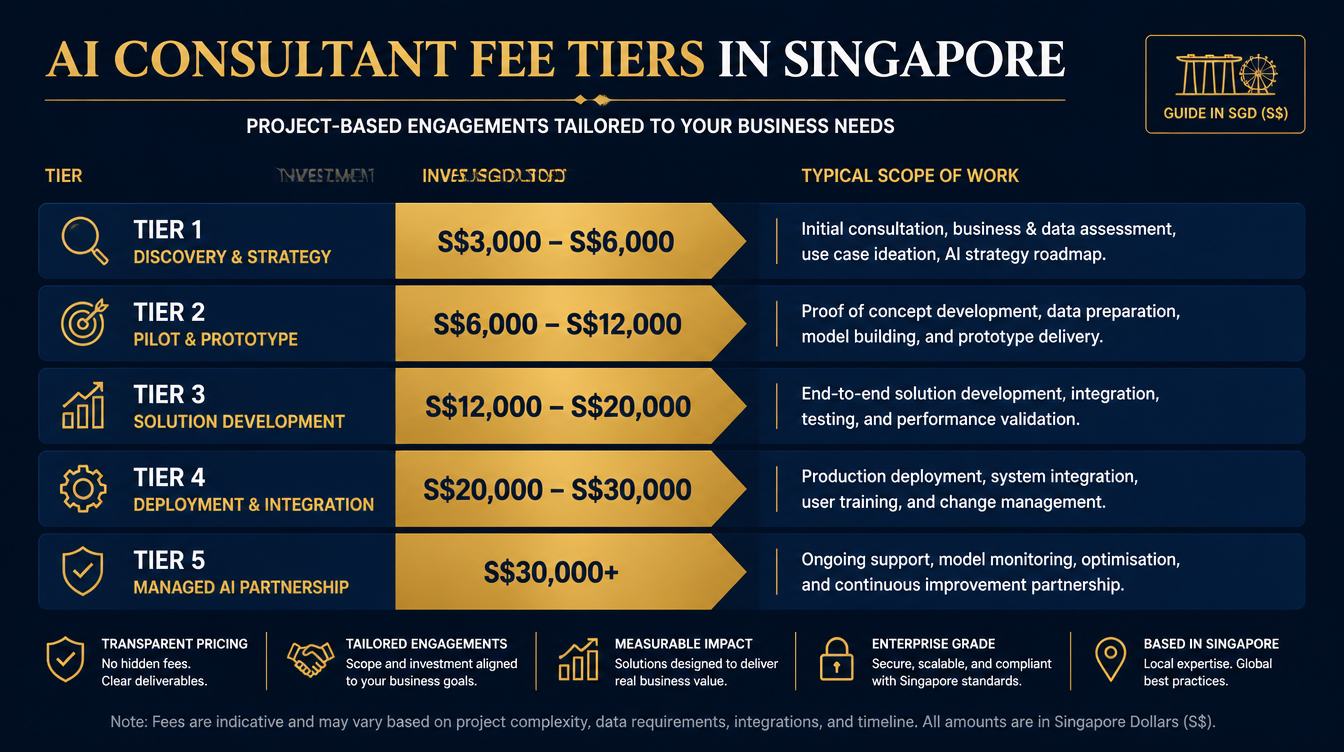
AI consulting in Singapore is not cheap, and it should not be. A credible engagement, one that delivers a working AI implementation with trained staff and documented workflows, costs from S$8,000 to S$30,000+ depending on scope and complexity. With EDG grant support at 50%, the net cost after grant is S$4,000 to S$15,000+.
Businesses that are looking for a S$500 hour-long "AI advice session" are not ready for an AI consulting engagement. They might benefit from a workshop or a self-paced AI course first. But if your business is losing meaningful time or revenue to problems that AI can solve, the investment in a proper engagement has a return that justifies the cost.
When You Are Not Ready
There are legitimate reasons to wait. If your processes are not yet standardised, if the same task is done differently by different team members and there are no documented procedures, AI will automate the inconsistency and produce inconsistent outputs. Fix the process first.
If your leadership team has not aligned on what problem they want to solve, an engagement will stall at Phase 1 as competing priorities emerge. Get internal clarity before you bring an external consultant in.
If you have just been through a major operational disruption (a system migration, a restructuring, a rapid growth phase) give the organisation time to stabilise before adding the change management demands of an AI implementation.
These are honest assessments. A consultant who tells you to sign an engagement regardless of your readiness is optimising for their revenue, not your outcome. If you are uncertain about your readiness, the right starting point is an AI readiness assessment, a bounded, time-limited diagnostic that tells you exactly where you stand.
The Honest Reality of AI Consulting in Singapore
I want to close the main body of this article with some observations that do not appear in most AI consulting content, because most AI consulting content is written by people who want to sell AI consulting.
Most AI implementations fail not because of the technology but because of the change management. The AI tools available in 2026 are genuinely capable. The limiting factor is almost always the human side: a team that feels threatened by AI and subtly resists adoption, a manager who endorsed the project but is too busy to champion it, a workflow design that made sense on paper but does not match how people actually work. An AI consultant who does not understand change management will deliver technology that sits unused.
AI hype has created a generation of over-promise. I have seen clients come to me after paying for "AI implementations" that turned out to be a ChatGPT subscription with some basic prompts and a Zap automation. That is not an AI consulting engagement. A real engagement has a diagnosis phase, a strategy phase, documented deliverables, and measurable outcomes. Ask any prospective consultant to show you examples of their deliverables from past engagements, not testimonials, not case study headlines, but the actual documents.
The Singapore grant landscape is real value, but it requires proper structuring. The combination of EDG, PSG, and CTC can cover a substantial portion of a well-structured AI transformation project. But "AI consultant told me the grant would cover it" is not the same as having an approved Letter of Offer in hand. Grant applications can be rejected, and work done before an LOI is issued is not covered. Structure the engagement correctly from the start.
The best AI consulting engagement ends with the client less dependent on the consultant, not more. If your AI consultant has delivered their work well, your team is trained, your systems are documented, and you can maintain and extend the AI implementation internally. The ongoing advisory relationship should be a choice, not a dependency. Be wary of engagements structured to keep you needing the consultant indefinitely.
For those ready to take the next step, an AI transformation engagement starts with a structured readiness conversation, no obligation, no sales pitch, just an honest diagnosis of where your business stands.
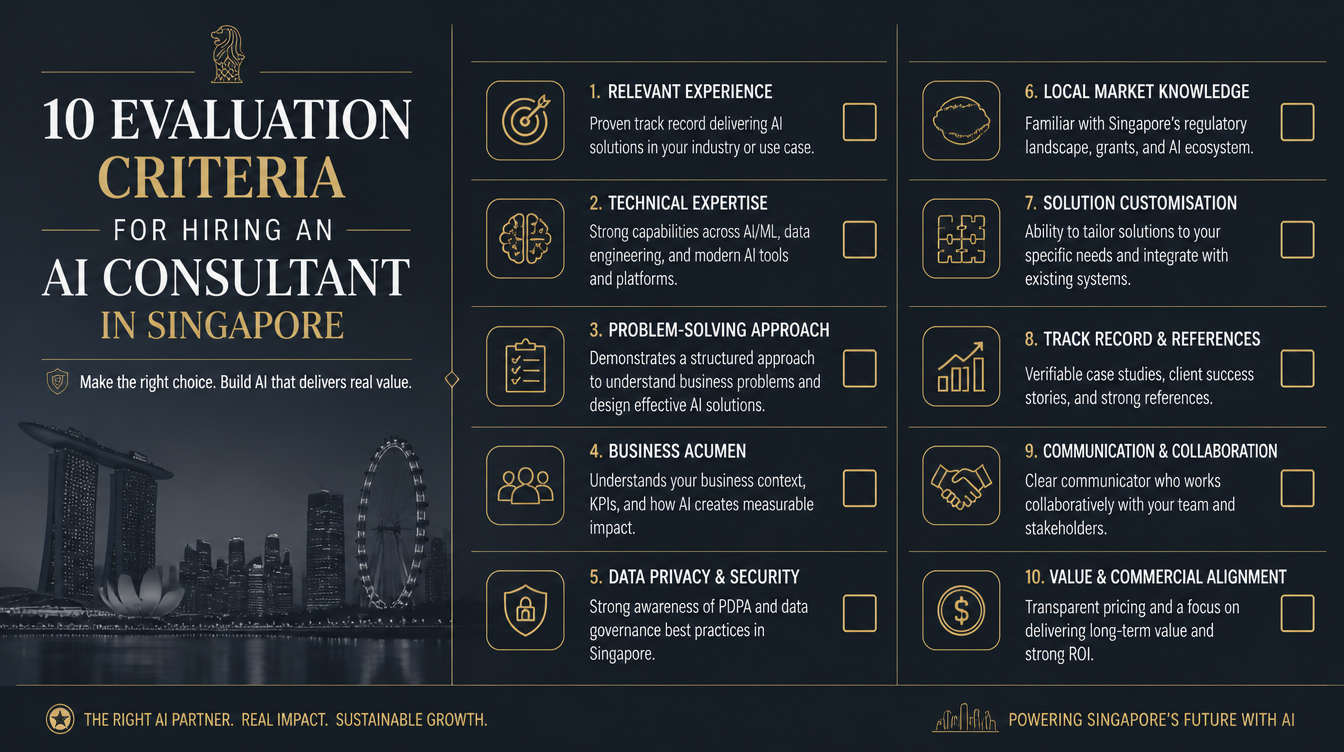
You can also review the hire AI consultant Singapore checklist and understand AI consultant fees in Singapore for 2026 before making your decision.
Common questions
What is an AI consultant in Singapore? Enterprise Singapore's PSG and EDG stopped taking new applications on 29 September 2026. New applications now go through the EDGE Grant. An AI consultant in Singapore is a professional who helps businesses identify where artificial intelligence can create value, designs the implementation strategy, oversees the build, and manages the change management required for adoption. Unlike a software developer who builds what they are told, or a data scientist who works with historical models, an AI consultant is a strategic partner who works across the full problem-to-solution lifecycle. In Singapore specifically, a credible AI consultant will also understand the regulatory framework (IMDA governance, PDPA), the grant landscape (EDG, PSG, CTC), and the local business context.
How much does an AI consultant cost in Singapore? EDG stopped taking new applications on 29 September 2026. New applications now go through the EDGE Grant. AI consulting fees in Singapore vary significantly depending on scope and certification. For a full AI readiness assessment and implementation roadmap, expect to pay S$8,000 to S$15,000. A complete 90-day implementation engagement including POC, full build, and training typically runs S$15,000 to S$40,000 depending on complexity. With EDG grant support at 50%, the net cost to the SME is halved for qualifying projects. Ongoing advisory retainers typically run S$2,000 to S$5,000 per month. Be wary of very low-cost offerings. They rarely include the deliverables that a real engagement requires. See AI consultant fees Singapore 2026 for a more detailed breakdown.
Do I need a PMC-certified AI consultant for the EDG grant? EDG stopped taking new applications on 29 September 2026. New applications now go through the EDGE Grant. Yes. For your AI consulting fees to be covered under the Enterprise Development Grant, the consultant must hold a valid PMC (Practising Management Consultant) certification recognised by Enterprise Singapore. Without PMC certification, the grant application for consulting fees will be rejected. Ask any prospective consultant for their PMC number and check it on the SBACC register. Mine is SPMC-10960. The register lists me under my full legal name, Tung Kai Sheng, and shows PMC-10960, the code I held before my upgrade to Senior PMC. It does not display tiers for anyone, so what it confirms is the person and the certification, not the grade.
What is the difference between an AI consultant and an AI software vendor? A software vendor sells you a specific product and helps you implement it. Their recommendation will always be their product, regardless of whether it is the best fit for your situation. An AI consultant is technology-agnostic, the recommendation should be whatever best serves the client's needs, which might be a vendor's product, an open-source tool, a custom build, or a combination. A consultant also stays with you through the problem diagnosis and change management phases, which a vendor typically does not. The conflict of interest in using a vendor for strategic AI advice is real and should be understood going in.
How long does an AI consulting engagement typically last in Singapore? Most substantive AI consulting engagements run three to six months from initial assessment to handover. The Phase 1 readiness assessment is typically two to four weeks. The Phase 2 roadmap and POC is six to eight weeks. The Phase 3 full implementation is six to twelve weeks. An engagement that is structured as a single month of advisory with no implementation phase is unlikely to produce lasting results. After the main engagement, ongoing advisory is typically structured as a monthly retainer lasting six to twelve months while the internal team builds full capability.
Which industries in Singapore benefit most from AI consulting? Based on my work with Singapore SMEs, the highest-impact AI consulting use cases appear in: professional services (proposal automation, document processing, client communication), logistics and supply chain (demand forecasting, route optimisation, documentation handling), retail and e-commerce (customer inquiry triage, inventory management, personalised marketing), healthcare administration (appointment scheduling, insurance claim processing, patient communication), and manufacturing (quality control documentation, maintenance scheduling, supplier communication). IMDA's National AI Strategy 2.0 identifies healthcare, logistics, financial services, education, and sustainability as national priority sectors, which means these sectors also have the most favourable funding environment.
What should I look for when hiring an AI consultant in Singapore? Enterprise Singapore's PSG and EDG stopped taking new applications on 29 September 2026. New applications now go through the EDGE Grant. Seven things to evaluate: (1) PMC certification (verify the number, (2) specific past project deliverables) not testimonials, ask to see actual documents, (3) methodology (they should describe a phased approach with diagnosis before recommendation, (4) grant expertise) can they help you apply for EDG/PSG/CTC correctly, (5) change management capability (how do they handle team resistance and adoption, (6) technology independence) do they recommend specific vendors regardless of client needs, and (7) honesty about limitations, a good consultant will tell you when AI is not the right solution. See the hire AI consultant Singapore checklist for a complete evaluation framework.
Can small businesses with fewer than 20 employees benefit from AI consulting? EDG stopped taking new applications on 29 September 2026. New applications now go through the EDGE Grant. Yes, and often more dramatically than larger businesses, because every hour of operational efficiency saved has a higher relative impact on a small team. My most successful AI consulting engagements have been with businesses of five to fifteen people, where a well-designed AI workflow can effectively function as a new team member (handling customer inquiries, drafting documents, processing data) without the overhead of a full hire. The constraint for very small businesses is usually budget: the minimum viable AI consulting engagement (a readiness assessment plus one POC) costs from S$8,000 upwards, which is a meaningful investment for a five-person firm. EDG grant support at 50% makes this more accessible. See AI solutions for SMEs for options suited to different business sizes.
What is IMDA's role in Singapore's AI landscape? Enterprise Singapore's PSG stopped taking new applications on 29 September 2026. New applications now go through the EDGE Grant. The Infocomm Media Development Authority (IMDA) is Singapore's primary regulator and developer for the digital and AI economy. In the AI consulting context, IMDA's most relevant roles are: publishing the AI Governance Framework (the principles Singapore businesses are expected to follow when deploying AI), administering the AI Verify testing toolkit (for assessing AI system behaviour against governance principles), developing AI talent frameworks through SkillsFuture, and co-funding AI adoption through the Productivity Solutions Grant in partnership with Enterprise Singapore. An AI consultant working in Singapore should have working knowledge of IMDA's governance frameworks, both because clients in regulated sectors need to comply with them and because they represent the minimum professional standard for responsible AI deployment.
What does an AI consultant NOT do? An AI consultant does not: write production code at scale (that is a software developer's role), build proprietary machine learning models from scratch (that is a data scientist's role), manage your day-to-day AI tool subscriptions (that is an operations function), or guarantee business outcomes that depend on factors beyond the AI system itself (market conditions, sales execution, management decisions). A good AI consultant is clear about scope. Beware of consultants who promise guaranteed ROI percentages or business outcomes they cannot control. That is not consulting, it is marketing. The consultant's accountability is for the quality of the diagnosis, the rigour of the strategy, and the soundness of the implementation. The business outcomes that follow depend on execution by the business itself.
Related reading
Stay sharp
The weekly Singapore grant playbook.
Operator-grade pieces on EDGE, CTC and the rest of the stack, straight to your inbox once a week. No spam, no upsell.
One email a week. Unsubscribe in one click.
Keep reading
AI Transformation Singapore: Complete Guide 2026
AI transformation Singapore in 2026: what it actually means, the Enterprise × Workforce framework, grants up to 70%, real costs, and how SMEs win.
10 min read
AI TransformationDigital Transformation vs AI Transformation Singapore
Digital transformation vs AI transformation in Singapore: DT moves you online, AT automates the judgment calls. Know the difference before you apply for grants.
10 min read
AI TransformationAI Transformation Roadmap Singapore: SME 12-Month Plan
An AI transformation roadmap Singapore SMEs can follow, month 1 to 12, funded through EDGE and CTC grants, proving it cheaply before you build big.
10 min read