AI Consultant Fees in Singapore: The Honest Breakdown for 2026
AI consultant fees in Singapore range from S$3,000 to S$100,000 per engagement. This is the honest breakdown of what each tier delivers and how grants can reduce your cost by up to 50%.
Nick Tung
@nick_tung_ · 16 min read
Published:
Updated:
Update, 25 September 2026: PSG, EDG and MRA take new applications until 29 September 2026. From 30 September 2026, new projects apply under Enterprise Singapore's EDGE grant. Applications submitted before 30 September are still assessed under the old scheme's rules, so where this article describes PSG, EDG or MRA, read it as how those schemes worked. Per Enterprise Singapore's release of 9 September 2026, EDGE supports SMEs at up to 50% on most activities and up to 70% on internationalisation and sustainability, within a S$100,000 grant cap per company per year. Eligibility is decided by Enterprise Singapore.
AI consultant fees in Singapore range from S$3,000 for a discovery audit to over S$120,000 for a company-wide transformation programme. The variation is not arbitrary. It reflects genuine differences in scope, credentials, infrastructure complexity, and the degree of change management required. This article gives you the unvarnished numbers, the reasoning behind them, and a framework to judge whether any given engagement is priced fairly.
Why AI Consultant Fees in Singapore Vary So Dramatically
AI consultant fees in Singapore vary because the label "AI consultant" covers an enormous range of actual competencies, from a freelancer who assembles ChatGPT plugins to a senior practitioner who redesigns operational workflows, integrates with enterprise systems, trains staff, and coordinates government grant applications. You would not expect a graphic designer and an advertising agency partner to charge the same rate; the same logic applies here.
There are several structural reasons the spread is so wide in the Singapore market specifically.
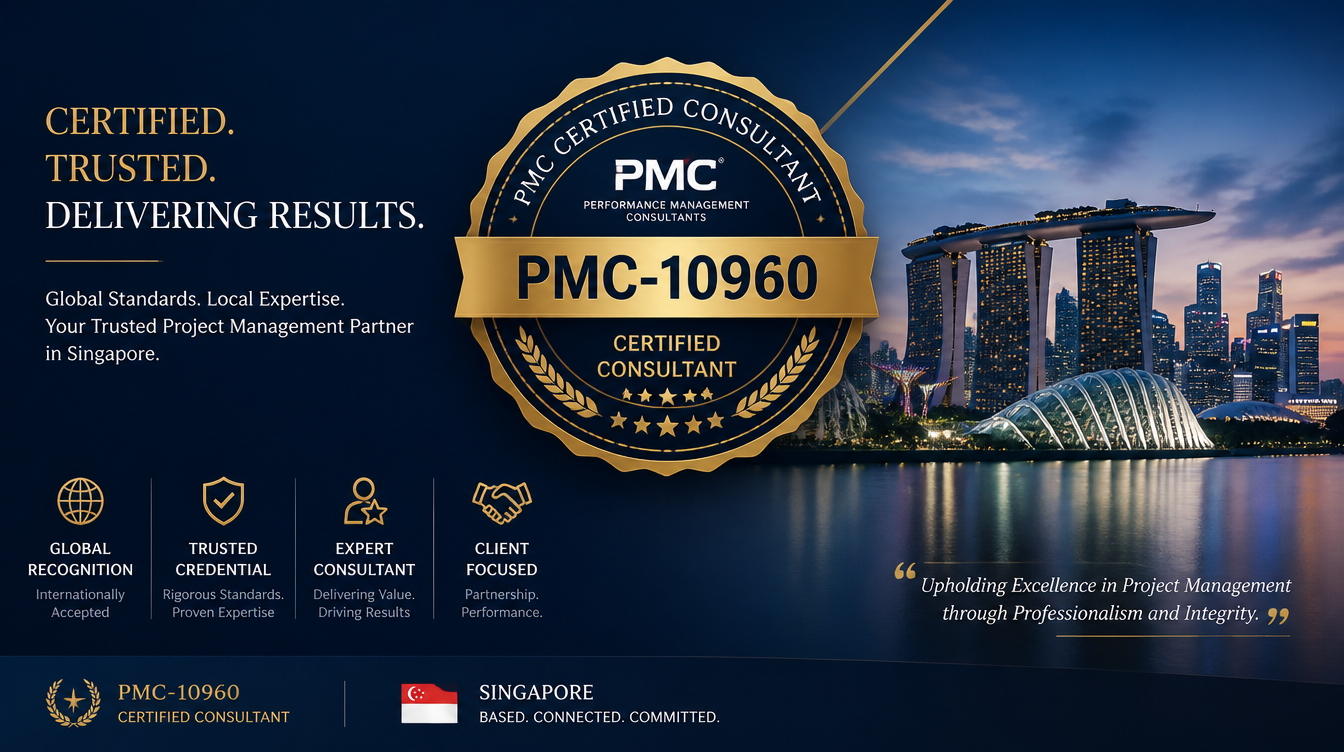
The credentials gap is real. Singapore's IMDA and EnterpriseSG ecosystems have formalised the Practising Management Consultant (PMC) certification, administered by the Singapore Business Advisors and Consultants Council (SBACC). A PMC-certified consultant (like SPMC-10960) has demonstrated competency in productivity-driven transformation, which, in practical terms, means they know how to produce work that satisfies both the client and the government auditor's requirements. Uncertified practitioners are cheaper, but under EDG their fees cannot be supported as management consultancy costs, which need a consultant certified to TR 43 or SS 680. That immediately limits what they can help you accomplish.
Scope complexity is non-linear. Automating one document-processing workflow is a bounded problem. Redesigning how an entire sales or operations department uses AI involves stakeholder alignment, legacy system integration, training programme design, and ongoing governance. The effort, and therefore the fee, does not scale linearly with the number of workflows.
The Singapore market is maturing but not yet commoditised. Unlike web design or accounting, AI transformation consulting in Singapore has not yet been reduced to fixed-price packages with defined deliverables. Most engagements are still custom-scoped, which means pricing is negotiated rather than listed. Buyers without market knowledge frequently either overbid (when they trust a large brand name) or underbid (when they choose the cheapest option and discover the limitations only after signing).
Demand is outstripping supply. IMDA's AI Roadmap (2024) projects that Singapore will need to upskill over 15,000 workers annually in AI-adjacent roles. The pool of consultants who can actually implement, not just advise, is considerably smaller. Experienced practitioners can command higher rates because the alternative for clients is waiting, which has its own cost.
Understanding these structural factors gives you a stable framework for evaluating any quote you receive, regardless of how it is packaged.
The Fee Tiers: From S$3,000 Discovery Audits to S$100,000+ Transformation Programmes
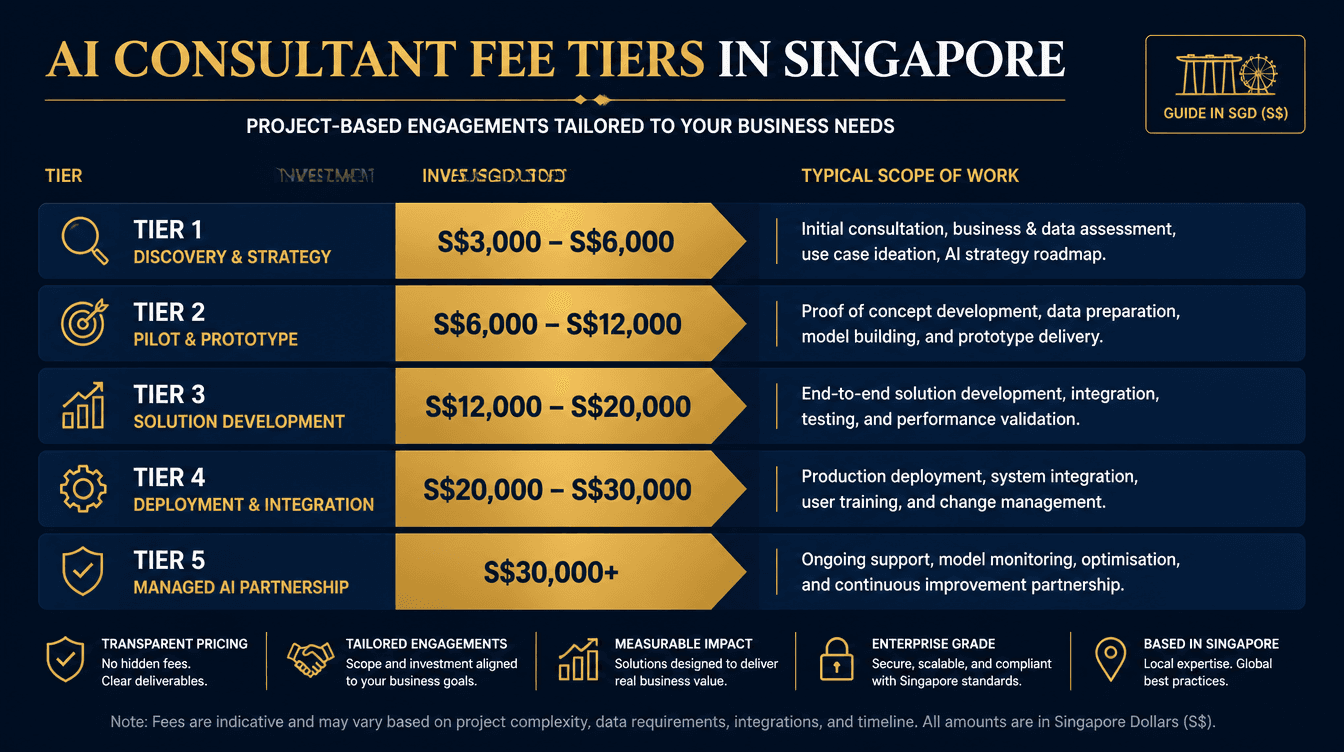
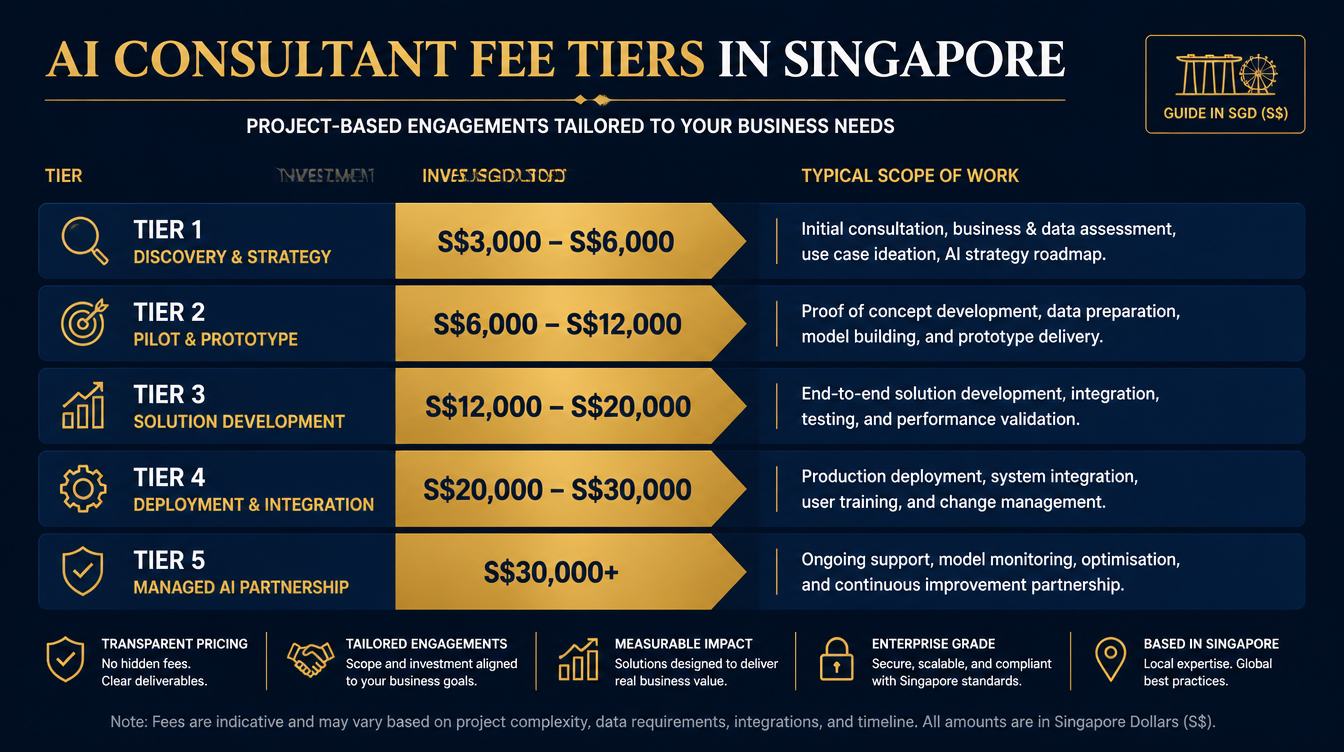
The Singapore market for AI consulting fees has settled into five recognisable tiers. These are not industry-official brackets. They are based on observed market practice among working consultants serving Singapore SMEs and mid-market companies.
Tier 1: AI Readiness Audit: S$3,000 to S$8,000
This is the entry point for most engagements. A well-executed AI Readiness Audit takes two to four weeks and produces a written report that maps your current processes, identifies the highest-ROI AI opportunities, estimates effort and cost for implementation, and recommends a sequenced roadmap.
At S$3,000, you are typically getting a templated audit with limited customisation, useful as a starting point but insufficient for grant applications. At S$6,000 to S$8,000, you get a bespoke engagement where the consultant interviews your team, maps your actual workflows, and produces documentation that can serve as the discovery phase for an EDG grant application.
The audit tier is appropriate when: you have not yet committed to AI adoption and need evidence to build an internal business case; you are applying for an EDG grant and need the scoping study that forms part of the grant proposal; or you want to stress-test a vendor's proposal against an independent assessment.
What an audit does NOT include: implementation, software, training, or ongoing support. If a consultant quotes S$3,000 and promises all of that, the numbers do not add up.
Tier 2: Single-Process AI Implementation: S$8,000 to S$25,000
This tier covers the automation of one defined business process. Common examples include: lead qualification and routing, invoice processing and matching, document classification and extraction, customer service deflection via an AI chatbot, or scheduling and dispatch optimisation.
A typical engagement at this tier runs six to twelve weeks and includes process scoping, solution design, build or configuration (using tools like n8n, Zapier, Claude, or custom code), integration testing, staff training on the new workflow, and a handover document.
The pricing spread within this tier is driven primarily by integration complexity. If your data lives in a standard CRM like HubSpot or Salesforce, integration is straightforward. If your data is in a proprietary ERP, an Access database from 2011, or a paper-based system that first needs digitalisation, costs rise sharply.
Tier 3: Department-Wide AI Transformation: S$25,000 to S$60,000
This is where the majority of substantive SME AI transformation work sits in Singapore. A department-wide engagement typically covers three to eight processes across one function (marketing, operations, HR, or finance) over a three to six month period.
What distinguishes this tier from Tier 2 is not just the number of processes but the change management component. When you transform how an entire department works, you are not just deploying tools. You are changing roles, habits, reporting structures, and sometimes headcount. A competent consultant at this tier will include: an AI-augmented roles design exercise, a training programme for the affected team, a governance framework (who owns what AI output, how errors are reviewed), and a metrics baseline so you can actually measure the ROI post-implementation.
This tier is where EDG grants become particularly significant, because the project scale justifies the grant application overhead and the qualifying costs are high enough to produce meaningful savings.
Tier 4: Company-Wide AI Programme: S$60,000 to S$120,000
A company-wide AI programme covers multiple departments, typically runs six to twelve months, and includes elements that do not appear in smaller engagements: a formal AI strategy document (often required for board or investor visibility), cross-departmental AI governance, integration across your core business systems, and ongoing advisory as implementation proceeds.
At this tier, the consultant is often acting as a fractional AI officer, attending leadership meetings, advising on AI procurement decisions, and serving as the accountable party for the transformation's success metrics. The relationship is longer and the consultant's investment in outcomes is deeper.
This is also where grant coordination becomes a significant value-add. A consultant who can navigate both EDG and Career Conversion Programme (CTC) applications simultaneously can potentially bring your net cost well below S$60,000 despite the headline fee being higher.
Tier 5: Enterprise Transformation: S$120,000+
For large enterprises, multi-year programmes, or organisations with complex technical and regulatory requirements (financial services, healthcare, government-linked entities), fees move above S$120,000 and often into the S$200,000 to S$500,000 range for multi-year engagements. These programmes involve teams of consultants, formal programme management, and integration with enterprise architecture reviews.
Most Singapore SMEs will not operate at this tier. It is included here for completeness, and because some SMEs mistakenly benchmark their quotes against enterprise pricing and conclude that everything at S$30,000 is cheap, which is not necessarily true at the SME scale.
Day Rates vs. Project Fees vs. Retainers: Which Model Fits Your Situation
The pricing model matters as much as the number, because different models create different incentives for both parties.
Day rates are the clearest signal of a consultant's market positioning. In Singapore, senior AI consultants with demonstrated delivery experience charge S$1,500 to S$3,500 per day. PMC-certified practitioners typically command the upper half of that range (S$2,000 to S$3,500) because their certification creates accountability and their work is eligible for grant support. Junior consultants or those newer to the field charge S$800 to S$1,500 per day.
Day rates are appropriate when: the scope is genuinely uncertain and fixed-price proposals would require excessive contingency; you are engaging for advisory or review work rather than implementation; or you need flexibility to redirect the consultant's effort as your understanding of the problem evolves.
The risk of day rates is scope creep. Without agreed deliverables, it can be difficult to assess whether the time is being used well.
Project fees (fixed-price engagements) give you budget certainty and create a deliverable-based accountability structure. The consultant bears the risk of underestimating effort. For this reason, experienced consultants building project fees will typically include a defined discovery phase before committing to a fixed price, the cost of poor scoping falls on them.
Project fees are appropriate for Tier 2 and Tier 3 engagements where the scope is well-understood: one process, agreed inputs, agreed outputs, agreed timelines.
Retainer models are monthly engagements, typically running three to twelve months, where the consultant provides a defined number of days per month for ongoing implementation, advisory, or optimisation. Retainers in the Singapore AI consulting market typically run S$5,000 to S$20,000 per month depending on the scope and seniority.
Retainers suit companies that need consistent advisory as they roll out AI adoption across multiple teams, or where the transformation is happening in phases and they need ongoing course-correction from someone who understands their business deeply.
The model to be cautious about is the "diagnostic report only" engagement disguised as project work. Some consultants charge S$5,000 for a report that lists AI tools and does not include any implementation plan, training, or accountability for outcomes. You want a consultant who has skin in the game past the report stage.
What Drives Pricing: The Four Factors That Determine What You Pay
When you receive a quote from an AI consultant, these four factors will be doing most of the work.
Factor 1: Credentials and Accountability
PMC certification is not just a qualification. It is an accountability structure. PMC-certified consultants can sign off on EnterpriseSG grant applications, which creates a formal responsibility for the quality and accuracy of their scope documentation. That accountability has value, and the market prices it.
Beyond PMC, look for: demonstrated implementation experience (case studies with named clients or verifiable outcomes, not just testimonials), sector-specific knowledge if your business is in a regulated industry, and evidence of post-implementation support rather than just delivery and exit.
Uncertified consultants are not necessarily worse practitioners, but they cannot access the grant ecosystem that significantly affects your net cost, and they operate without the oversight structure that PMC imposes.
Factor 2: Scope Complexity
Two factors make scope complex in ways that drive cost: system integration and data quality.
If your core business systems are modern and well-documented (Xero for finance, HubSpot for CRM, Shopify for e-commerce), integration is a bounded engineering problem. If your data lives in legacy systems, spreadsheets, or paper, the consultant first needs to solve a data problem before an AI problem, and data problems are often the most time-consuming part of the engagement.
The second complexity driver is the number of stakeholders whose workflows are affected. A process that one person owns is far easier to redesign than a process that spans three departments with different managers, different incentive structures, and different views on what "good" looks like.
Factor 3: Infrastructure vs. Workflow Design
Some AI implementations require building or procuring technical infrastructure: a custom AI agent, a vector database for document retrieval, an API integration with a proprietary system, or a fine-tuned model for a specific task. This infrastructure work is typically the most technically demanding and the most expensive component.
Other implementations involve configuring existing tools and redesigning workflows without building anything new. If your business can achieve its goals by better configuring tools you already have access to (or by adopting well-supported SaaS tools like Microsoft Copilot, Notion AI, or Claude for Teams) the implementation cost is lower and the ongoing maintenance is simpler.
A good consultant will explicitly separate these two components in their proposal, so you can see what you are paying for.
Factor 4: Change Management and Training
This is the factor most often underweighted in AI consulting proposals, and the one most predictive of whether implementations actually stick.
Technology does not transform businesses. People using technology differently transforms businesses. An AI implementation that includes well-designed training, a clear "new way of working" document, a change champion within your team, and a governance framework for reviewing AI outputs will achieve significantly better outcomes than the same technology deployed without those elements.
Change management components add cost, typically fifteen to twenty-five percent of the total engagement fee. But they are not optional if you want results. A consultant who prices them out or treats training as a half-day box-tick is signalling something important about their model for success.
How EDG and CTC Grants Can Reduce Your Consultant Fees by Up to 50%
Singapore's grant infrastructure for AI adoption is among the most accessible in Asia, and it materially changes the economics of hiring an AI consultant. Two grants are directly relevant: the Enterprise Development Grant (EDG) and the Career Conversion Programme (CTC).
Enterprise Development Grant (EDG)
The EDG is administered by EnterpriseSG and funds productivity and capability upgrading projects for Singapore-registered SMEs. For AI transformation consulting, the EDG typically covers qualifying third-party consultant fees, software costs, and training costs.
For eligible SMEs (Singapore-registered, at least 30% local shareholding, under S$100M annual revenue for the enhanced support tier), the EDG currently supports up to fifty percent of qualifying project costs. This means a S$40,000 AI transformation engagement could cost you S$20,000 net of grant.
The conditions are specific. The consultant must be a qualifying third-party vendor, not a related party of the company, and in practice, grant applications are far stronger when the consultant is PMC-certified or equivalent. The project scope must clearly map to productivity improvement, with measurable outcomes defined in advance. The application must be submitted and approved before the project commences (retrospective claims are not accepted).
The EDG process takes four to eight weeks for assessment, so factor this into your timeline. Many consultants will charge the discovery and scoping phase separately, which allows the grant application to be prepared before the main implementation begins.
Career Conversion Programme (CTC)
The CTC is a Workforce Singapore programme administered through NTUC's e2i and sector-specific partners. It supports companies that are redeploying existing staff into new AI-augmented roles.
If your AI transformation programme involves changing what your employees do, not just adding tools to their existing workflow, CTC can cover up to ninety percent of salary support during the transition period (typically three to twelve months, depending on the programme). This is not a consultant fee subsidy; it is a salary subsidy for the staff being retrained.
In practice, the CTC and EDG can stack. A company implementing AI in its operations department might use EDG to fund the consultant's fees and CTC to cover the salary cost of the operations team while they transition to new AI-augmented roles.
Companies that engage a consultant who is familiar with both grant structures, and can help with the applications as part of the engagement, typically capture significantly more value than those who treat grant applications as a separate administrative exercise.
For a deeper look at both programmes, see what a Singapore AI consultant actually does and the full checklist for hiring one.
Calculating ROI: How to Know If an AI Consultant's Fees Are Worth It
The most rigorous question to ask before signing any AI consulting engagement is not "Is this fee reasonable?" but "What is the measurable outcome, and what is the financial value of that outcome?" If the consultant cannot answer the second question with specificity, that is diagnostic.
Here is a worked example based on a common SME use case.
The scenario: A Singapore trading company with twelve staff processes approximately 200 purchase orders per month. Each PO requires manual data extraction from supplier PDFs, entry into their accounting system, and three-way matching against delivery records. Total manual processing time: approximately 35 hours per month across two staff members.
The proposed engagement: An AI consultant proposes an AI-powered document extraction and matching system integrated with the company's Xero account. Project fee: S$38,000. Estimated implementation time: ten weeks.
The ROI calculation:
- Manual time recovered: 30 hours per month (conservative, accounting for edge-case review)
- Blended staff cost per hour: S$28 (mid-level operations staff in Singapore, loaded)
- Annual saving from time recovery: 30 × S$28 × 12 = S$10,080
- Error reduction benefit: The company currently experiences approximately three costly matching errors per month, averaging S$400 each in remediation cost. AI-driven matching reduces this to near-zero. Annual saving: 3 × S$400 × 12 = S$14,400
- Total annual saving: S$10,080 + S$14,400 = S$24,480
Applying the EDG grant:
- Gross consultant fee: S$38,000
- EDG support (50% of qualifying costs): S$19,000
- Net cost to company: S$19,000
ROI timeline:
- Net cost: S$19,000
- Annual saving: S$24,480
- Payback period: approximately 9 months
This is a realistic, not optimistic, projection. The ROI is favourable not because AI consulting fees are cheap, they are not, but because the economics of recovering 30 hours of skilled labour per month compound quickly, and the grant meaningfully changes the net investment.
The discipline here is specificity. "AI will make your business more efficient" is not an ROI calculation. "AI will reduce your PO processing time by thirty hours per month, saving S$24,480 annually against a net investment of S$19,000" is. Ask every consultant to express their value proposition in the second form.
There is also a secondary value category that is harder to quantify but real: opportunity cost of not implementing. If your competitors are automating their operations and you are not, the gap compounds over eighteen to thirty-six months in ways that are difficult to reverse. IMDA's SMEs Go Digital data shows AI adoption among Singapore SMEs has been accelerating since 2022, companies that delay are not staying still; they are falling behind a moving benchmark.
For a deeper look at AI solutions available for Singapore businesses, the ROI profiles vary significantly by industry and use case.
What Cheap AI Consulting Actually Costs Your Business
The S$1,000 AI audit that promises to "identify all your AI opportunities" is a product category, not a consulting engagement. Understanding what it actually delivers helps you calibrate what you are comparing when you evaluate quotes.
The typical cheap AI audit follows a predictable pattern. A consultant (or, increasingly, a consultant who has used an AI tool to generate the report) produces a document that lists popular AI tools (ChatGPT, Copilot, Canva AI, Notion AI, HubSpot AI) alongside generic descriptions of what each tool does. There may be a section suggesting which tools "could be relevant" to your industry. The document might be thirty pages long and look authoritative.
What it will not contain: a map of your actual processes; an assessment of your data infrastructure and whether it supports AI adoption; a realistic effort and cost estimate for implementation; a prioritised recommendation with a business case; or any plan for how your staff will actually change the way they work.
The client who buys this report typically does one of three things: files it and does nothing (most common); attempts to implement one or two tools themselves with mixed results; or hires a proper consultant twelve months later to start from scratch, having spent S$1,000 on something that did not move them forward.
The real cost of the cheap audit is not the S$1,000. It is the twelve months of opportunity cost during which competitors who hired competent consultants were compounding their productivity advantage. For a business processing S$5M in revenue, a twelve-month delay in capturing a 15% efficiency gain in one department represents approximately S$75,000 in foregone value, assuming a modest application of AI.
There is a related failure mode worth naming: the consultant who is excellent at selling AI consulting but has never actually implemented anything. They will produce compelling presentations, use confident language about "AI transformation," and reference case studies that are vague enough to be unprovable. The safeguards against this are simple: ask for a named reference you can call; ask to see a sample deliverable from a previous engagement; ask exactly what tools and methods they used for a specific client's implementation. Vagueness at this stage is diagnostic.
Cheap is not always wrong. A S$3,000 discovery audit from a competent practitioner who clearly scopes the deliverable and limits the engagement accordingly is entirely reasonable. What is wrong is paying S$1,000 for something labelled a "full AI strategy" or paying S$8,000 for what is actually a templated report. Price is only meaningful in relation to what is delivered.
The Market Rate in Singapore vs. Global Comparisons
Singapore sits in an interesting position in the global AI consulting market: comparable in day-rate terms to London and other top-tier European markets, significantly below the US, and significantly above offshore markets in India or Southeast Asia. Understanding this positioning helps you interpret quotes you receive and decide whether it makes sense to consider offshore or hybrid models.
Singapore senior AI consultant: S$2,000 to S$3,500 per day. This is the rate for a practitioner with five or more years of experience, demonstrated delivery capability, and familiarity with the Singapore regulatory and grant environment. PMC-certified consultants sit at the upper end.
London/UK senior AI consultant: approximately GBP 1,200 to 2,200 per day (S$2,100 to 3,900). Comparable to Singapore at the senior level.
US senior AI consultant: USD 3,000 to 5,000 per day (S$4,000 to 6,700). The US market has a more mature enterprise AI consulting sector, which has pushed rates higher. Large consulting firms (McKinsey, BCG, Accenture) operate at the top of this range or above.
India-based AI consultant: USD 200 to 600 per day (S$270 to 810). Significant cost difference, but several important caveats apply for Singapore businesses.
The case for offshore consulting in AI transformation is weaker than it appears for Singapore SMEs specifically. First, grant eligibility: EDG grants require qualifying third-party consultants who meet EnterpriseSG criteria, which in practice means Singapore-based practitioners with the appropriate credentials. An offshore consultant cannot sign off on your grant application. Second, regulatory context: MOM, PDPA, and Singapore's specific labour and data governance requirements are not knowledge an India-based consultant typically holds. Third, change management: the cultural and organisational dynamics of Singapore SMEs are specific enough that a consultant who has only worked in Indian or Western enterprise contexts will face a significant learning curve. Fourth, communication overhead: the asynchronous communication costs of offshore consulting are often underestimated, particularly for fast-moving implementation work.
Hybrid models (where an offshore team handles technical build under the supervision of a Singapore-based consultant who manages client relationships, change management, and grant documentation) can work well when the technical scope is well-defined and the deliverables are clear. This is essentially what large consulting firms do with their delivery centres, and some boutique Singapore consultancies operate the same model.
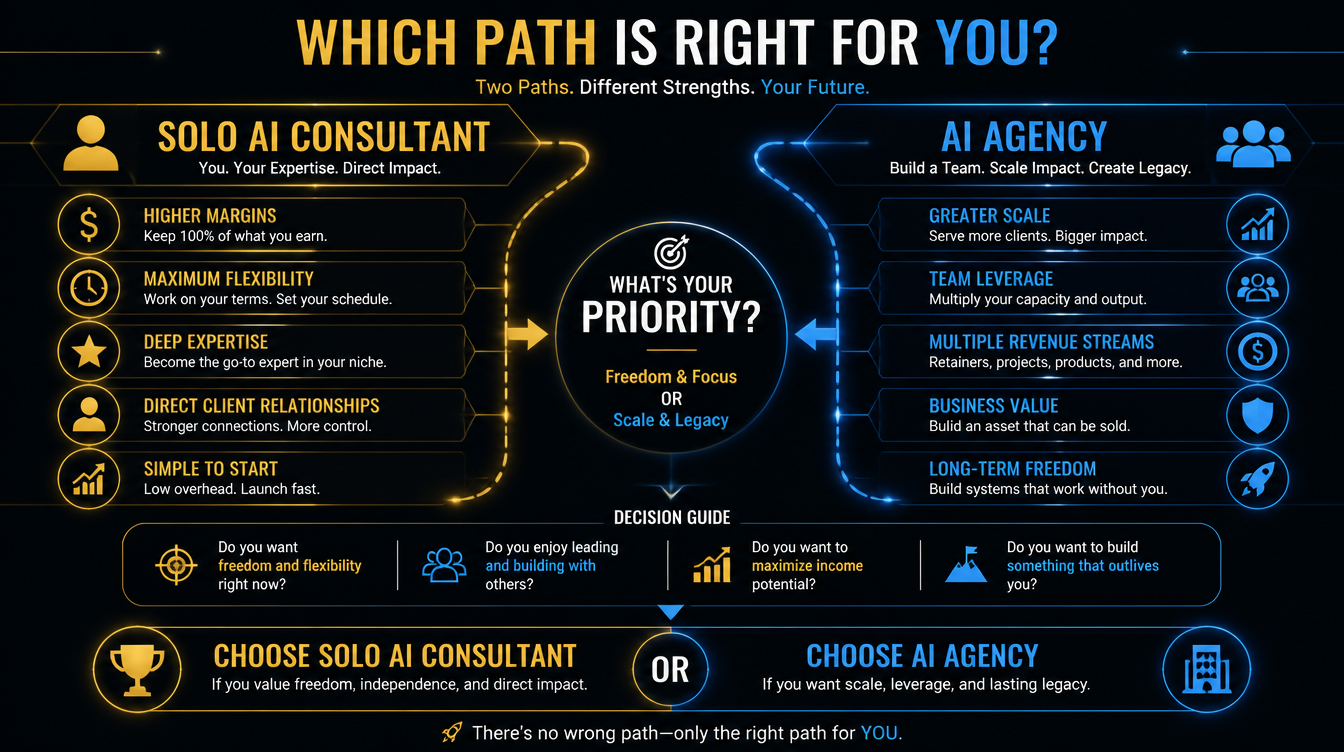
The honest summary on global comparison: if you are a Singapore SME, the relevant benchmark is the Singapore senior consultant rate, S$2,000 to S$3,500 per day, or S$8,000 to S$120,000 at the project level depending on scope. The global comparison is useful context, but it does not change the practical decision. You are paying for Singapore market knowledge, grant advisory capability, and the accountability structure that comes with credentials recognised by Singapore's government agencies.
For a full framework on what to look for before you hire, the AI consultant hiring checklist covers the questions to ask and the red flags to watch for.
Common questions
How much does an AI consultant cost in Singapore for a small business? EDG stopped taking new applications on 29 September 2026. New applications now go through the EDGE Grant. For a Singapore SME engaging an AI consultant for the first time, the realistic entry point is S$3,000 to S$8,000 for an AI Readiness Audit that produces a written report and roadmap. A first implementation engagement, automating one process, typically costs S$8,000 to S$25,000. With EDG grant support at 50%, a S$15,000 implementation engagement nets out at S$7,500. Most SMEs find that the first engagement pays for itself within six to twelve months if the implementation targets the right process.
What is the difference between an AI consultant's day rate and a project fee? A day rate (S$1,500 to S$3,500 for senior Singapore practitioners) is billed per day of work, with the total determined by actual time spent. A project fee is fixed in advance for a defined scope of work, the consultant takes the risk of time overruns. Project fees suit well-scoped implementations where both parties agree on the deliverables. Day rates suit advisory work, ambiguous discovery phases, or engagements where the direction may change. Most substantive implementations are quoted as project fees with a defined discovery phase billed separately at a day rate.
Are AI consultant fees covered by Singapore government grants? EDG stopped taking new applications on 29 September 2026. New applications now go through the EDGE Grant. Yes, qualifying projects can receive EDG support of up to 50% of consultant fees for Singapore-registered SMEs meeting EnterpriseSG criteria. The grant covers the third-party consultant fee, relevant software, and training costs. The consultant must be a qualifying third-party vendor and the application must be approved before the project starts. PMC-certified consultants are well-positioned to help with grant applications as part of the engagement scope.
Why do PMC-certified AI consultants charge more? EDG stopped taking new applications on 29 September 2026. New applications now go through the EDGE Grant. PMC (Practising Management Consultant) certification, administered by the Singapore Business Advisors and Consultants Council (SBACC) under the IMDA and EnterpriseSG framework, imposes competency standards and creates accountability for the quality of the consultant's work. Under EDG, management consultancy costs are only supported when the consultant holds a TR 43 or SS 680 certification (PMC, RMC or SCMC). Under EDGE, which opened on 30 September 2026, Enterprise Singapore lists SS 680 certification as required at application for Business Strategic Planning, Financial Framework and Corporate Strategy, Sustainability Strategy Development, International Branding, ISO/IEC 27001 and ISO/IEC 42001. In practice, the premium for PMC certification (which pushes day rates toward the S$2,500 to S$3,500 range versus S$1,500 to S$2,000 for uncertified practitioners) is frequently offset by the grant savings the consultant can unlock.
How do I compare AI consultant quotes in Singapore? EDG stopped taking new applications on 29 September 2026. New applications now go through the EDGE Grant. Do not compare headline numbers without normalising for scope. The right comparison framework: (1) What exactly are the deliverables? A report, a working implementation, training, or ongoing support? (2) What is included in the fee versus separately quoted? (3) Does the consultant have a plan to apply for EDG or CTC grants, and if so, what is the net cost? (4) What is the measurable outcome and how will success be defined? (5) Can the consultant provide a named reference from a comparable engagement? Two quotes can both be S$30,000 and represent radically different value propositions.
What is a reasonable timeline for an AI implementation in Singapore? EDG stopped taking new applications on 29 September 2026. New applications now go through the EDGE Grant. A single-process implementation (Tier 2) typically runs six to twelve weeks from scoping to handover. A department-wide engagement (Tier 3) runs three to six months. Timeline is heavily influenced by data readiness, if your data is in a state that requires significant cleaning or digitisation before AI can be applied, add four to eight weeks. EDG grant approval adds four to eight weeks before you can commence a grant-funded project, so factor this into your project start date.
What does an AI consultant do that a software vendor cannot? A software vendor implements their own product. An AI consultant is vendor-neutral and scopes the right solution for your problem, which may or may not involve their preferred tools. More importantly, an AI consultant is accountable for the outcome, did your processes change, did your staff adopt the new workflows, did you capture the projected savings? Vendors are accountable for installation and configuration. Consultants are accountable for adoption and results. For this reason, the most valuable AI consulting engagements include implementation, training, and a post-implementation review, not just a software setup.
What happens if the AI implementation does not deliver the projected ROI? This is the most important question to ask before signing any engagement. A serious consultant will define success metrics at the outset and include a review mechanism, typically a three-month post-implementation assessment, to measure actual against projected outcomes. If the implementation is grant-funded, there is an additional accountability layer: EnterpriseSG requires project completion reports that document actual outcomes. Ask any consultant how they handle underperformance. The answer will tell you a great deal about their confidence in their own work and their model of accountability.
Is it worth hiring a local Singapore AI consultant versus an offshore team? EDG stopped taking new applications on 29 September 2026. New applications now go through the EDGE Grant. For most Singapore SMEs, yes. The practical reasons: local consultants can unlock EDG and CTC grants (typically worth 50% of qualifying costs), they understand Singapore's regulatory context (PDPA, MOM guidelines on AI in the workplace), they can conduct effective stakeholder workshops with your Singapore-based team, and they do not have the communication and timezone overhead of offshore engagement. The cost difference between a Singapore senior consultant (S$2,000 to S$3,500/day) and an offshore practitioner (S$300 to S$800/day) sounds significant but narrows substantially when you account for grant subsidies and the cost of communication overhead on complex implementations.
Related reading
Stay sharp
The weekly Singapore grant playbook.
Operator-grade pieces on EDGE, CTC and the rest of the stack, straight to your inbox once a week. No spam, no upsell.
One email a week. Unsubscribe in one click.
Keep reading
AI Business Consultant Singapore: What They Do, What to Pay + How to Hire Right (2026)
What an AI business consultant actually does, how they differ from AI agencies, and how EDGE and CTC grants can fund part of the engagement.
13 min read
AI TransformationWhat Does an AI Consultant Actually Do in Singapore?
An AI consultant in Singapore does far more than recommend ChatGPT. Here is the honest breakdown of deliverables, methodology, and what to expect from an engagement.
19 min read
AI TransformationHow to Hire an AI Consultant in Singapore: The SME Owner's 10-Point Checklist
Hiring an AI consultant in Singapore without a framework is expensive. This 10-point checklist helps Singapore SME owners evaluate, compare, and choose the right AI consultant.
17 min read