Registered Management Consultant Singapore: What PMC Certification Means + Why It Matters (2026)
What 'registered management consultant' means in Singapore, how PMC certification works, why EDG required it, and how to verify any consultant.
Nick Tung
@nick_tung_ · 12 min read
Published:
Updated:
Update, 25 September 2026: PSG, EDG and MRA take new applications until 29 September 2026. From 30 September 2026, new projects apply under Enterprise Singapore's EDGE grant. Applications submitted before 30 September are still assessed under the old scheme's rules, so where this article describes PSG, EDG or MRA, read it as how those schemes worked. Per Enterprise Singapore's release of 9 September 2026, EDGE supports SMEs at up to 50% on most activities and up to 70% on internationalisation and sustainability, within a S$100,000 grant cap per company per year. Eligibility is decided by Enterprise Singapore.
Registered Management Consultant Singapore: The Truth About PMC, SS 680, and Who Actually Qualifies (2026)
Let me be straight with you.
There is no official "registered management consultant" list in Singapore that you can Google and cross-check. Anyone with a laptop can call themselves a business consultant, a management advisor, a transformation specialist. No law stops them.
But here is where it gets real.
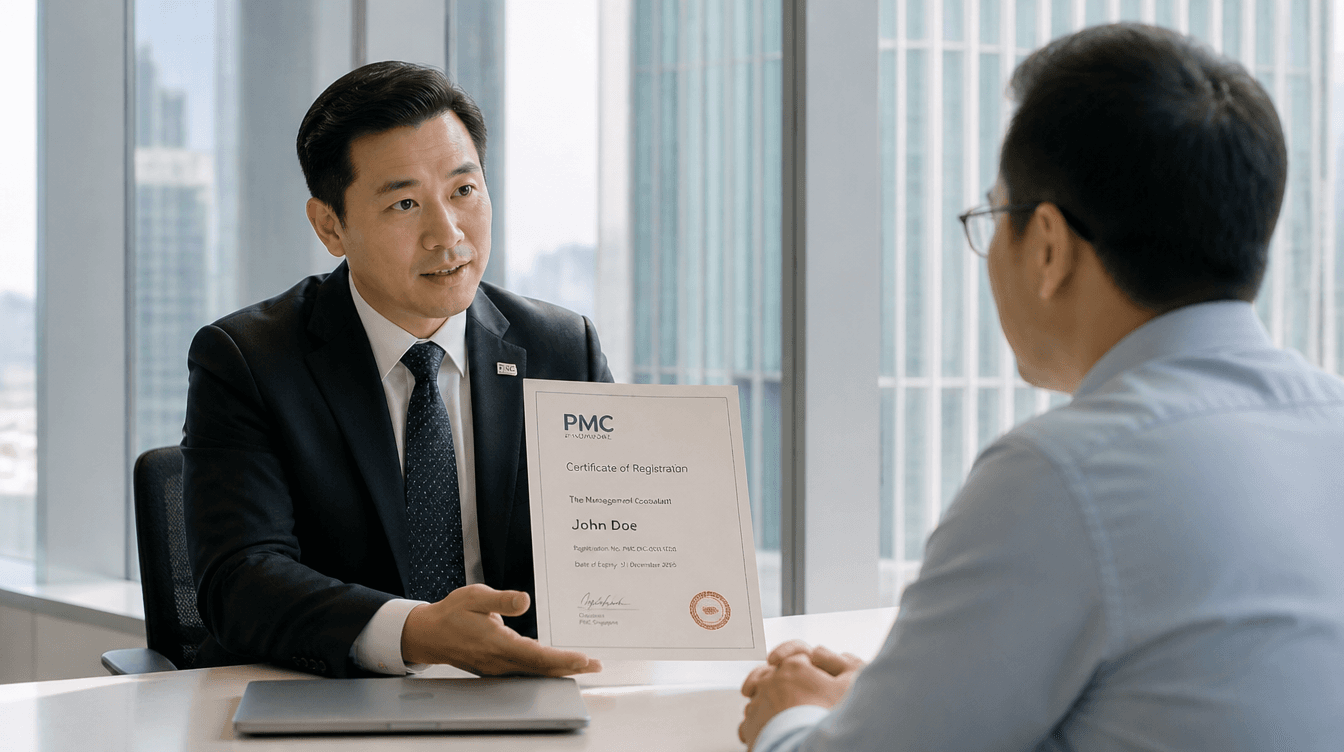
When you apply for an EDG (Enterprise Development Grant) with a consultancy component, the Business Grants Portal does not ask whether your consultant is certified. It requires proof, right there in the application form. You must key in your consultant's certification number, full name, NRIC, and certificate details before the application can proceed.
If that certification number does not exist in the accredited body's records, the application stops. Not reviewed slowly. Stopped at the form.
That is what "registered management consultant" actually means in the EDG context: it is a mandatory input field in BGP, not a nice-to-have credential.
That is what "registered management consultant" actually means in Singapore: it is the credential that opens the door to grant-funded consultancy for your business. This article tells you exactly what it is, who has it, how to verify it in under five minutes, and what to watch out for when hiring.
The short answer: A registered management consultant in Singapore holds one of three EnterpriseSG-recognised certifications (PMC or SPMC (via SBACC), RMC (via IMC(S)), or SCMC (via TUV SUD)) all aligned to the current SS 680:2021 standard. When you apply for an EDG consultancy project, you must enter the consultant's certification number, name, NRIC, and certificate details into the Business Grants Portal. Without a valid certification, the application cannot be submitted.
Anyone Can Call Themselves a Consultant. Here Is What Actually Separates Them.
The Singapore market is flooded with consultants. Some are brilliant. Many are not. And from the outside, it is almost impossible to tell the difference.
The certification framework exists precisely because of this. EnterpriseSG does not want SMEs to waste grant money on consultants who cannot deliver. So they gatekeep the EDG: to claim consultancy costs, your consultant must hold a government-recognised credential aligned to SS 680:2021, the Singapore Standard for management consultancy.
SS 680:2021 replaced the older TR 43:2015 standard, which expired in February 2025. If anyone still references TR 43 as the current requirement, they are out of date.
Three certification bodies are currently recognised by EnterpriseSG:
| Certification | Full Name | Issued By | Includes Insurance |
|---|---|---|---|
| PMC | Practising Management Consultant | SBACC | Yes, mandatory professional indemnity |
| RMC | Registered Management Consultant | SBACC | No |
| SCMC | Singapore Certified Management Consultant | TUV SUD | No |
All three are accredited by the Singapore Accreditation Council (SAC) and aligned to SS 680:2021. Any of the three satisfies the BGP certification requirement for EDG consultancy projects. Nick Tung holds SPMC-10960, issued by SBACC.
The insurance difference is significant, and covered in detail below.
What Is PMC Certification and Why Does SBACC Issue It?
PMC stands for Practising Management Consultant. It is the certification issued by SBACC, the Singapore Business Advisors and Consultants Council, which was the first management consultancy body in Singapore to achieve ISO/IEC 17024 accreditation (the international standard for professional certification bodies).
SBACC runs the certification at sbacc.org.sg/services/pmc-search-result. The assessment covers:
- Competency in diagnosing business problems
- Knowledge of the consultancy process (as defined in SS 680:2021)
- Professional ethics and accountability
- Ability to deliver and measure outcomes
The certification is not a one-and-done. PMC holders are required to maintain continuing professional development (CPD) to retain the credential. This is why the number matters: SPMC-10960 is a traceable, maintained professional identity, not a certificate someone printed in 2012 and forgot about.
Why PMC Has One Advantage RMC and SCMC Do Not: Professional Liability Insurance
All three certifications (PMC, RMC, SCMC) satisfy the BGP requirement. But they are not identical.
One of the stated benefits of PMC certification through SBACC is worldwide territorial professional liability insurance coverage, included as a condition of holding the credential. SBACC requires this of PMC holders. RMC (SBACC) and SCMC (TUV SUD) do not carry this same requirement.
Professional liability insurance for a management consultant covers claims arising from professional negligence, situations where the consultant's advice, analysis, or recommendations cause a client financial loss. It covers errors and omissions in deliverables, breach of professional duty, and the legal defense costs that come with any dispute. The "worldwide territorial" scope means the coverage applies not just to Singapore-based engagements but to any client work regardless of where it is carried out.
For an SME running a grant-funded EDG project, this matters in a quiet but important way. If the project does not deliver what was scoped (if the transformation plan turns out to be wrong, if the recommendations do not hold) a PMC consultant has professional liability coverage that provides the client a real path to recourse. With an RMC or SCMC holder, that same coverage is absent unless the consultant separately arranged their own policy.
This is not a headline difference. Most engagements go well, deliverables get signed off, and the Usage Report gets filed without incident. But when you are committing S$20,000 to S$60,000 of your own money before EDG reimburses you, and waiting months for that reimbursement, the question of who is accountable if something goes wrong is worth asking once, quietly, before you sign.
Nick Tung holds SPMC-10960 specifically. The credential opens the same EDG doors as the other two. It also comes with this.
What Is SS 680:2021 and Why Did It Replace TR 43?
TR 43 was the original Technical Reference for management consultancy in Singapore, published in 2015. Technical References are interim standards. They get reviewed, upgraded, and eventually replaced by full Singapore Standards.
SS 680:2021 is that full Singapore Standard. It provides a more comprehensive specification for management consultants: what they must be able to do, how they must behave, and how their competency must be assessed. It expired TR 43:2015 in February 2025.
What this means practically: if you are engaging a consultant for an EDG project in 2026, their certification must be assessed against SS 680:2021, not TR 43. Any consultant still referencing TR 43 as their credential base needs to confirm their certification has been migrated to the new standard.
SBACC, SBACC, and TUV SUD have all completed this migration for their certificate holders.
Registered Management Consultant vs Certified Business Consultant vs Certified Automation Consultant: Is There a Difference?
In everyday conversation, people use these terms interchangeably. And for the purposes of EnterpriseSG recognition, they mostly overlap.
Here is the actual breakdown:
Registered management consultant, refers to someone holding PMC, RMC, or SCMC certification. The word "registered" signals their credential is held with an accredited body. In the EDG context, this is the specific type of consultant whose fees qualify for grant support under the management consultancy category.
Certified business consultant, same thing. Business advisory, commercial strategy, operations improvement, these all fall under the scope that PMC, RMC, and SCMC cover. The terminology differs; the credential does not.
Certified automation consultant, this is where it gets slightly different. There is no standalone "automation consultant" certification in Singapore. But automation and digital transformation projects fall under the EDG Innovation and Productivity pillar, and a PMC-certified consultant can absolutely scope and deliver these projects. For pre-approved automation solutions, PSG is actually the faster route, no consultancy certification required, just a quote from a pre-approved vendor.
The question to always ask is not "what do they call themselves" but "do they hold PMC, RMC, or SCMC?"
How the EDG Grant Actually Works for Consultancy Projects
A lot of SME owners think the EDG is complicated. It is not complicated. It is just specific.
Here is the simple version:
- Your company qualifies, registered in Singapore, at least 30% local equity, within the turnover/headcount limits
- You identify a project: business transformation, productivity improvement, capability building, market expansion
- You engage a PMC/RMC/SCMC-certified consultant to scope and deliver it
- You apply through the Business Grants Portal before starting the project
- EnterpriseSG reviews and issues a Letter of Offer (LOO)
- Work begins, deliverables are completed, outcomes are documented
- You submit the Usage Report with evidence
- EDG reimburses up to 50% of qualifying consultancy fees
The 50% subsidy is real money. A S$20,000 consultancy project costs you S$10,000 after EDG. A S$50,000 transformation project costs S$25,000. Stack SFEC on top if eligible and you cut the net cost further.
The catch: step 4 is non-negotiable. If the project starts before the LOO is issued, none of the costs qualify. The most expensive mistake Singapore SMEs make is starting early because someone told them the approval was "almost certain."
It is not certain until you have the LOO in your hands.
How to Verify a Registered Management Consultant in Five Minutes
You do not need to trust what any consultant tells you. You can verify.
Step 1: Ask for their certification number, full name as registered, and NRIC. PMC holders give you a PMC-XXXXX number. RMC holders give you an SBACC reference. SCMC holders give you a TUV SUD reference. You will need all of this to complete the BGP application form, the form requires the certification number, name, NRIC, and certificate details as mandatory fields.
Step 2: Go to the relevant body's website and check the number. SBACC maintains a directory at sbacc.org.sg/services/pmc-search-result. SBACC maintains one at imcs.sg. To verify Nick Tung's SPMC-10960 directly, click here.
Step 3: Ask for a BGP project reference from a recent EDG engagement. A certification number alone proves the credential exists. A BGP reference proves the credential was accepted by EnterpriseSG in a real grant-funded project, which is the stronger signal.
That is it. Three steps, five minutes. Any consultant who resists this is not worth hiring.
5 Red Flags That Should End the Conversation Immediately
They cannot produce a certification number. If they say "I used to be certified" or "I am in the process of certifying," walk away. Used to does not qualify for EDG. In process does not qualify either. Remember: you need their cert number, name, and NRIC to complete the BGP form, if they cannot give you these, there is nothing to enter.
They hold RMC or SCMC but cannot confirm insurance. Both are legitimate certifications. But neither mandates professional liability insurance the way PMC does. Worth asking once: "Do you hold a professional liability policy, and can you show me proof?" A PMC holder through SBACC has worldwide territorial coverage built into the credential. For the others, it depends on the individual consultant.
They still reference TR 43 as the current standard. TR 43:2015 expired February 2025. Anyone citing it as current is not keeping up with their field.
They guarantee EDG approval. No one can guarantee this. EnterpriseSG makes the assessment decision. A consultant who promises approval is either naive or dishonest, either way, not the person you want handling your grant application.
They want fees before your LOO is issued. No work or payment on the project should happen before the application is submitted, so fees at that stage should raise questions.
Their deliverables are documents, not outcomes. SS 680:2021 defines the consultancy process in terms of measurable outcomes. A consultant who delivers reports without implementation has given you paper, not transformation. For EDG Usage Reports, you need evidence of actual change, processes running, systems deployed, staff trained and using new workflows.
What Does This Cost, and Is It Worth It?
PMC-certified management consultants in Singapore typically charge:
- Day rate: S$1,500 to S$3,000 depending on specialisation and seniority
- Project-based: S$10,000 to S$60,000 for a scoped EDG-fundable engagement
- Ongoing advisory retainer: S$3,000 to S$8,000 per month (usually outside grant scope)
After EDG at 50%, those numbers become S$5,000 to S$30,000 net for project work. That is a significant reduction for a well-scoped transformation project.
The real question is not whether you can afford a certified consultant. It is whether you can afford the alternative, an uncertified consultant who costs you the same in fees but delivers zero grant access, zero documented outcomes, and zero evidence for a Usage Report that will never be approved.
For AI and automation projects, the PMC credential also signals that the consultant understands Singapore-specific implementation, the grant landscape, the workforce implications, the CTC requirements if workforce transformation is involved, and the PSG pre-approved solutions catalogue for faster-moving projects.
Common questions
What is a registered management consultant in Singapore? EDG stopped taking new applications on 29 September 2026. New applications now go through the EDGE Grant. A registered management consultant in Singapore is a professional holding one of three EnterpriseSG-recognised certifications: PMC (Practising Management Consultant, issued by SBACC), RMC (Registered Management Consultant, issued by SBACC), or SCMC (Singapore Certified Management Consultant, issued by TUV SUD). All three are accredited against SS 680:2021, the current Singapore Standard for management consultancy. Without one of these credentials, a consultant cannot support EDG grant applications for management consultancy fees.
What does PMC stand for in Singapore? EDG stopped taking new applications on 29 September 2026. New applications now go through the EDGE Grant. PMC stands for Practising Management Consultant. It is issued by SBACC (Singapore Business Advisors and Consultants Council), which was Singapore's first ISO/IEC 17024-accredited management consultancy certification body. PMC holders are identifiable by their reference number (e.g. SPMC-10960) and are recognised by EnterpriseSG for EDG grant-funded engagements.
What is the current standard for management consultants in Singapore, TR 43 or SS 680? SS 680:2021 is the current standard. TR 43:2015 was the original Technical Reference but it expired in February 2025 and has been fully superseded by SS 680:2021. Any consultant still referencing TR 43 as their credential base should confirm their certification has been migrated to the new standard. SBACC, SBACC, and TUV SUD have all completed this migration.
Do I need a certified management consultant to apply for the EDG? EDG stopped taking new applications on 29 September 2026. New applications now go through the EDGE Grant. Only if your EDG application includes management consultancy fees. For the consultancy cost components of an EDG project, EnterpriseSG requires the consultant to hold PMC, RMC, or SCMC certification aligned to SS 680:2021. If you are applying for software, equipment, or other non-consultancy costs, this requirement does not apply.
What is the difference between PMC, RMC, and SCMC in Singapore? EDG stopped taking new applications on 29 September 2026. New applications now go through the EDGE Grant. All three are EnterpriseSG-recognised certifications aligned to SS 680:2021 and all three satisfy the BGP certification requirement for EDG consultancy projects. The key structural difference is insurance: PMC (via SBACC) includes worldwide territorial professional liability insurance as a stated benefit of holding the credential, covering professional negligence, errors and omissions, and legal defense costs. RMC (SBACC) and SCMC (TUV SUD) do not carry this same requirement. Nick Tung holds SPMC-10960 via SBACC.
Is there a "certified automation consultant" credential in Singapore? Enterprise Singapore's PSG and EDG stopped taking new applications on 29 September 2026. New applications now go through the EDGE Grant. No separate automation consultant certification exists in Singapore's current framework. Automation and AI transformation consulting falls under the same management consultancy scope covered by PMC, RMC, and SCMC. A PMC-certified consultant can scope and deliver automation projects for EDG funding. For pre-approved IT and automation solutions, the PSG is the faster route and does not require a PMC consultant.
How do I verify a PMC-certified consultant in Singapore? EDG stopped taking new applications on 29 September 2026. New applications now go through the EDGE Grant. Ask for their PMC number (format: PMC-XXXXX), their full registered name, and NRIC, you will need all three to complete the BGP application form. Check the certification number against SBACC's directory at sbacc.org.sg/services/pmc-search-result. You can verify Nick Tung's SPMC-10960 directly here. For RMC holders, check imcs.sg. For extra confidence, ask for a BGP project reference from a recent EDG engagement, this proves the certification was accepted in a real grant application, not just that the number exists.
How much does a registered management consultant charge in Singapore? EDG stopped taking new applications on 29 September 2026. New applications now go through the EDGE Grant. Day rates typically range from S$1,500 to S$3,000. Full EDG-scoped projects range from S$10,000 to S$60,000 depending on scope and duration. After EDG subsidises 50% of qualifying fees, a S$20,000 project has a net cost of S$10,000 to the SME. Additional stacking with SFEC is possible for eligible companies. The certification premium over uncertified consultants is typically recovered through grant access alone.
Stay sharp
The weekly Singapore grant playbook.
Operator-grade pieces on EDGE, CTC and the rest of the stack, straight to your inbox once a week. No spam, no upsell.
One email a week. Unsubscribe in one click.