Job Redesign Consultant Singapore: Workforce Transformation + Grant Funding (2026 Guide)
A job redesign consultant restructures roles so workers do higher-value work. CTC funds up to 70%, and WDG(JR+) up to 70% for SMEs. Here's how it works in Singapore in 2026, with AI as the forcing function.
Nick Tung
@nick_tung_ · 16 min read
Published:
Updated:
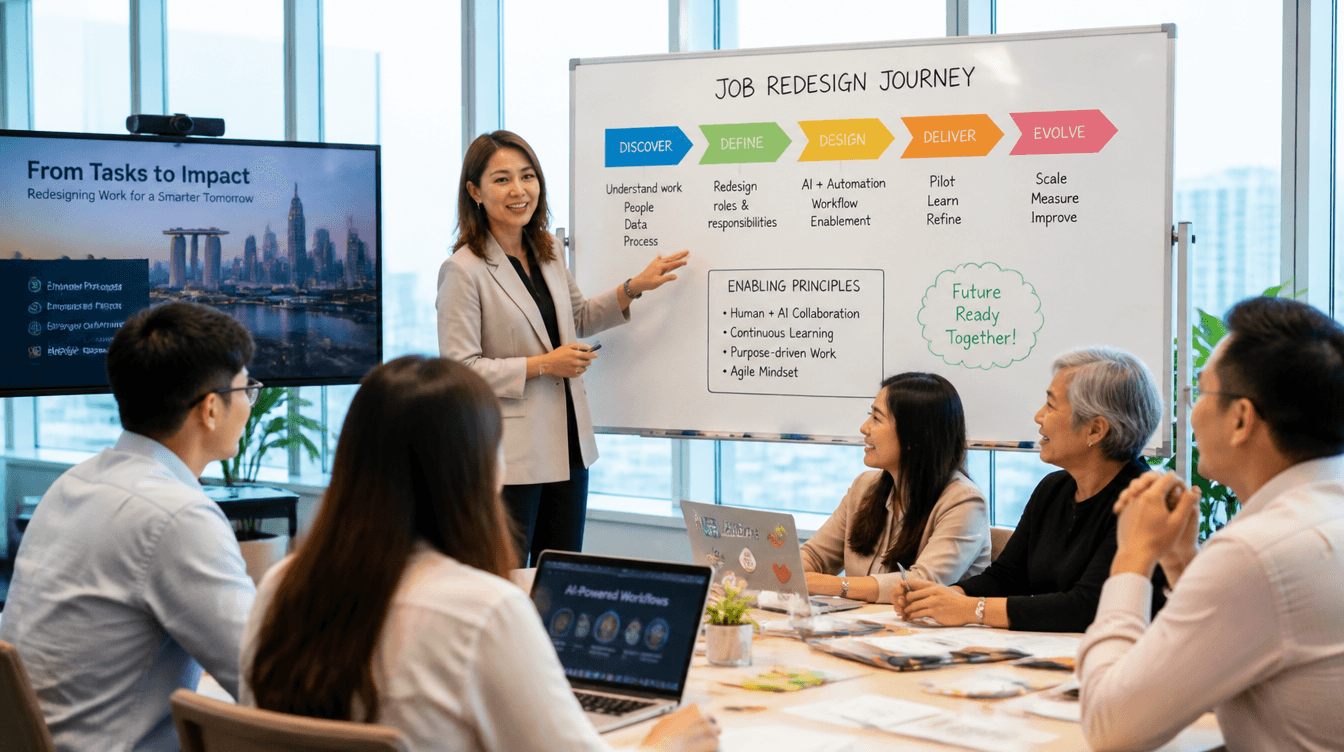
Update, 25 September 2026: PSG, EDG and MRA take new applications until 29 September 2026. From 30 September 2026, new projects apply under Enterprise Singapore's EDGE grant. Applications submitted before 30 September are still assessed under the old scheme's rules, so where this article describes PSG, EDG or MRA, read it as how those schemes worked. Per Enterprise Singapore's release of 9 September 2026, EDGE supports SMEs at up to 50% on most activities and up to 70% on internationalisation and sustainability, within a S$100,000 grant cap per company per year. Eligibility is decided by Enterprise Singapore.
A job redesign consultant helps companies restructure roles so that people do higher-value work, and gets the government to fund most of it. In Singapore in 2026, that's not a luxury. It's how you keep good workers, stay competitive with AI tools doing more of the grunt work, and unlock grant funding that covers up to 70% of the cost, through CTC or the SkillsFuture Workforce Development Grant (Job Redesign+). If you're searching for a job redesign consultant in Singapore, here's exactly what to look for, what the process involves, and what red flags to avoid.
What does a job redesign consultant do?
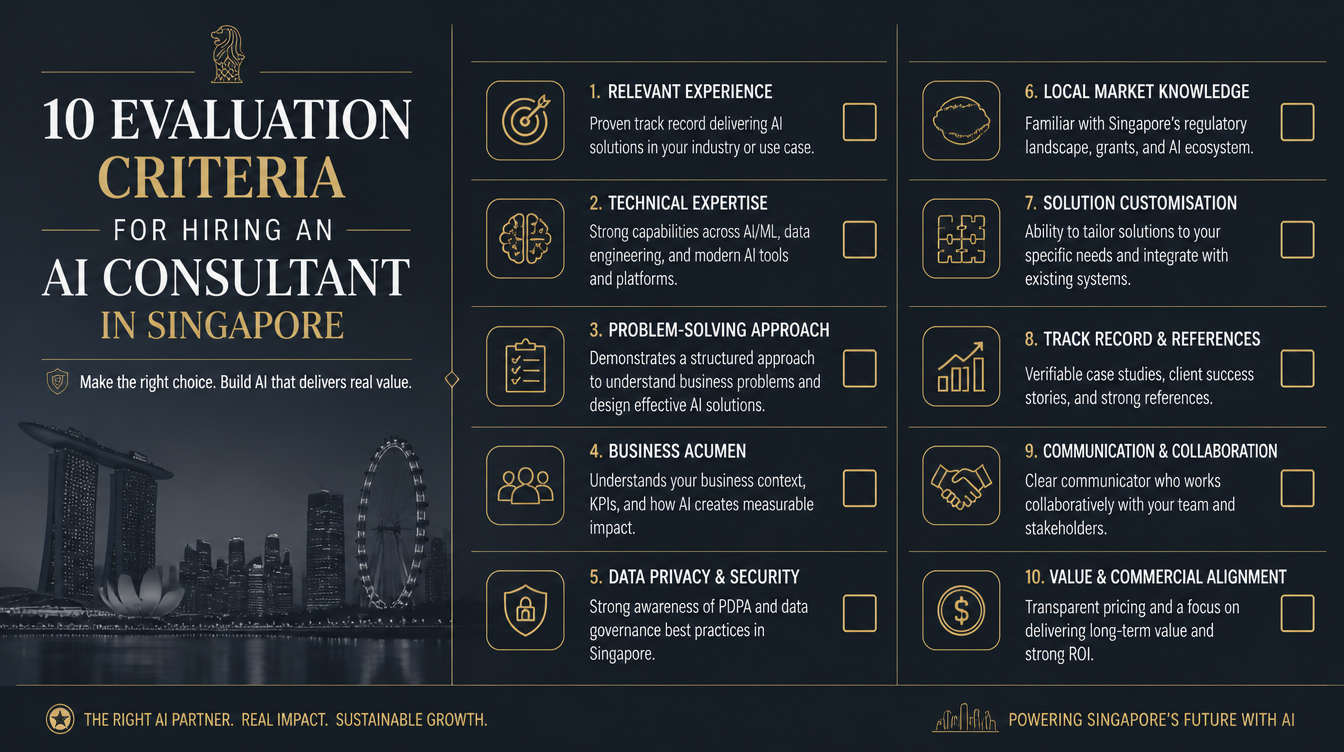
A job redesign consultant analyses existing roles, identifies which tasks can be automated, restructured, or elevated, and redesigns job scopes so workers move into higher-value responsibilities. The output is a documented Job Redesign Plan (with new job descriptions, a training roadmap, and evidence of improved worker outcomes) that satisfies MOM and e2i requirements for grant disbursement.
This is distinct from a standard HR consultant. A job redesign consultant has to understand both the operational workflow (what people actually do day to day) and the AI/automation tools that can absorb lower-value tasks. Without that dual lens, you end up with redesigned job titles that are really just the old job with a new name.
In Singapore, job redesign is formally recognised under the Workplace Transformation agenda run by Workforce Singapore (WSG), e2i (Employment and Employability Institute), and NTUC's Company Training Committee (CTC). These bodies set the standards a credible consultant has to meet.
Job redesign vs job elimination vs retraining: why the distinction matters
This is where a lot of companies get confused, and where some consultants cut corners.
Job redesign means restructuring what a role does, not eliminating the role. The worker stays employed, typically at the same or higher grade, and takes on responsibilities that require more judgment, communication, or expertise. The tasks removed are usually rule-based, repetitive, or high-volume manual work.
Job elimination is exactly what it sounds like. If a consultant recommends eliminating positions and calls it "redesign," that's a red flag, and it may disqualify you from grant funding. MOM and e2i require evidence that redesign results in better outcomes for workers, not headcount reduction dressed up in consulting language.
Retraining overlaps with redesign but focuses on skills acquisition rather than role structure. You can have retraining without redesign (sending someone on a course that doesn't change their job) and redesign without retraining (shifting responsibilities between roles using existing skills). The strongest programmes combine both, which is what CTC-funded programmes are specifically built to do.
For CTC grant eligibility, your initiative must demonstrate clear worker outcome improvements: higher skills level, higher wages, or broader responsibilities. If you can't show that, you're probably not doing job redesign. You're doing something else.
The 5-step job redesign process a good consultant runs
Every reputable job redesign engagement in Singapore should follow roughly this structure:
Step 1: Current-state audit The consultant maps every role in scope, what tasks are performed, how often, at what skill level, and what percentage of time is spent on each. This isn't a survey exercise. It requires direct observation, process interviews, and often time-and-motion analysis for operational roles.
Step 2: AI and automation opportunity scan This is where 2026 is different from 2019. A credible consultant today will assess which tasks can be absorbed by AI tools, not as a future possibility but as a current reality. Document scanning, customer query triaging, data entry, report generation, scheduling, these are being automated now, not eventually. The scan identifies which tools exist, what they cost, and what realistic productivity gains look like.
Step 3: New role design Based on steps 1 and 2, the consultant redesigns each job scope. This includes rewriting job descriptions, defining new KPIs, and mapping the decision points that will remain human. The goal is roles where workers are managing exceptions, building relationships, or applying expertise, not processing volume.
Step 4: Training roadmap Every redesigned role needs a clear training plan covering the skills gap between the old and new scope. This feeds directly into SkillsFuture-recognised training plans and CTC funding documentation. The training roadmap should name specific programmes, providers, and durations, not just say "provide relevant training."
Step 5: Implementation and outcome tracking Job redesign isn't done when the documents are submitted. A good consultant tracks actual outcomes, are workers performing the redesigned roles? Are wages moving? Are retention rates improving? This matters both for grant compliance and because it's the only honest way to know if the redesign worked.

Why AI is the forcing function for job redesign in Singapore in 2026
The honest answer is that AI tools have already changed what "a good job" means in most industries. A customer service executive who spends 70% of their day copy-pasting standard replies is doing a job that a well-configured chatbot now handles in seconds. A finance admin who manually reconciles invoices is competing with AI that does it in minutes. The question is no longer "will AI affect this role?" It's "has it already, and is your company structured to reflect that?"
MOM's 2025 Labour Market Survey showed continued tightness in mid-skill segments even as certain task categories declined in demand. The workforce policy response (channelled through WSG, e2i, and SkillsFuture) has been consistent: redesign roles to move workers into tasks AI cannot easily replicate (complex judgment, stakeholder management, creative problem-solving, technical expertise), and fund the transition through grants.
e2i's job redesign framework specifically identifies three "win" conditions: productivity improvement for the employer, career progression for the worker, and skills development that's SkillsFuture-aligned. A job redesign consultant who isn't designing to all three of those outcomes isn't set up to help you access CTC or EDG funding successfully.
The AI layer also changes what's possible at the SME level. Large companies have always had HR transformation budgets. What's different now is that a 15-person logistics company or a 30-person accounting firm can redesign two or three roles using AI tools that cost $200/month, get a trained consultant to document the process for grant compliance, and come out with a funded transformation that would have cost 10x more five years ago.
How CTC (Company Training Committee) funds job redesign
The Company Training Committee (CTC) Grant, administered under NTUC, is specifically designed to support industry-wide job redesign and training initiatives. It's one of the most direct funding paths for workforce transformation in Singapore.
Key facts for 2026:
- Coverage: Up to 70% of qualifying costs, including consultant fees, training costs, and implementation costs
- Who qualifies: Singapore-registered companies that are unionised or partnering with an NTUC affiliate, working with a CTC-recognised consultant
- Scope: Must demonstrate industry-level impact, not just company-level change. Individual company projects are typically packaged under broader industry CTC initiatives
- Worker outcome requirement: The application must show measurable improvements in worker skills, wages, or career progression, not just process changes
The practical path for most SMEs is to work with a consultant who is already operating within an active CTC framework for your industry. That means the industry-level application is already approved, and your company's participation slots into an established programme rather than requiring you to build a new CTC proposal from scratch.
For more detail on how CTC funding works and what it covers, see the CTC grant guide.
How EDG (EnterpriseSG) funds workforce transformation
The Enterprise Development Grant (EDG), run by EnterpriseSG, is the other major funding path for job redesign, and it's accessible to companies whether or not they're unionised.
Under EDG's Human Capital pillar, companies can claim support for:
- Job redesign projects (direct consultancy costs)
- Capability building and training tied to the redesigned roles
- Process redesign that affects workforce structure
EDG coverage rates in 2026:
- SMEs: up to 50% of qualifying costs
- Non-SMEs: up to 30%
- Enhanced rates may apply for specific priority sectors or if you're a SkillsFuture Enterprise Credit (SEC) holder, in which case you can offset the company co-payment and effectively reach 90%+ coverage
The EDG application requires a clear project scope, a named consultant, cost breakdown, and projected outcomes. Vague proposals ("improve our workforce") don't pass. What works is specificity: "Redesign 8 roles in our operations department, moving workers from manual processing to exception management and quality oversight, reducing processing cost per transaction by 35% while increasing median wages by $400/month."
For EDG job redesign applications, a PMC-certified consultant with verifiable past projects significantly improves your application quality and approval rate. EnterpriseSG assessors look for evidence of methodology, not just credentials.
See the full EDG grant guide for eligibility requirements and how to structure your application.
What to look for in a job redesign consultant in Singapore
Not all consultants who call themselves "workforce transformation" or "job redesign" specialists are set up to help you access government funding. Here's what actually matters:
PMC Certification The Practising Management Consultant (PMC) certification, issued by SBACC, indicates that the consultant has been vetted as a qualified provider for government-funded business transformation projects. Look for a verifiable PMC number. Mine is SPMC-10960, and the SBACC register lists it under my full legal name, Tung Kai Sheng, as PMC-10960, the code I held before my upgrade to Senior PMC. Without this, the consultant cannot be named in your EDG application as a qualifying service provider.
e2i or WSG alignment For CTC-funded job redesign, the consultant should have working knowledge of e2i's job redesign methodology and be able to structure deliverables to meet e2i's documentation requirements. Ask directly: "Have you run job redesign projects that were funded under CTC?" and ask for anonymised case studies.
AI fluency, not just HR theory A consultant who comes from a pure HR background but doesn't understand what modern AI tools actually do will produce redesigned job descriptions that still contain tasks AI already handles. That's a missed opportunity at best, and a failed redesign at worst. Your consultant should be able to point to specific tools (not category descriptions) and explain which tasks in your operations they would absorb.
Worker outcome documentation The grant requirement is worker outcomes, not company efficiency. Ask the consultant to show you an example Job Redesign Report from a past project. Does it show baseline wages, redesigned role wages, skills progression mapped to SkillsFuture frameworks, and actual post-implementation outcomes? If the report is all org charts and process diagrams with no worker outcome data, that's a gap.
Honest scoping A trustworthy consultant will tell you upfront which roles are realistic candidates for redesign versus which should be left alone (or which are actually elimination candidates, which is a different conversation). If every role in your company is apparently a "redesign opportunity," be sceptical.
Red flags: when "job redesign" is really something else
This matters more than most companies realise because misrepresenting job elimination as job redesign is both a grant compliance issue and a potential MOM concern.
Red flag 1: The consultant recommends headcount reduction as the primary outcome Job redesign is specifically about improving roles for the workers who stay. If the main recommendation is to cut 30% of your workforce and "upskill" the remaining 70%, you're looking at a retrenchment plan that someone has relabelled. That may be the right business decision, but it's not what CTC or EDG fund.
Red flag 2: No worker outcome data in past projects Ask for case studies with named worker outcomes, not anonymised company metrics. "We helped a logistics company improve throughput by 40%" is a company outcome. "Warehouse operations staff moved from manual inventory counting to exception management and system oversight, median wages increased from $2,400 to $2,950 within 12 months" is a worker outcome. The grant bodies care about the second type.
Red flag 3: Can't explain the MOM/e2i alignment Any credible consultant working in Singapore's job redesign space should be able to explain, in plain English, how their methodology aligns with WSG's Lean Enterprise Development Scheme (LEDS), e2i's job redesign criteria, and the CTC worker outcome framework. If the answer is vague or they've never worked with these bodies directly, find someone who has.
Red flag 4: No AI assessment in the methodology In 2026, a job redesign that doesn't include a systematic AI opportunity scan is incomplete. It's like doing a facilities audit in 2015 without considering cloud migration. The redesign might still improve things, but you're leaving the most significant productivity and wage-growth levers unexamined.
Red flag 5: Pushy grant promises without seeing your business Legitimate consultants qualify your grant eligibility based on your specific situation, company size, industry, headcount, current grant history, and what outcomes you can realistically achieve. Anyone who promises "70% funded, guaranteed" before understanding your business is either uninformed or selling harder than they're delivering.
How I approach job redesign and AI transformation (SPMC-10960)
My work sits at the intersection of two things most consultants do separately: AI implementation and workforce transformation. In practice, those two things are the same project. You can't redesign a job without understanding what AI will change about it, and you can't implement AI well without redesigning the roles that interact with it.
The way I run a job redesign engagement:
I start with a current-state audit that's honest about which tasks in your business are already being done worse by humans than AI tools can do them today. That's not a comfortable conversation in every company, but it's the only starting point that produces a redesign worth funding.
From there, I build the AI layer first (identify the tools, pilot them in a contained scope, measure actual productivity impact) and then design the human roles around what the AI does well and where it falls short. The redesigned job is built on evidence, not on a theoretical org chart.
The documentation I produce (Job Redesign Plans, training roadmaps, worker outcome frameworks) is built to meet EnterpriseSG EDG and CTC requirements so your funding application is clean. I've been through enough of these to know what assessors look for and what causes applications to stall.
As an SPMC-10960 certified consultant, I hold the certification that EDG applications submitted by 29 September 2026 need for consultancy costs to qualify. For CTC-pathway projects, I work with industry partners who have active CTC frameworks so your company can slot into an existing approved programme rather than starting a new one from scratch.
If you're an SME and you want to know honestly whether your roles are redesign candidates, what AI tools would actually change in your operations, and what grant funding you could realistically access, that's the conversation to start. I'll tell you what I see, not what you want to hear, and we'll figure out if it makes sense to go further from there.
Also relevant: how the PSG grant works for AI tools adoption, often the first step before a full job redesign programme.
Common questions
What is a job redesign consultant in Singapore? A job redesign consultant in Singapore helps companies restructure existing roles so that workers move into higher-value, higher-skill responsibilities, typically by identifying which tasks can be automated or absorbed by AI tools, rewriting job scopes accordingly, and building the training roadmap to close the skills gap. In the Singapore context, this work is aligned to MOM, WSG, and e2i frameworks, and is fundable under CTC or the SkillsFuture Workforce Development Grant (Job Redesign+).
How much does a job redesign consultant cost in Singapore? EDG stopped taking new applications on 29 September 2026. New applications now go through the EDGE Grant. Engagement fees typically range from S$8,000 to S$30,000+ depending on the number of roles in scope and the depth of the AI assessment. Under the SkillsFuture Workforce Development Grant (Job Redesign+), administered by SWDA, SMEs can claim up to 70% of qualifying costs, capped at S$150,000 per enterprise, with component caps of S$50,000 for workforce consultancy, S$60,000 for capability building and S$90,000 for workforce technology solutions. Technology solutions cannot be claimed on their own. Under CTC, up to 70% of qualifying costs may be covered. EDG covers up to 50% for SMEs and closes to new applications on 29 September 2026, so it is not the scheme to plan a job redesign project around. Net cost to the company after grants is often S$5,000 to 15,000 for a mid-size engagement.
What is the CTC grant and how does it fund job redesign? The CTC (Company Training Committee) Grant is administered under NTUC and provides funding for industry-wide job redesign and training initiatives. It covers up to 70% of qualifying costs including consultant fees and training. Companies access it by participating in an active CTC industry programme, either through NTUC's direct sector partnerships or through a consultant who operates within an existing CTC framework.
What is the difference between job redesign and retrenchment? Job redesign keeps workers employed and restructures their responsibilities toward higher-value work. Retrenchment eliminates roles. The distinction matters for grant eligibility: CTC and WDG(JR+) fund redesign because the outcome is better jobs and higher skills. They don't fund what is effectively a headcount-reduction exercise relabelled as "transformation." MOM also monitors that worker outcomes, not just company productivity, improve as a result of redesign programmes.
Does a job redesign consultant need to be PMC certified? EDG stopped taking new applications on 29 September 2026. New applications now go through the EDGE Grant. For EDG applications submitted by 29 September 2026, consultancy costs only qualify when the consultant holds a TR 43 or SS 680 certification, such as PMC (Practising Management Consultant). The PMC certification is issued by SBACC after vetting the consultant's methodology and track record. Working with a non-PMC consultant on an EDG application means their fees may not qualify for grant coverage.
How long does a job redesign project take in Singapore? EDG stopped taking new applications on 29 September 2026. New applications now go through the EDGE Grant. A typical SME engagement runs 3 to 6 months from initial audit to implemented redesign with documented worker outcomes. The grant application and approval process adds 8 to 12 weeks before the project can formally start (for EDG) or depends on CTC programme timelines. Companies that try to rush the audit phase typically produce weaker job redesign plans that don't hold up to MOM or EnterpriseSG scrutiny.
What industries benefit most from job redesign in Singapore? Logistics, manufacturing, retail, F&B, professional services, and healthcare administration are all sectors where AI is changing specific task categories significantly. That said, job redesign opportunities exist in any industry where a significant portion of workers spend time on rule-based, high-volume, or information-processing tasks, which is most industries. The AI opportunity scan is what determines which roles are genuine candidates.
How do I find a credible job redesign consultant in Singapore? EDG stopped taking new applications on 29 September 2026. New applications now go through the EDGE Grant. Look for: a verifiable PMC certification number (check the EnterpriseSG PMC directory), demonstrated experience with CTC or EDG-funded job redesign projects (ask for anonymised case studies with worker outcome data), and an explicit AI assessment methodology in their approach. Avoid consultants who promise grant funding percentages before understanding your business, or who produce job redesign reports that are primarily org charts with no worker outcome tracking built in.
Stay sharp
The weekly Singapore grant playbook.
Operator-grade pieces on EDGE, CTC and the rest of the stack, straight to your inbox once a week. No spam, no upsell.
One email a week. Unsubscribe in one click.